Delayed Brooklyn Village project in Charlotte to start with 250 affordable housing units
Affordable housing will be the primary focus in the first phase of the long-awaited Brooklyn Village mixed-use project in Charlotte.
Spread across two buildings, about 250 apartments will be available for those making 30% to 80% of the area’s median income, according to developer Donahue Peebles III, executive vice president of The Peebles Corp.
Peebles presented
For a family of four, that’s an income range between $31,800 and $84,800.
“We’re placing affordable housing in uptown Charlotte that will be perpetually affordable,” said Peebles, who presented the updated plan on the project to the Mecklenburg Board of County Commissioners Tuesday night. “We’re in one of the most high resource areas in the city of Charlotte… When we place affordable housing in high resource neighborhoods, we can provide people, particularly low income people, with the best opportunity to succeed.”
While affordable housing was always a part of the $700 million project, it wasn’t the original driver in the first phase of construction. Nor were there that many affordable units.
Originally, the plan called for 552 apartment units with 55 of them being listed as income-restricted.
Cutting the first phase of development in half and making all the apartments affordable is a major change. One that was prompted by county commissioners concerned about the delays in the project and who wanted something to be put forward.
Brooklyn Village history
Peebles Corp., in partnership with Conformity Corp. under the name BK Partners, were selected by the county to be the master developers of a new community in Charlotte’s Second Ward in 2016.
It’s a section of the city that was once home to a vibrant and predominantly Black neighborhood, Brooklyn, until it was destroyed in the name of urban renewal.
What used to house Black businesses and families, later became a place for parking lots, the long-shuttered Board of Education building, Marshall Park and Bob Walton Plaza.
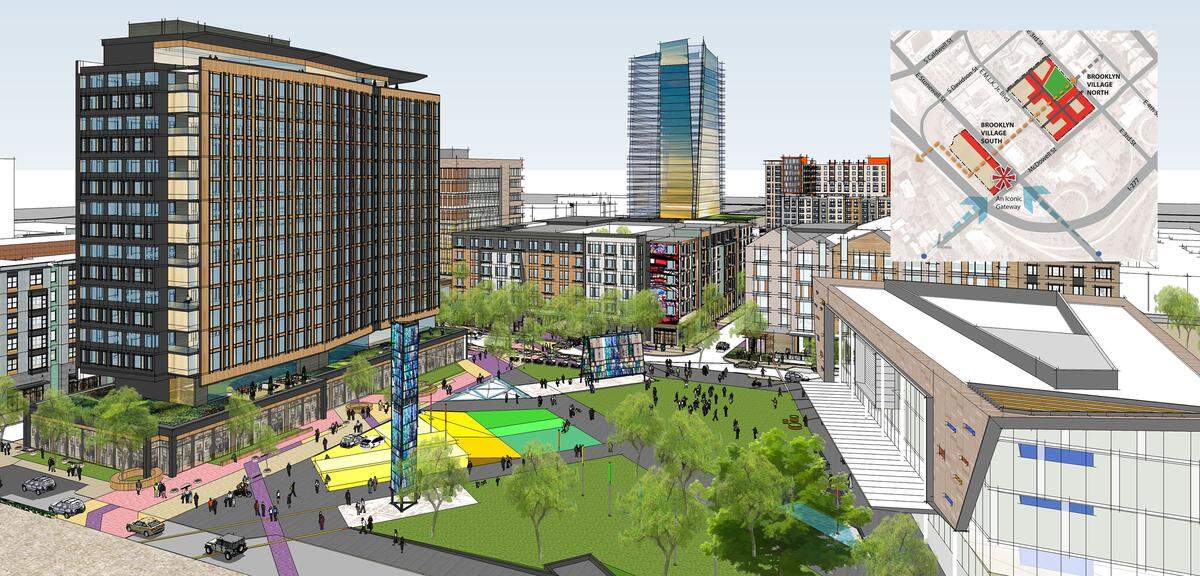
Overall, the 17-acre Brooklyn Village project would bring over 1,200 residential apartments, a hotel, retail and commercial space.
The redevelopment is planned to be an ode to the Brooklyn area with pieces of history, collected by the developers, spread throughout the property.
But the project has been heavily delayed, which has caused some contention between developers, the county and the community.
Part of the contract between the county and BK partners required that construction begin in 2025 but that didn’t occur. The development was initially supposed to be completed in 2021. Then a groundbreaking was set for the fall of 2023 before it was moved to the summer of 2025, then again to 2026.
Initial delays were caused by a five-year closing process, which came to an end in 2023, Peebles said. Further delays were due to high interest rates, lack of lending support and an oversupply of apartments, Peebles said.
Several commissioners expressed concerns over the construction delays in an August update of the project.
Commissioners Susan Rodriguez-McDowell and Mark Jerrell both wondered whether BK Partners would need to revamp their plans to accommodate the current commercial market.
Same start, more affordable housing
Peebles’ presented that revamped plan to the commissioners Tuesday night.
The affordable housing will be developed by Inlivian, Charlotte’s housing authority, and Legacy Real Estate Development, Peebles’ company, which focuses on income-restricted housing.
Of the 250 units, 100 will be set aside for those making 30% AMI or lower. Inlivian will provide housing vouchers for the project. Another 10 vouchers will be provided to victims of domestic violence.
The project will also include wraparound services, such as financial literacy training and job upskilling, provided by CORE, Inlivian’s support programmer.
The first phase is still scheduled to start in 2026 and be completed the following year.
However, the updated proposal requires several things from the county. The contract between BK Partners and the county needs to be amended to note the change in the first phase of the project.
BK Partners is looking for $2.5 million in gap financing from the county. Gap financing provides the final push in funds to help cover costs of building and maintaining affordable housing.
And the county needs to approve Inlivian and Legacy as the new developers on the project.
Those items will pop up on the commissioners agenda in the coming months.
Applause and hesitations
All of the commissioners who spoke at Tuesday’s meeting applauded the addition of more affordable housing.
Part of the contract between BK Partners required that 10% of the residential units be listed at affordable prices. The 250 proposed units would boost that number to about 20% of the overall 1,200 units. The other housing development projected for the site will include an additional 10% of affordable units.

Commissioner Jerrell said he appreciated the developers for changing their plans and moving something forward that was needed.
“The last time you were here, we were on a delay until 2027 and I’m guilty as charged by requesting in that meeting or saying that a delay, in my opinion, was not appropriate,” Jerrell said Tuesday night. “My ask was to tell us what we can do…This is a project where we have 100% affordable housing units to the tune of 250 units in and around uptown Charlotte…We still have things to cover but I, for one, am ecstatic that we can have this many units in this area.”
But the delays still weighed heavily on some of the commissioners.
Commissioner Elaine Powell said while she appreciates the addition of more affordable housing, she almost feels “nauseous” when she sees the project on the agenda because of how long the project is taking. She, along with Rodriguez-McDowell, agreed that the project needs to be looked at by the county’s economic development committee to make sure the numbers make sense. Especially with the gap financing request.
“We need to have it in economic development to go through with a fine tooth comb because it’s not what it started as,” Powell said. “There are so many components that are important to the community that we need to make sure that we’re not sleeping through that, that we’re really paying attention to it.”
County Manager Dena Diorio noted that the commission was only discussing the first phase of the project, which doesn’t include the retail or commercial development.
“This is not an economic development deal,” Diorio said. “This is an affordable housing deal. I think we need to be clear about trying to extract community benefits from an affordable housing project because that’s not what we do...A $2.5 million contribution from the county is not dissimilar from every other affordable housing project that we’ve ever looked. I don’t want this one to be viewed differently because it’s the Brooklyn Village affordable housing project as opposed to any other affordable housing project that we’ve worked on.”
Commissioner Vilma Leake said she just wants to see something completed within Brooklyn Village in her lifetime. She asked Peebles to promise that something will happen on the site soon.
He promised.
This story was originally published February 5, 2025 at 6:00 AM.