‘Just devastating’: Charlotte’s small businesses fight for survival amid coronavirus
When Billy Maddalon poured $200,000 into his historic Dilworth inn last year, the future for his business looked bright: the Republican National Convention was coming to town, and the hotel industry was expanding across Charlotte.
He pumped some of the cash from a property he recently sold into new paint, furniture, fixtures and other renovations at the iconic Morehead Inn.
But within the last two weeks or so, business has slammed to a halt. Guests canceled in droves as the novel coronavirus outbreak worsened in the United States.
The country’s economy has taken a devastating hit as the number of cases of the virus spiked in recent weeks in the U.S. and abroad. Small businesses in Charlotte are still reeling as measures have been enacted to curb the virus’ spread.
“It’s almost certain we’re going to fall into a recession,” said Charlotte-based Wells Fargo senior economist Mark Vitner. “We already have in all likelihood.”
Maddalon said he understands the need for the restrictions amid a public health crisis. But when business vanished, he felt he had no choice but to close the hotel temporarily.
“I have to admit, spiritually and emotionally, it’s just devastating,” he said. “You work so hard for such a long time in running a business.”
‘This could paralyze us’
In the span of a week, the coronavirus has brought life in Charlotte to a standstill.
Last Tuesday, North Carolina Gov. Roy Cooper declared a state of emergency as the number of cases swelled. That was followed with closing K-12 public schools for at least two weeks and banning mass gatherings of more than 100 people. Mecklenburg County went a step further and is prohibiting those with more than 50 people.
Cooper ordered bars and restaurants to close Tuesday, except for takeout and delivery. That means thousands of people are now without work across the state. The more than $21 billion restaurant industry employs more than half a million people statewide, according to the National Restaurant Association.
In Charlotte, there are over 147,000 workers in the hospitality and leisure industry, including restaurants and hotels, which constitutes more than 11% of the region’s total employment, according to the Charlotte Regional Visitors Authority.
“This is going to significantly impact all of the retail, all of our restaurants,” said Janet LaBar, president and CEO of the Charlotte Regional Business Alliance. “And I think their ability to withstand this will be difficult.”
Within a week, half of the business at Colonial Florists of Charlotte evaporated, said owner Raymond Chance. Weddings, birthday parties, reunions and even standing agreements with churches have been canceled. And delivery orders have dropped off.
If the virus continues through a major holiday, such as Mother’s Day, it would be devastating, he said.
“This could paralyze us,” said Chance, who has owned the flower shop for 43 years. “We have bills just like everybody else. It would be tough to try to pay them if this continues.”
Hotel and tourism dropoff
Maddalon, the inn owner, said he’s most worried about his employees. He has enough saved for a payroll or two — but he never would have expected a complete shutdown.
“As a business owner you struggle with, ‘do I just find work to keep them busy?’” he said. “Then I look at how long they think this might last: I think, gosh, I’m going to run out of money. At some point we’re going to have to start thinking about what bills we can pay, and what we can’t.”
The hotel market in Charlotte has flourished in recent years. There are nearly 3,000 hotel rooms under construction in the county, according to figures provided by the Charlotte Regional Visitors Authority in November.
The future of that growth hangs in the balance.
Even major chains are struggling. While closing some properties, hotel chain Marriott is beginning furloughs that it expects will impact tens of thousands of workers, the Wall Street Journal reported Tuesday.
Cheryl Watkins decided to shut down her bed and breakfast temporarily after all of the guests for the month of March canceled.
Watkins, who runs Ms. Elsie’s Caribbean Bed and Breakfast with her family, said she’ll have to dip into her personal savings to weather the downturn.
“We rely on our business,” said Watkins, who has owned the business for 20 years. “If it extends for a long period of time it will affect us tremendously.”
‘Like a hurricane’ for restaurants
Even before Cooper’s decision to shut down restaurants, restaurant owner Pierre Bader said he’d already seen a drop in business that “hit us like a hurricane” last week with an 80% drop in customers. Last Friday, Aria Tuscan Grill in uptown had 67 guests out 350 reservations, and on Saturday, 120 guests out of 400.
Bader said he has about 80 workers at his two restaurants, Aria Tuscan Grill and Cincchetti’s, and catering for Founders Hall events. His restaurants will be closed as delivery and pickup aren’t economically feasible. His employees are without jobs for now.
“There were a lot of tears this morning from a lot of employees,” he said Tuesday afternoon. “It’s the hardest thing you could ever do in your life.”
His biggest concern is for his staff, especially the hourly workers that Bader said every restaurant relies on. He’s worried about how they’ll get help other than filing for unemployment.
“Those people are the most affected,” he said, “It’s heart-wrenching and uprooting their livelihood.”
In his 35-year restaurant career, Bader said he’s never seen anything like this.
“The worst part is there is no end to it,” he said.
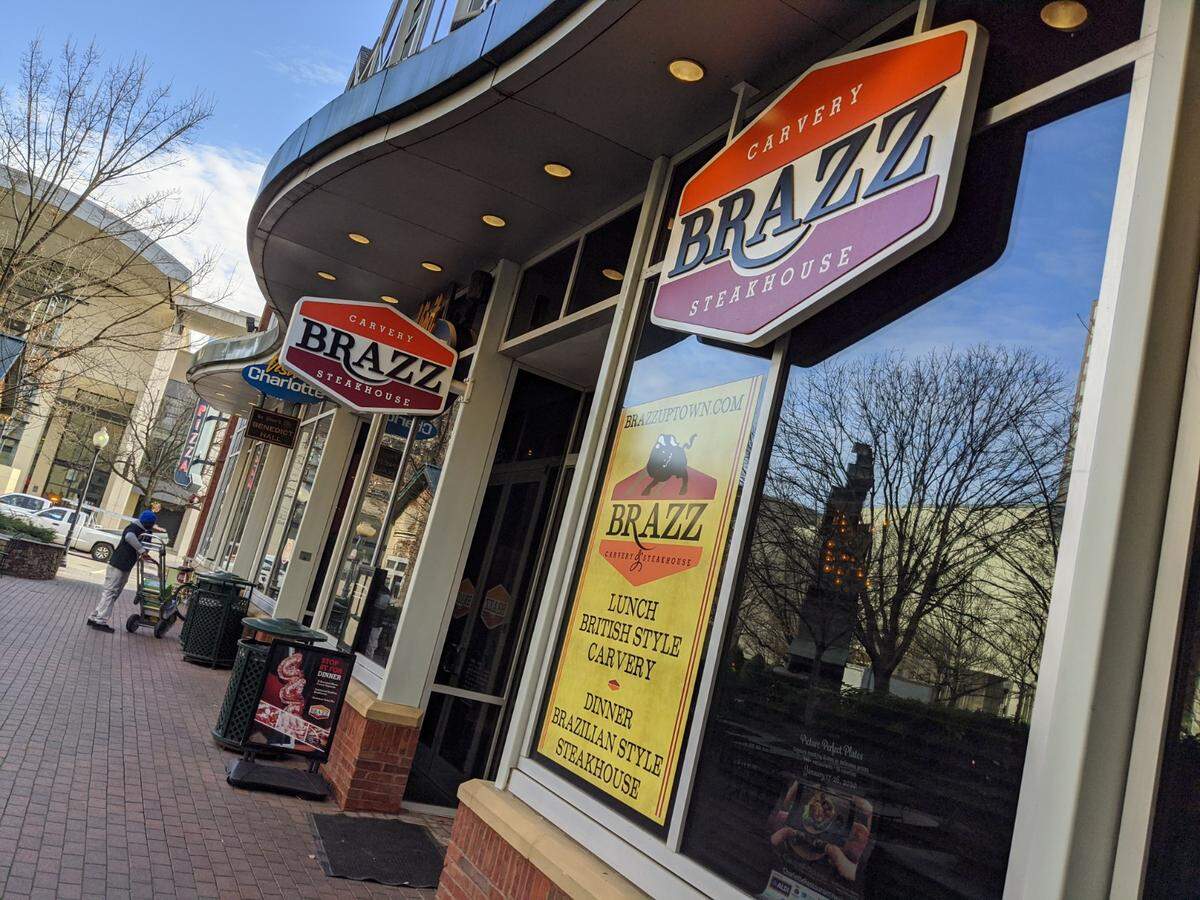
Mital Naik, who co-owns Brazz Carvery & Brazilian Steakhouse in uptown with wife Zankhna, also said delivery and curbside pickup aren’t an option for the restaurant. The Brazilian steakhouse serves lunch and dinner daily, offering rodizio style all-you-can-eat buffet. After Tuesday’s lunch, the restaurant closed.
“We have some delivery but it’s not enough to open the doors for,” Naik said.
He saw business drop 80% this week to nearly “non-existent” at lunch on Tuesday.
Naik said it’s worse for his staff of eight who rely on the weekly paycheck or tips to pay their bills.
“They’re out of work until we’re able to open again,” Naik said.
Hawthorne’s NY Pizza & Bar, which has eight Charlotte-area locations, had already decided before Cooper’s order to offer only take-out and delivery through Door Dash.

Still, Christopher Mullis, general manager of the East 7th Street location, said they can’t put as many pizzas out the door as they can serve in the dining room.
“It’s definitely going to put constraints on revenue coming in,” Mullis said.
He said the restaurant is seeing a drastic decline in business, at least 50% on Sunday.
In his 16 years, he’s said even the 2008 financial crisis didn’t hit as hard as the coronavirus. He understands the governor’s decision, but he, too, is most concerned about his staff of 35. He said 12 are servers.
“They’ll be completely out of work until this is over,” he said. However, he’ll try to rotate them into the take-out schedule but it will be limited.
Bader said businesses will survive, but the devastation could linger.
“We are resilient people as a country and group, and we will survive,” he said. “I just hope there’s help for hourly people.”
Help for workers and businesses
The U.S. Small Business Administration granted a request this past week that Cooper made for a disaster declaration for the state’s business owners, the News & Observer reported. That enables small businesses to apply for low-interest federal disaster loans.
He also eased some restrictions on state unemployment benefits in a move to help workers and businesses affected by the coronavirus.
Among the changes are an elimination of the waiting period to apply and of the requirement that recipients be actively looking for jobs to obtain the benefits. And workers who see fewer hours but don’t lose their jobs completely can qualify in some cases.
LaBar said the Charlotte Regional Business Alliance is having conversations with members of Congress from North Carolina to push for federal relief for businesses.
In Charlotte, the Foundation for the Carolinas launched an effort this week to help mitigate the economic impacts of the virus. The city and Charlotte-based LendingTree contributed $1 million each to the fund, which will go to area nonprofits.
“These are all tests of how collaborative, how resilient can we be?” LaBar said. “It’s trying times. And yet there are some really great stories that are coming out of this.”
This story was originally published March 18, 2020 at 9:12 AM.