Top NC health official: Coronavirus test results ‘very imperfect’ indicator of spread
Each morning, North Carolina’s health department publishes an official number of confirmed coronavirus cases across the state. County health departments release their own numbers throughout the day, and the media relentlessly compiles, tracks and reports on the latest totals.
But those numbers don’t tell the complete story of how widespread the disease is in North Carolina, the state’s epidemiologist said.
“The case counts that we get are not a great marker for how fast this is accelerating or what the true burden of COVID-19 is out there in the community,” Zack Moore said. “That’s true not just here in North Carolina, but everywhere.”
North Carolina now has more than 500 confirmed cases statewide. More than half of the state’s counties have reported at least one case. Wake, Mecklenburg and Durham counties account for more than half of the total.
The state reported its first deaths due to the virus on Wednesday morning.
As the virus becomes more widespread “the difference between the case counts and the actual disease get bigger. We have to accept that those case counts are a very imperfect way of tackling it,” Moore said.
A lack of testing early on limited the ways North Carolina could respond to the outbreak. And state health officials have encouraged those with mild symptoms not to get tested.
How, then, do public health officials plan on tracking the virus and the disease? And how can they provide lawmakers and executives with the information needed to expand restrictions on movement or to remove them? Information as essential as: What is the mortality rate of people who contract the virus?
“We in public health have been thinking about the better ways to get actionable information,” Moore said. “The basic answer is that we are going to be using some of the tools that were developed for influenza surveillance and have been in use for decades.”
Elizabeth “Betsey” Tilson, the state’s health director, said: “The best way to understand the spread is not to test everybody. Instead it’s using our evidence-based surveillance strategies that we use for influenza and apply that to COVID-19.”
Those measures, Moore said, have been pretty good for tracking widespread respiratory illnesses and generate weekly influenza reports. The Centers for Disease Control and Prevention has a network of providers across the country, including participants in North Carolina, that give them useful data. That’s being turned into a COVID-19 tool now.
Among the data that are collected by the surveillance program is the percentage of people who come in with a fever and cough and testing positive for COVID-19; the number of people who come out for testing; the percentage of emergency room visits in North Carolina for symptoms consistent with COVID-19; the change in that number over time; and the number of people who are being admitted to hospitals.
The answers to those questions will hopefully provide state health officials with the information needed to determine when the virus has peaked and when it is coming down.
“It’s going to be very helpful to us as we try to make decisions about control measures,” said Moore, admitting that the data does not provide a good indication of who is not seeking medical care.
The desire for more actionable information comes as some counties, including Mecklenburg, Wake and Durham, are instituting “stay at home directives” and Gov. Roy Cooper has closed public schools through at least May 15. President Donald Trump, however, is signaling re-opening parts of the economy in the next few weeks.
State Sen. Andy Wells, a Republican from Catawba County, wants the state to do random sampling and use statistical analysis to give policymakers a better sense of the virus as they wrestle with next steps.
Along with confirmed positive cases, the state reports testing numbers each morning. Fewer than 10,500 tests have been completed as of Wednesday morning, NC DHHS reported. But those numbers, too, are incomplete as they do not include all negative tests from commercial labs or research centers. They are required to report positive tests.
North Carolina’s population is more than 10.5 million.
“What we need is data. We are in desperate need of data. We are making decisions in the dark,” Wells said Tuesday. “We’re doing what we think is the right thing and we don’t know. And that’s tragic. We’ve taken a full economic shutdown and that might be the right call, it might not. We don’t know.”
Moore said random sampling is not part of state health officials’ plans. Nor is turning to other surveillance methods. Google searches, for example, have been helpful in tracking the flu. For coronavirus, which has dominated news coverage and people’s concerns for weeks, that’s not going to work.
“The first priority is to take tried and true evidence methods. We’re making sure we’re using those,” he said.
Moore said that within the next few weeks officials hope to make that surveillance data public — both statewide and nationally. The flu data collected the same way is made public.
Health officials do not know how far behind the actual cases are lagging the publicly reported numbers. For Hepatitis C cases, for example, for every one diagnosed case there are 14 more undiagnosed, Moore said.
No such multiplier exists for coronavirus and it is unlikely to be the same in disease hot spots like New York City or Spain as it is in Raleigh or Charlotte, Moore said.
Testing limits
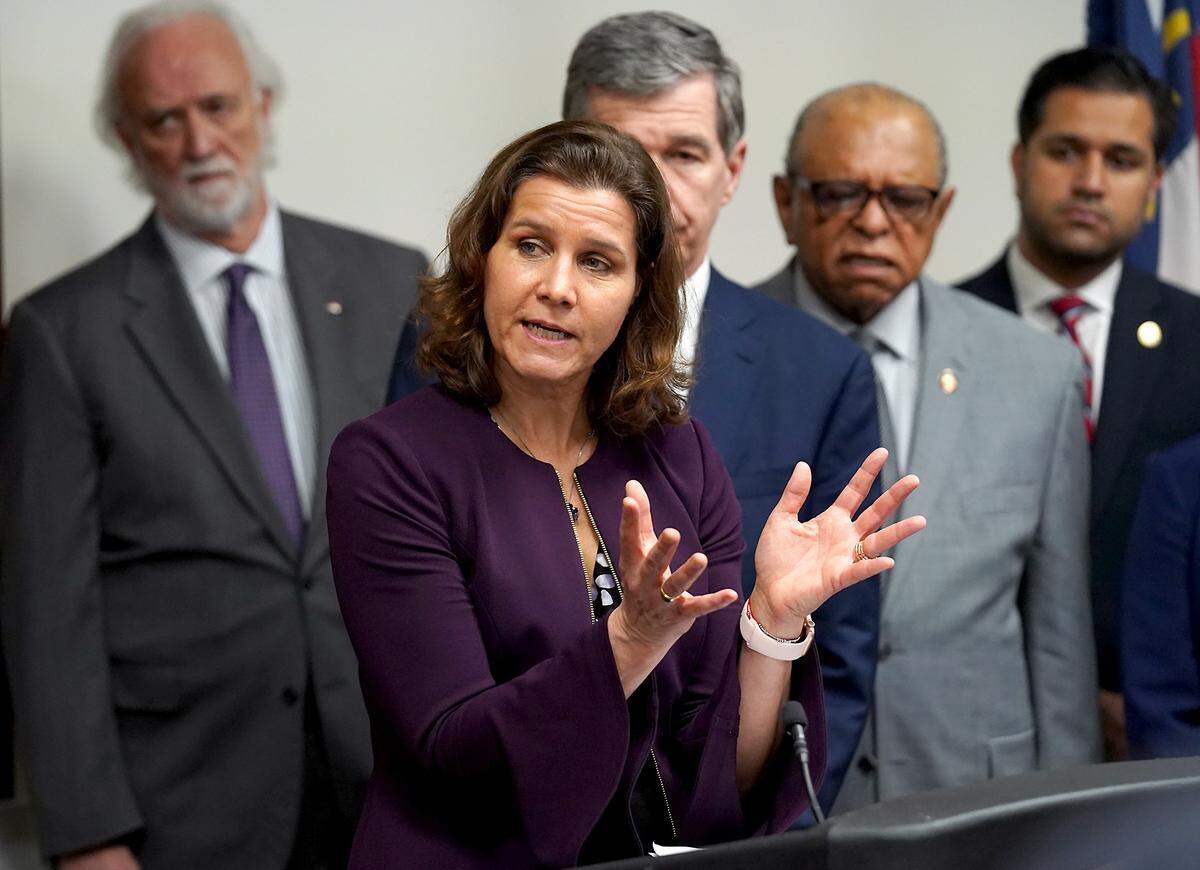
North Carolina’s state health director opened a press conference Tuesday with a call for those with mild symptoms to stay home rather than exposing others by leaving their home to get tested.
“A test will not change what someone without symptoms will do,” Tilson said.
The priority population for testing are the seriously ill, patients in the hospital, those living in high-risk settings like nursing homes, health care workers and first responders.
People who are experiencing a worsening of symptoms, those over 65, and those with underlying health conditions should call their doctor, county health office or, in bad cases, 911 right way, Tilson said.
She said those with mild symptoms can go back to normal activities once they’ve gone seven days since their symptoms first appeared, gone without a fever for three days without medicine, and seen other symptoms improve. That matches CDC guidance.
Ideally, the United States would have been able to test everyone before the virus became widespread. But problems with testing supplies limited the nation’s ability to test. Mecklenburg County Health Director Gibbie Harris acknowledged that more testing early on would have helped fight the virus’ spread.
“If we had more tests available, it would have given us a better picture of what we were dealing with and it might have changed our response,” she said Tuesday. “It’s hard for us to tell if we are just testing very sick people and missing people who are only mildly ill.”
Local officials say they don’t even know how many people in Mecklenburg County have been tested so far. But they say they are working with test sites to begin collecting that information.
Now there are shortages of the personal protective equipment, or PPE, needed by health care workers in hospitals across the country. That includes products like gloves, masks and gowns that health care workers wear to protect themselves from contracting the virus.
Wells, the state senator, said the nation and the state are capable of increasing testing and protecting health care workers with proper gear at the same time. He compared it to fighting two fronts in World War II.
“As a society, we’re capable of ramping up. I think we can address both issues of treating the sick, identifying the sick and finding out the scope and the severity of this disease as it relates to current penetration and fatality rates,” Wells said.
Ramping up production
Trump has invoked the Defense Production Act, which allows the federal government to direct domestic industrial production. But he has not used it to compel companies to convert production to needed protective equipment or medical equipment such as ventilators. Trump instead has relied on some businesses to make those decisions for themselves.
Epidemiologist Emily Gurley, an associate scientist at the Johns Hopkins Bloomberg School of Public Health, said that because the U.S. had such limited capacity to do tests, public health officials have been “playing catch up.”
“They’re urgently working to recruit firefighters once the house is already on fire,” she said.
Gurley advocated for a coordinated national approach akin to what the U.S. employed during World War II when it helped turn factories into producers of military equipment. Now, she said, the government could give companies incentives to produce personal protective equipment for health care workers. And the military could be employed to set up testing sites.
Dr. Deborah Birx, who is one of the key leaders in the federal response to the coronavirus, said Tuesday that the government and providers are working on to give people the ability to take their own nose swab sample at home and then send it off for testing.
Such an at-home swab would help preserve the scarce personal protective equipment, she said.
Now that the U.S. has been able to increase its testing capabilities — in part because companies like Burlington-based LabCorp can process many more tests in a single day — some want to see widespread testing in areas without community spread.
Dr. Anthony Fauci, the nation’s top infectious disease expert, said that mass testing can still have a large impact in containing the virus in parts of the country without large outbreaks.
“They still have a window of a significant degree of being able to contain. In other words, when you test, you find somebody. You isolate them, you get them out of circulation and you do the contact tracing,” Fauci said Tuesday at the White House. “When you have a big outbreak it’s tough to do anything but mitigation.”
North Carolina moved from containment to mitigation after discovering community spread.
Gurley, like Fauci, outlined the three key steps to stopping the transmission of infectious diseases: finding infectious people, then isolating them and quarantining the people they’ve been in contact with.
Testing, Gurley said, is crucial to the first part of that process. And it would help prevent a surge in cases that could overwhelm available hospital beds in many communities.
“The problem is we don’t have enough tests so the people we’re testing in each state are only the most severe,” she said.
Countries that have done widespread testing for the virus, including South Korea, have been able to take targeted measures to stem its spread. Countries that haven’t, including Italy, have relied more on what Gurley calls “blunt measures” — strategies such as “stay at home” orders. Several U.S. states have issued “stay at home” orders.
Waiting takes a toll
The lack of testing or test results, however, can be tough on potential patients. Adam Kaplan, his wife and three children attended the BrickUniverse Lego Fan Convention on March 8 at the Raleigh Convention Center.
Another attendee who was there at the same time tested positive for coronavirus. The Kaplans, who live in North Raleigh, called the Wake County health department. Kalplan’s wife and his two youngest children were tested.
Nine days later, only one of them has gotten their results back. Negative. But the family, listening to the advice of health officials, has quarantined itself at home.
“It’s getting a little punchy around here. There’s quite a bit of anxiety we’ve been dealing with as a whole,” Kaplan said. “The kids are taking it about as well as they can.”
Kaplan said no one is showing symptoms at this point, but he is growing frustrated that the tests may have been lost.
“They keep telling us to hold on and wait for the test results to come,” he said.
This story was originally published March 25, 2020 at 11:11 AM with the headline "Top NC health official: Coronavirus test results ‘very imperfect’ indicator of spread."
.JPG)