Experts: Racism, misinformation fuel NC’s high coronavirus rate among blacks, Hispanics
In North Carolina and around the country, African Americans are getting COVID-19 and dying from the disease much more often than white people.
Why?
While health experts talk about a variety of reasons, Dr. Mandy Cohen, the state’s secretary of health and human services, can explain it in two words: “Structural racism.”
“Health disparities in our country are historic and persistent, and when we have a crisis like this, I think it shines a light on health disparities that, frankly, I’ve been working on for 3 1/2 years,” Cohen told The News & Observer. Those disparities have been perpetuated, Cohen added, by “unfortunate decisions” about policies like failing to expand Medicaid in the state.
Read this story in Spanish at Enlace Latino. Lea este artículo en español en Enlacelatino.org.
Like many other states that are reporting the racial demographics of confirmed COVID-19 cases and deaths, North Carolina is seeing a disparately high impact on the state’s black residents. As of Friday afternoon, 1,086 black people had tested positive for COVID-19.
That’s 39% of the 2,781 cases where the race of the patient was known. North Carolina’s population is 22% black.
That gap is wide enough that in the unlikely event that every single one of the 1,087 patients whose race was not recorded were white, black patients would still make up a disparately high portion of the state’s cases.
The same pattern extended to deaths, with black people accounting for 27 of the state’s 69 COVID-19 deaths (where race was known) or 39%.
The high number of deaths and illness among black North Carolinians was not unexpected. For one thing, they’re a result of long-term deficits in education, health care and opportunities that often force black residents to take on the manual jobs that are still deemed “essential” at a time that much of the population is able to stay home.
And that amounts to racism, said the Rev. William Barber II, co-chair of the Poor People’s Campaign and a past president of the North Carolina NAACP.
“It’s not the germ, it’s not the virus and it’s not merely race. Because to say it’s just race is to say that people’s biology has a certain predisposition to the disease,” Barber said.
Instead, he said, it’s “the existing disparities prior to the pandemic that are further exposed and exploited by the germ once the pandemic hits.”
Working at the drive-thru
Cohen also cited a higher rate of chronic health conditions and uninsured people among the state’s black population.
“While it is too early to say I fully understand all of the nuances of what this means and where the numbers will shake out, I definitely think we’re seeing the underlying health disparities in our system play out in COVID-19,” Cohen said.
In North Carolina, 10.7% of residents are uninsured. So are 29.7% of the state’s Hispanic population, 18.6% of its American Indian population and 10.7% of the black population — compared to a 9.8% uninsured rate in the white population.
Patients without health insurance often will allow illness to progress before seeing a doctor, said Dr. Georges Benjamin, executive director of the American Public Health Association.
“You’re also less likely to have a relationship with a primary care doctor,” Benjamin said, “so at a time like this, when you’re not really sure what your symptoms are, your ability to just pick up the phone and call somebody through the telemedicine system or through the nurse advice line is highly limited.”
Nationally,according to the Economic Policy Institute, lower-wage workers are less likely to be able to work from the relative safety of home: 19.7% of black workers and 16.2% of Hispanic workers.
Rita Blalock, who works at a downtown Raleigh fast food restaurant, is one of those workers deemed “essential.” Blalock is associated with NC Raise Up, a local wage advocacy coalition.
“We don’t wear masks, we have gloves, but that’s really a concern because people are still coming to the drive-thru, breathing, coughing … plus coming inside and doing the same thing,” Blalock said.
As business has slowed, her hours have been cut. When the pandemic started, Blalock was working five days a week. Now, she told the News & Observer, she rarely works and plans to apply for unemployment benefits.
Nevertheless, Blalock, who lives alone, is still trying to catch hours where she can — despite fears of being exposed while at work.
“I feel like I need to be home and safe, but then again, if I just stay home and don’t get any help, I’m going to be lost,” Blalock said. “I need funding, I need food. ... I know I do need to stay home, but if I stay home, how am I going to support myself?”
Barber and the Poor People’s Campaign have called on federal officials to help Blalock and other workers by providing paid sick leave for everyone, health care including free COVID-19 treatment for everyone and a “guaranteed and adequate” income for all front-line workers, including those in health care, at grocery stores and behind fast food counters.
“We should be putting more resources into communities that have historic denial of those resources,” Barber said. “Because people have to understand: If you don’t help address the effect of the pandemic in certain communities, the germ is not going to stay in those communities.”
CDC study and NC data
A study released in recent days by the Centers for Disease Control and Prevention found that in March, the first month the agency monitored COVID-19 in the United States, black people were disproportionately likely to be hospitalized than other races.
Across the 14 states studied, the population was 59% white, 18% black and 14% Hispanic. The 580 patients hospitalized for whom race and ethnicity data was available, though, were 45% white, 33% black and 8% Hispanic. North Carolina was not included in the CDC study.
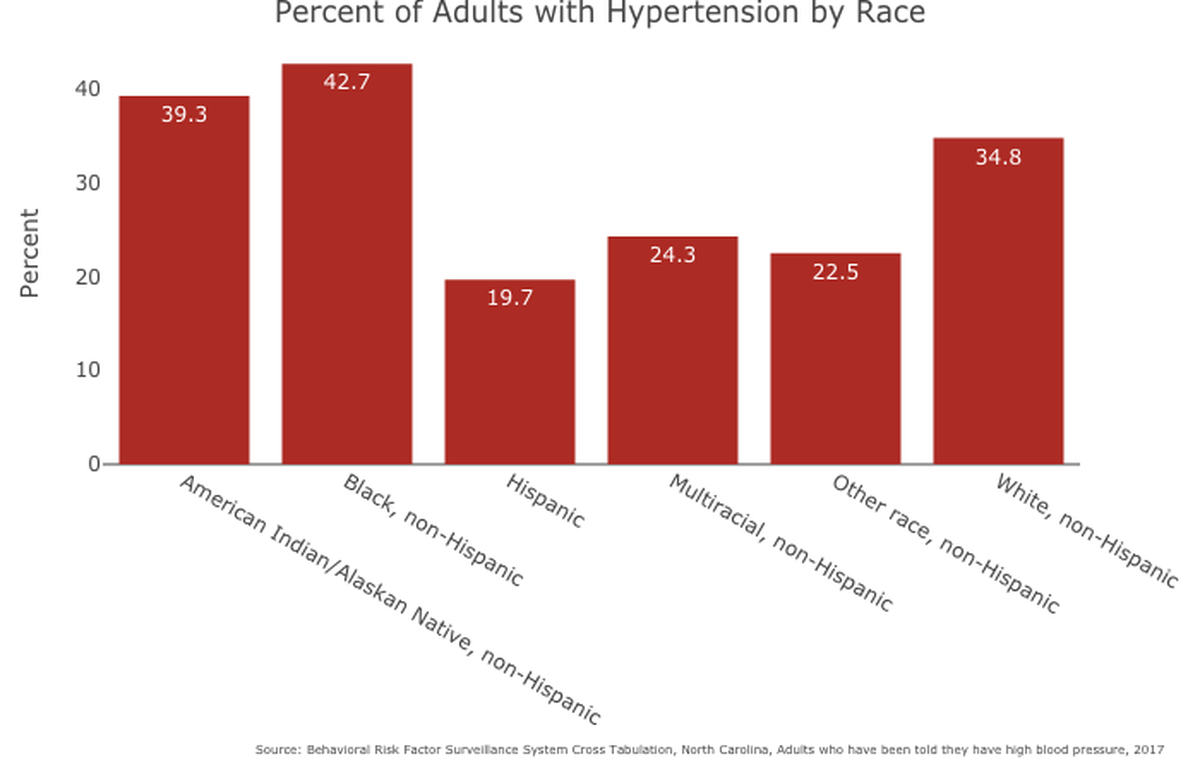
The study also found that nearly 90% of those hospitalized had one or more underlying medical conditions. The most common conditions among those hospitalized were high blood pressure, obesity, and chronic lung conditions like asthma, diabetes and heart disease.
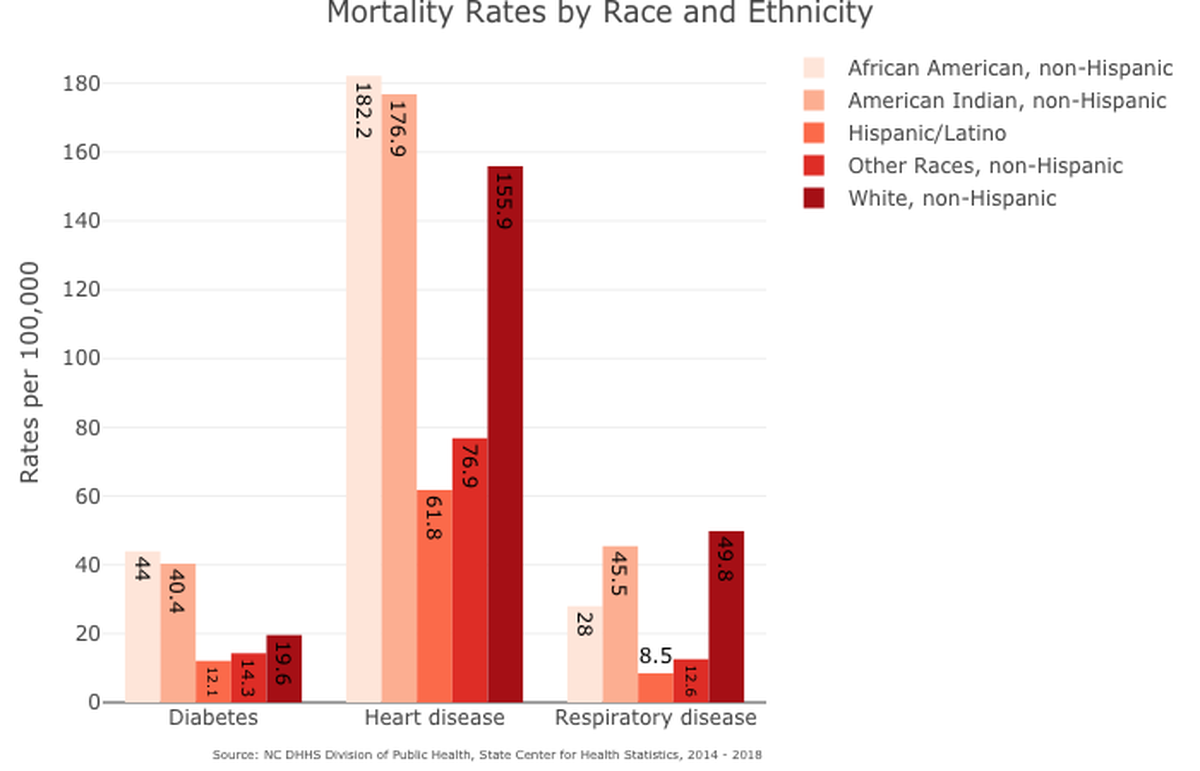
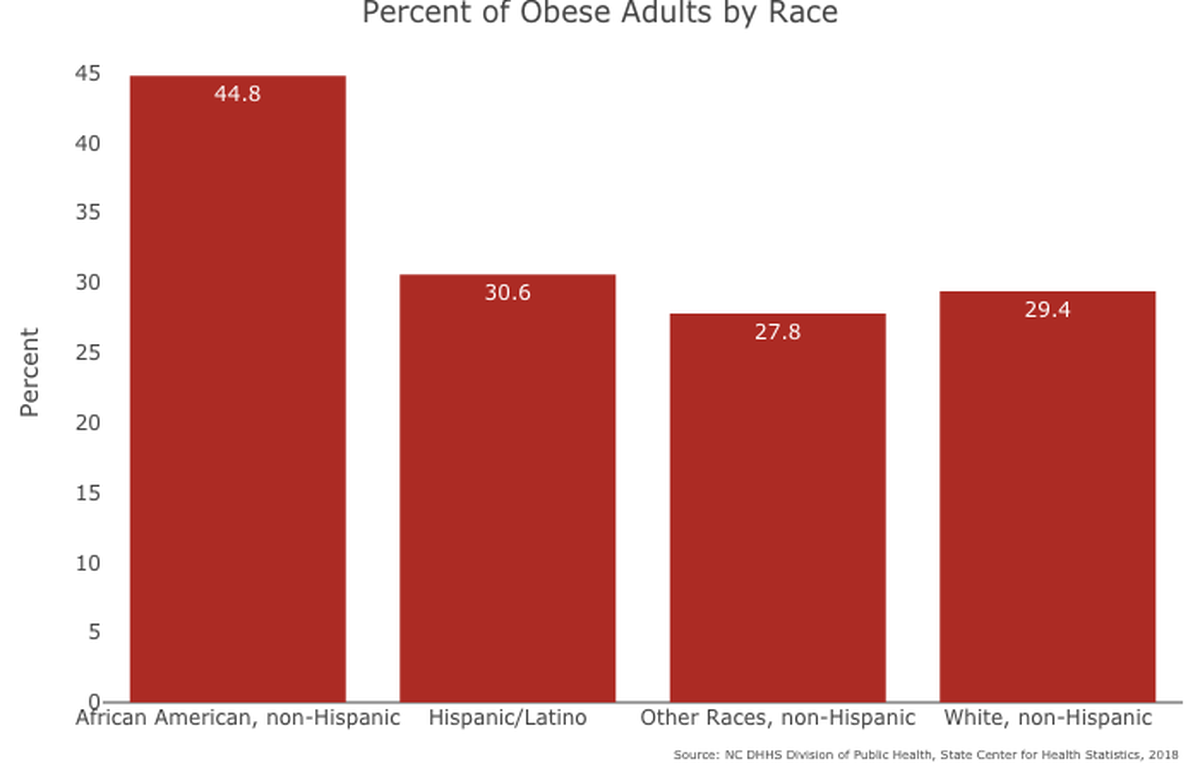
Black residents of North Carolina are more likely to suffer from most of those diseases than white residents, according to data collected by the Centers for Disease Control and Prevention and N.C. Department of Health and Human Services.
For instance, between 2014 and 2018, heart disease killed 182.2 black North Carolinians per 100,000 people, as compared to 155.9 white residents per 100,000. And 44.8% of the state’s black adults were obese in 2018, compared to 30.6% of Hispanic and 29.4% of white adults.
Health officials react
Last week, Mecklenburg County Public Health Director Gibbie Harris addressed the disparity in her community. According to the U.S. Census Bureau, a third of Mecklenburg’s population is black. But, Harris said, 48% of Mecklenburg County’s positive tests had come from black residents.
Black residents of Charlotte and Mecklenburg County, Harris said, struggle more with social determinants like jobs, housing and education than their white counterparts.
“Why should it be surprising that COVID-19 is treating this population any differently? This is just symptomatic of the problems we have in our system for this particular population in our community,” Harris said, adding that it is important to increase access to testing and care for the county’s black population.
In the Triangle, Durham and Wake counties have not released any public information about the race of patients, but they have released information about the age and gender of patients.
Orange County has assumed a particularly hard line on demographic information, with the county maintaining that it will “never” share information about confirmed COVID-19 patients such as age, race, gender or ZIP codes.
Counties that are including race among the reported demographics of confirmed COVID-19 patients are frequently showing that black residents are contracting the virus at disproportionate rates.
Wilson County has reported that 65% of the 47 confirmed COVID-19 patients are black in a county where 40% of residents identify as black. Cumberland County is a similar story, with 39% of its population identified as black and 51% of its 72 confirmed COVID-19 cases.
Data gaps
While North Carolina has released data about patients who test positive for COVID-19, there is no information available about the demographics of the thousands of people across the state being tested for the illness.
That is important, one expert said, because of a suspicion that testing is happening in an uneven manner.
“I think that there’s been a lot of confusion about who is being tested and who’s not,” said Nadine Barrett, a Duke University assistant professor of family medicine and community health. “There’s been quite a bit of information coming from social media about telling stories about not being tested or being sent home from the hospital.”
When a lab has a North Carolina patient test positive for COVID-19, it must report that incident to the state, along with the date of the sample and the resident’s date of birth. Typically, Cohen said, local health departments are then backtracking to determine the patient’s demographics.
“We will continue to try to match all of these cases with the information about them, but they (officials) have to go one-by-one, and it does take personal interactions to do each one,” Cohen said.
She added, “Even if it’s not perfect and not complete, at this point I think this does give us a picture of what’s going on.”
The process is different, though, for negative tests.
A lab will typically report once a day how many tests it has done and how many are negative. No date of birth or other information are reported to the state that health departments could use to determine the demographics of those tested.
Even if that information was reported, Cohen said, DHHS and local health departments don’t have the capacity to investigate each case, particularly because resources are focused on increasing testing overall.
In an effort to gain some understanding of who’s testing negative, , Cohen added, DHHS officials have asked some academics to try to use statistical analysis to model who is making up that group.
But testing is just one place where experts believe more information is needed. Benjamin, the American Public Health Association’s executive director, said data is needed about doctor’s office visits and hospital visits.
“We would like to get a comprehensive picture of who’s exposed, who wasn’t exposed, who’s at risk, where were they at risk, where did they get sick, where they went and what their clinical outcome was,” he said.
Julie Ivy, a N.C. State University professor of health systems engineering, said she’d like publicly available websites to display who is getting sick and who is dying.
“Give me a sense of the at-risk populations. I can see race on one page, I can see gender on another, I can see age on another, and it would be helpful to see the intersections,” Ivy said. By seeing those intersections, she said, people would be better able to understand if they’re at higher risk.
It is also important, Ivy added, for patients who do contract COVID-19 to better understand when they should seek medical care, something Ivy referred to as a “threshold” that could be different depending on a person’s age or medical condition.
Hispanic health and COVID-19
In North Carolina, 209 people identifying as Hispanic have been confirmed to have COVID-19. That makes up 9% of cases, almost exactly the proportion Hispanics make up of the state’s population.
But there is ethnicity data missing for 1,474 confirmed cases and 10 deaths. An advocate for the Latino community said the true number of cases is likely much higher than those reported.
Kattia Blanco, the health manager at El Centro Hispano, a Triangle-area Latino advocacy nonprofit, said Hispanics often don’t disclose their ethnicity when filling out forms, particularly if they’re undocumented. Many will list their race — which could be white, black or mixed, among others — but skip ethnicity.
“It could be fear, I imagine,” Blanco said. Undocumented immigrants with no social security numbers often avoid registering with clinics altogether, she said.
“We’ve seen people who say they haven’t seen a doctor since they came here from their home countries,” said Blanco. “We then check their blood pressure and find out they have hypertension.”
Immigrant health is also affected by a multitude of factors such as language barriers, immigration status, health insurance ineligibility, no broadband access, and widespread misinformation.
These risk factors are only likely to grow as seasonal farmworkers soon arrive in North Carolina from Mexico and other Latin American countries, the News & Observer previously reported.
The N.C. Farmworker Health Program said that agricultural farmworkers, who are almost all Hispanic, are at high risk for COVID-19 and other illnesses. Farmworkers frequently suffer from high blood pressure, heat-related illness and diabetes, among other conditions.
Farmworkers also frequently live in close quarters, which increases their risk.
Reaching those who need it
Benjamin, the public health association official, and several other experts interviewed for this report recalled hearing a rumor in the early days of the pandemic that black people were immune from the illness — a rumor perpetuated on social media.
Finding a way to quash those rumors in traditionally underserved groups and push back with vital information is vital, Benjamin said.
“If I hear that it’s not as much of a risk to me, my behavior’s likely to be more risky,” Benjamin said. “If I think this thing is definitely coming after me, I’m going to behave a little differently. I’m much more likely to wash my hands more, wear a mask.”
During the AIDS epidemic, Benjamin recalled, healthcare officials worked with barbershops and faith leaders to distribute pamphlets and make the threat clear. Those avenues aren’t necessarily open right now, Benjamin added, but officials can use social media, radio and TV to get accurate information out.
Cohen, North Carolina’s DHHS secretary, pointed to North Carolina’s messaging on the need to worship in your home during Holy Week and Passover as an example of working with faith leaders to disseminate a public health message.
Rev. Robert Hodges of Raleigh’s St. Paul AME Church is among those faith leaders. Hodges said he had a cousin die from COVID-19 in Maryland and has two people in his congregation with cousins battling the virus in intensive care.
But when Hodges performs four services on Easter Sunday, all on Facebook Live, he plans to preach a message of hope along with the now-standard reminders to stay home if at all possible.
“My message to my people and to the people that I’m blessed to be the pastor for is a message of hope,” Hodges said. “It may look dark now, but we’re going to come out of it.”
This reporting is financially supported by Report for America/GroundTruth Project and The North Carolina Local News Lab Fund, a component fund of the North Carolina Community Foundation. The News & Observer maintains full editorial control of the work. To support the future of this reporting, subscribe or donate.
This story was originally published April 11, 2020 at 12:39 PM with the headline "Experts: Racism, misinformation fuel NC’s high coronavirus rate among blacks, Hispanics."