Coronavirus cases in NC reach 10,000 — a grim milestone that could have been worse
Positive coronavirus cases have now passed 10,000 in North Carolina.
It’s a morbid milestone — but the state’s overall spread of the disease may be showing signs of slowing down, as The News & Observer has reported Monday.
North Carolina so far hasn’t been hit as hard by COVID-19 as some other states, although with limited testing here and across the country, it’s impossible to make exact comparisons. Slightly more than 1% of North Carolina’s 10.5 million people have been tested as of Monday, state data shows, which was about the same percentage as the national total.
Based on the federal data that is available, several states — including Louisiana, Colorado, Connecticut and Maryland — all have millions fewer people than North Carolina but more total confirmed cases. The News & Observer, which is collected directly from the state and county health departments, had a tally of 10,092 positive coronavirus cases as of Wednesday morning. That total is higher than the state’s count of 9,948 cases.
The coronavirus, which first appeared in North Carolina on March 3, had spread to 98 of the state’s 100 counties as of Wednesday morning.
Between Feb. 29 and April 28, confirmed U.S. coronavirus deaths spiked from zero to more than 55,000 people, according to the Centers for Disease Control and Prevention.
By comparison, the CDC estimates that between 24,000 to 62,000 people died from the flu over a five-month span from October 2019 to April 2020.
Modeling has shown that statewide actions instituted later in March — including closing businesses, schools and banning large gatherings — have worked to cut down the number of cases and deaths.
Researchers at the University of Washington have published numerous models for how the disease is expected to affect various places. An initial North Carolina model in March predicted around 2,400 deaths from coronavirus here. But in early April, a few weeks after restrictions to “flatten the curve” were put in place, a new version of that model predicted 500 deaths here from the disease, the News & Observer reported.
Deaths underreported in NC?
North Carolina ranks 19th in the CDC’s data of coronavirus-related deaths, with 342 deaths as of Tuesday. The state’s DHHS reported 354 deaths as of Wednesday.
However, due to a lack of testing, the real number of North Carolina deaths could actually be “many times greater” than the official statistics show.
That’s according to an April 21 article written jointly by reporters from multiple North Carolina media outlets, including The News & Observer and Charlotte Observer.
Those reporters analyzed public records and found hundreds of additional people who died in recent weeks from causes that could indicate coronavirus. But no testing was done to either confirm coronavirus as the cause or rule it out.
“Without the test results, whether negative or positive, it’s impossible to know how many of these North Carolina residents who died had the virus,” according to the article. “And the number of people in North Carolina who died with comparable symptoms, but without any test results recorded, is many times greater than the number whose death certificates say they tested positive.”
Balancing economy, public health
Democratic Gov. Roy Cooper acted more aggressively than many other Southern states in closing down businesses like restaurants and barber shops, and issuing a statewide stay-at-home order.
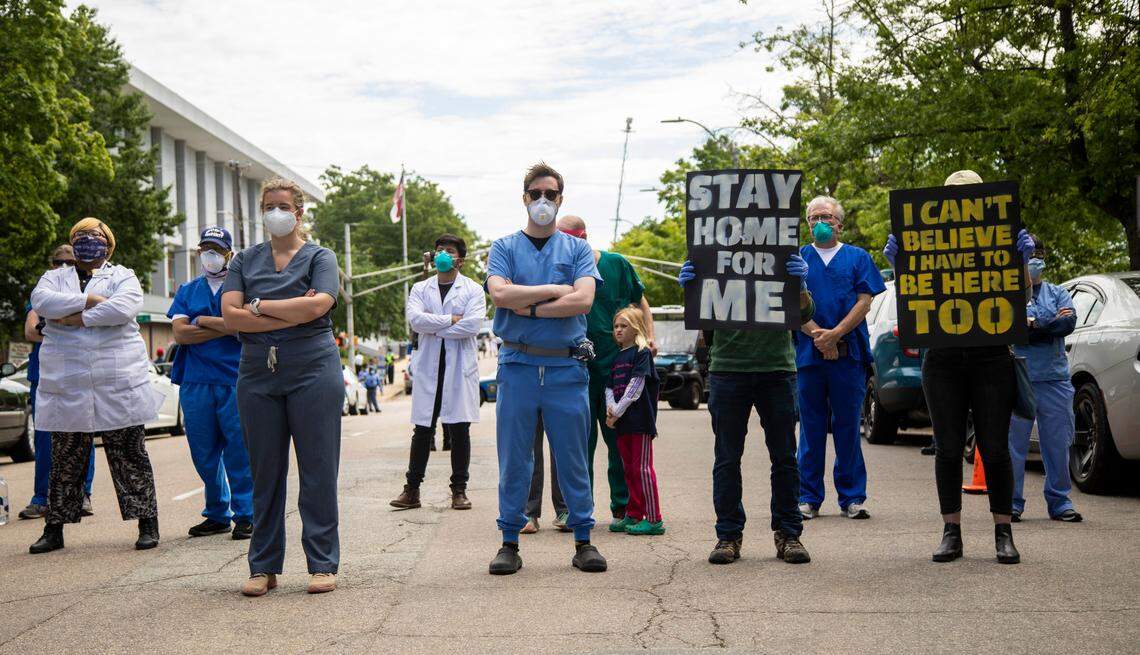
Health experts also tend to agree that reopening too early could cause a new spike in cases, leading to even more deaths. Some have protested Cooper’s various orders, calling on him to “reopen” the economy. But polling from both sides of the political spectrum shows that’s not a widespread view.
One poll released in mid-April by the conservative-leaning Civitas Institute found that 84% of North Carolinians approved of Cooper’s response so far to COVID-19.
Another poll from mid-April, by the liberal-leaning Public Policy Polling, found that 69% of voters thought Cooper’s response had been “about right,” while 11% said his orders didn’t go far enough, and 15% thought he went too far.
Last week, Cooper unveiled a three-phase plan to gradually reopen the state economy.
The state will move into the different phases, each of which is less strict than the last, based on what medical data is showing about the spread of the disease.
“It’s important to get our economy moving forward,” Cooper said when he announced the plan. “We’re helping with unemployment payments, stimulus money and the businesses that continue to be open. But I won’t risk the health of our people or our hospitals. And easing these restrictions now would do that.”
Under his plan, some sort of stay-at-home order will likely be in place at least through late May. But the current order ends May 8 and could be replaced with a less strict version — which could itself end within two or three weeks, if the medical statistics show a healthy enough downturn.
In the best-case scenario under Cooper’s plan, North Carolina could be into Phase 3 by late June or early July.
This story was originally published April 29, 2020 at 11:50 AM with the headline "Coronavirus cases in NC reach 10,000 — a grim milestone that could have been worse."