Gov. Cooper allows NC to move into Phase 1 of lifting coronavirus restrictions
By Dawn Baumgartner Vaughan ,
Steve Wiseman and
Jonathan M. Alexander
RALEIGH
North Carolina Gov. Roy Cooper issued an executive order Tuesday that allows the state to move into Phase One of lifting statewide restrictions that he said have slowed the coronavirus spread. The new order takes effect Friday at 5 p.m.
Cooper said the stay-at-home order will remain in place but will allow more reasons to leave home and will remove the distinction between essential and non-essential businesses. Those that open can only be occupied at 50 percent capacity.
Bars, personal care businesses like hair and nail salons, entertainment venues and gyms will still be prohibited from opening. Restaurants may continue serving customers with to-go orders and delivery but no in-house seating will be allowed in Phase One.
People will be allowed to socialize with non-family members once again. Small outdoor gatherings of no more than 10 people will be allowed, and people must maintain social distancing.
Childcare centers will be reopened but must follow strict cleaning guidelines. Cooper also said that summer day camps will be allowed to open as long as they follow Centers for Disease Control guidelines.
Where churches were only allowed to hold drive-in services where worshipers stayed in their cars under the current order, outdoor services with more than 10 people will be allowed in Phase One. People must maintain at least six feet of physical distancing and are encouraged to wear face coverings.
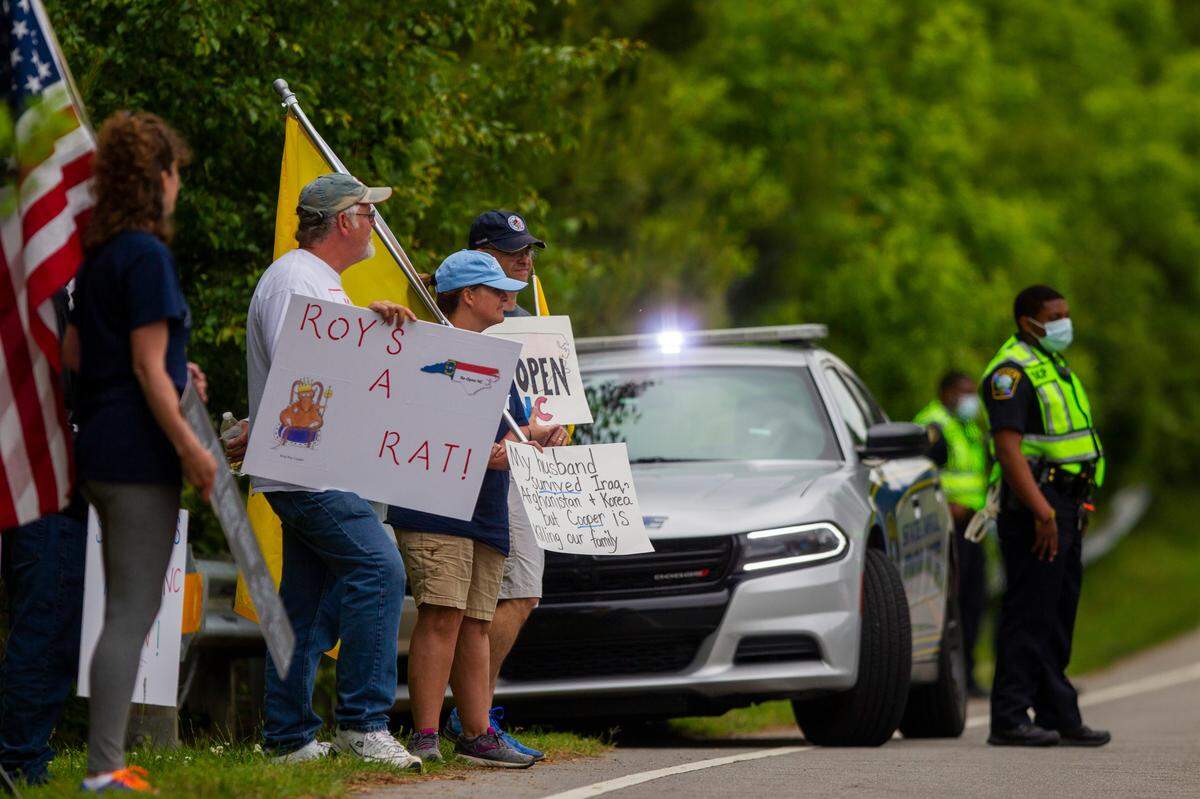
Protesters hold signs outside the NC Emergency Operations Center in Raleigh where Gov. Roy Cooper’s delivered his coronavirus response briefing Tuesday, May 5, 2020. Travis Long tlong@newsobserver.com
Hitting coronavirus benchmarks
Dr. Mandy Cohen, secretary of the state’s Department of Health and Human Services, said the state has hit three of the four benchmarks in trending related to the virus to allow for an easing of restrictions.
The number of patients with COVID-19 symptoms being seen by health care workers, the number of hospitalized COVID-19 patients and the percent of tests coming back positive are all declining or leveling off, she said.
Cohen said that just over half of all adults in North Carolina are at higher risk for severe COVID-19 illness because they have at least one underlying condition, are older than 65, or both.
“We cannot lower our guard,” she said.
The number of coronavirus cases continues to rise but Cohen said an increase in testing is a factor. She said the state is doing twice as much testing as it was a few weeks ago. But she added that the state will continue to watch those numbers.
“We are not perfect,” Cohen said. “But we are stable.”
The executive order that allows the state to move into Phase One runs through May 22. Cooper said if trends move in a negative direction, restrictions could return.
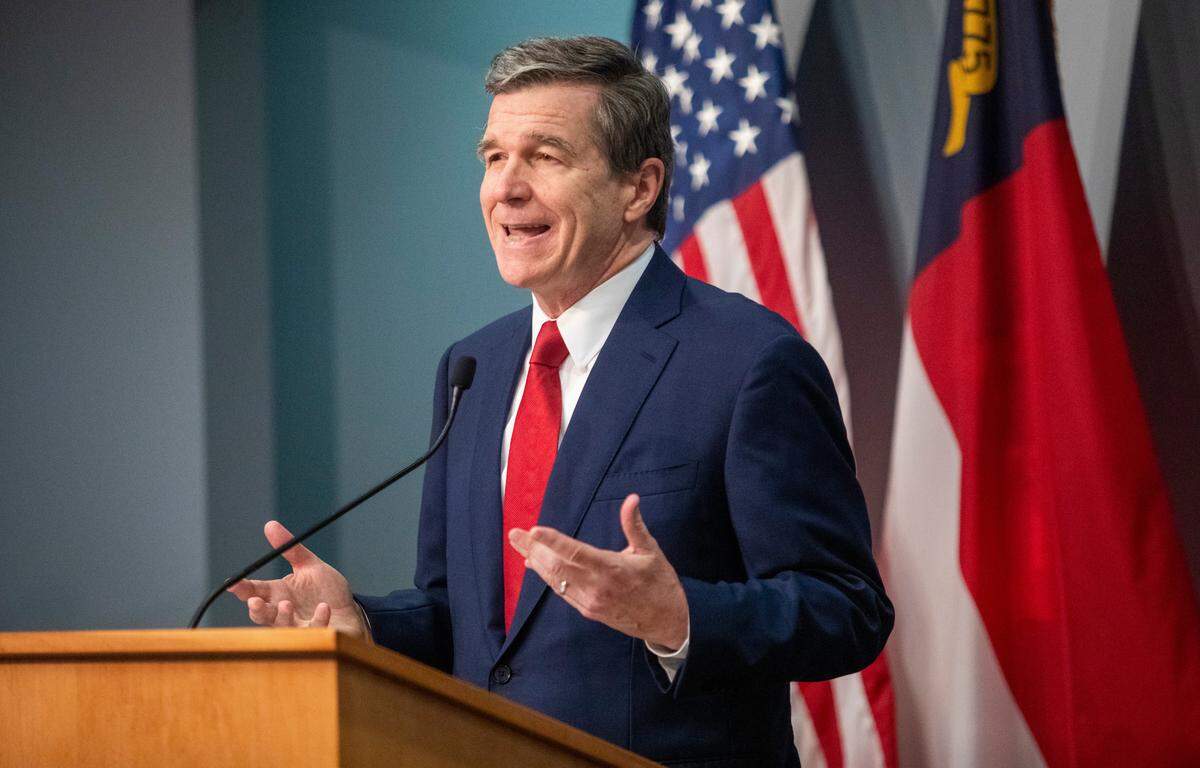
Gov. Roy Cooper speaks during a briefing on North Carolina’s coronavirus pandemic response Tuesday, May 5, 2020 at the NC Emergency Operations Center in Raleigh. Travis Long tlong@newsobserver.com
What Phase One means
The governor’s office describes Phase One as allowing travel not already defined as essential, including letting people leave home to shop at places such as clothing, sporting goods and housewares stores.
Those open stores will have to have customer and employee social distancing, extra cleaning, screen employees for symptoms, accommodate vulnerable workers and “provide education to employees and workers to combat misinformation.”
The state is also encouraging employers to use teleworking.
Under Phase One, gatherings are still limited to 10 people, and face coverings are still recommended in public along with social distancing of six feet. It will also reopen some parks.
Restrictions on nursing homes and other congregate care facilities will remain, and local emergency orders with more restrictive measures will still be valid.
“We still want you to stay home,” Cohen said.
But if you leave home, she said to follow “the three Ws”:
▪ Wear face coverings
▪ Wait six feet apart from people
▪ Wash hands often
“We certainly know that indoor activities are at a higher risk than outdoor activities,” Cohen said this week. “Activities where you sit for a prolonged period of time, generally for more than 10 minutes, that’s the thing that is going to increase our risk.”
In Phase One, people can socialize with friends as long as they are outdoors and socially distance — and still 10 people or fewer. The main purpose of a face covering, Cooper said, is to protect other people, especially if you may have COVID-19 but not know it yet.
‘We need consistency’
Some Republicans have been critical of the timeline of Cooper’s reopening plan and the impact on workers and small businesses.
Labor Commissioner Cherie Berry told the rest of the Council of State, which includes the governor, on Tuesday morning there are no nonessential people or businesses in North Carolina.
“We need consistency when these businesses start to reopen,” Berry said, about who can open and who can’t.
Phase One details announced later on Tuesday allows most businesses to open as long as they follow the same guidelines.
Retail stores can increase to 50% capacity as long as they can still follow social distancing and cleaning rules. However restaurants are still limited to take out and delivery services only during Phase One.
While North Carolina is on a similar reopening timeline as Virginia, Georgia already lifted restrictions on many businesses.
“The virus doesn’t respect state boundaries, and I have expressed my concern to the governor of Georgia that they’re opening more businesses than North Carolina,” Cooper said. “We hope that that doesn’t result in an upward trend of having more cases.”
State Treasurer Dale Folwell, who is recovering from COVID-19, said at the Tuesday morning meeting that he wants the Council of State to get a full debriefing of the state’s response.
Dawn Baumgartner Vaughan is the Capitol Bureau Chief for The News & Observer, leading coverage of the legislative and executive branches in North Carolina with a focus on the governor, General Assembly leadership and state budget. She has received the McClatchy President’s Award, N.C. Open Government Coalition Sunshine Award and several North Carolina Press Association awards, including for politics and investigative reporting.

.jpg)