
Fact check: NC shut down to save lives, but are rising unemployment rates deadly, too?
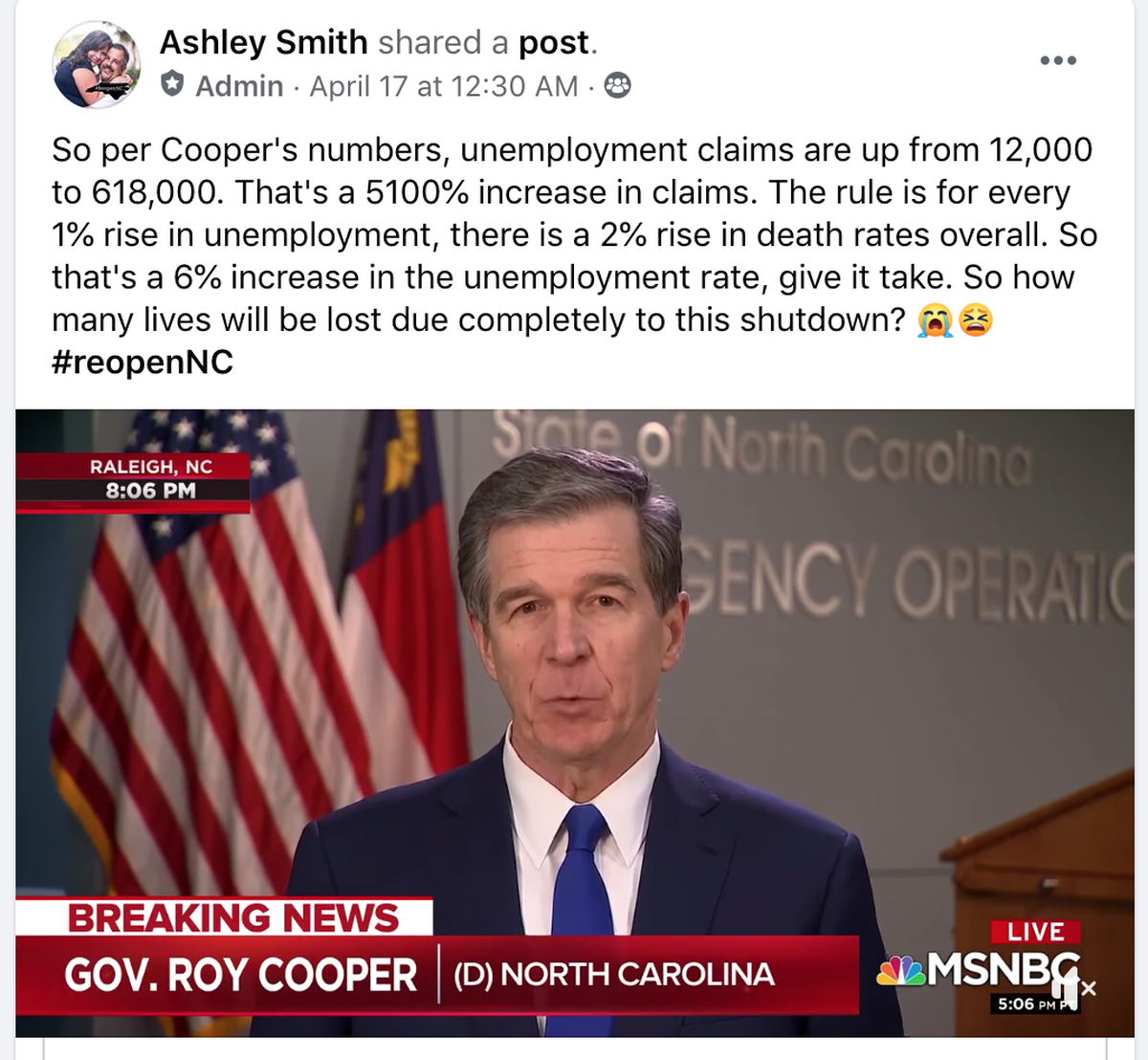
The issue: In an April 17 post in the Reopen NC Facebook group, leader Ashley Smith said, “The rule is for every 1% rise in unemployment, there is a 2% rise in death rates overall.”
Why we’re checking this: This post was liked by more than 1,000 Facebook users, and similar statements were shared in the Reopen Catawba Valley and Citizens to Reopen Carolina Beach groups. It aims to convince people to pressure the government to reopen the economy.
What you need to know: The majority of modern research on unemployment rates and mortality have found that higher unemployment rates are actually correlated to lower mortality rates. The numbers cited in Smith’s claim are similar to findings of a 1979 report to Congress, but that research found the deaths happening two to five years after a recession. Regardless, the recession caused by the COVID-19 response is in some ways unlike past periods of unemployment.
Since mid-March, as much as 20% of North Carolina’s workforce has filed for unemployment due to the government shutdown in response to the coronavirus pandemic, with more than 1 million unemployment claims. Protesters wanting to “reopen” the state say the rise in unemployment will lead to a higher mortality rate.
In the Reopen NC Facebook group, leader Ashley Smith questioned how many lives in North Carolina will be lost due to the shutdown.
“So per Cooper’s numbers, unemployment claims are up from 12,000 to 618,000. That’s a 5100% increase in claims,” Smith said in the post. “The rule is for every 1% rise in unemployment, there is a 2% rise in death rates overall. So that’s a 6% increase in the unemployment rate, give it take (sic). So how many lives will be lost due completely to this shutdown?”
Where does Smith’s claim come from?
Smith’s claim that for every 1% increase in unemployment, there is a 2% increase in mortality was based on a 2002 press release from Yale University about a study finding higher unemployment causes higher death rates, said Reopen NC spokesperson Stephen Xavier.
She also relied on a blog post from Scientific American about the costs of the pandemic, an article from the American Journal of Public Health that found unemployed individuals had an increased risk of suicide and an article about the link between unemployment and suicide from the World Economic Forum, Xavier said.
M. Harvey Brenner, a professor of health behavior and health systems at the University of North Texas, and the head researcher on the study described by the press release from Yale University, said in an email interview that the claim comes from reports he wrote for Congress’ Joint Economic Committee using historical data from 1936-1973.
In his 1979 report for the committee, Brenner said that from roughly 1940-1973, for every 1% increase in unemployment, there was an increase of 2% mortality. However, “this occurs over a period of 2-5 years lag following the increased unemployment,” Brenner said.
What does current research say?
Brenner’s research found that mortality due to high unemployment increased years after a recession, during an economic expansion. Regardless, there is evidence that during times of high unemployment, mortality actually decreases, said Christopher Ruhm, professor of public policy and economy at the University of Virginia.
When people aren’t working, they are not commuting to work, so they are less likely to die from traffic accidents as well as pollution-related causes, Ruhm said. Jose Tapia, assistant professor of politics at Drexel University, said there is also a decrease in cardiovascular deaths during periods of recession.
A notable exception to this decline in deaths is that during times of high unemployment, suicide rates increase, Tapia said. However, suicides are a small portion of overall deaths.
Sam Harper, associate professor of epidemiology, biostatistics and occupational health at McGill University, said these findings are consistent with most contemporary research.
“More rigorous studies over the past few decades have generally consistently found that increases in unemployment lead to reductions in the overall death rate,” Harper said. “It is important to be clear, however, that many things other than the economy are important for death rates (drugs, human behaviors, medical care), so the fact that increases in unemployment may lead to short-term reductions in mortality doesn’t mean we should recommend recessions to reduce mortality.”
Brenner said this finding that mortality rates decrease during times of unemployment “is not inconsistent with my earlier report to the JEC,” since his report found mortality to increase with a lag. Whether the increase in mortality years after a recession found in Brenner’s research should be attributed to a recession or the resulting expansion is argued among experts, said Tapia.
Tapia said that the types of death found during periods of expansion are not related to unemployment.
“The cause of death that is more sensitive to the conditions of the economy is traffic-related mortality,” Tapia said. “But it is very obvious that traffic mortality is not connected to the business cycle with a lag. Because what happens is that during periods of economic expansion, the volume of traffic increases both through industrial traffic, trucks moving goods around, sales representatives promoting products, people going to work, and recreational traffic, people going to visit friends.”
The difference between unemployment and being unemployed
One thing researchers tend to agree on is that individual unemployment increases a person’s risk of death.
“The question, ‘Does becoming unemployed increase an individual’s risk of death?’ is not the same question as, ‘When the economy contracts and unemployment increases, do death rates increase?’” Harper said.
The research generally says that individuals who lose their jobs, especially during times of high employment, are more likely to die than those who don’t, Ruhm said.
Some studies have found that individual unemployment can lead to poorer mental health and higher suicide rates, like the study from the American Journal of Public Health that Smith relied on for her claim. However, this is not the same as macroeconomic trends of overall unemployment caused by a weaker economy, which leads to changes in human activity, like traffic patterns and pollution.
The claim was referring to trends in overall unemployment.
What does this mean for COVID-related unemployment?
Brenner’s study found that when there was a 1% increase in unemployment, there was a 2% increase in mortality from 1940-1973 — but in different economic conditions from today, so it is false to portray this finding as a “rule” that can be used to calculate the number of people who will die during the recession following the shutdown.
Economic growth aside, death rates have been decreasing in the U.S. throughout the last century, Harper said, and it is virtually impossible to tell how the relationship between mortality and unemployment will continue during the pandemic.
While past studies have generally found that high unemployment correlates with low mortality, they did not cover the economic changes the world is seeing now, Harper said. Future researchers will have to separate coronavirus-related deaths from other casualties, which will be no easy feat.
While some sources of death, such as traffic-related incidents, might decline as a result of unemployment, it is unlikely they will outnumber the deaths related to COVID-19, Ruhm said. These deaths include fatalities from the virus, as well as “indirect increases such as those for individuals who have a heart attack but delay going to the emergency room or those related to what are probably very substantial declines in mental health,” Ruhm said.
Brenner said he’s working on an updated study on the relationship between the economy and mortality.
“It is essential to understand that the most efficient health policy, in relation to reduction of all COVID-related mortality — especially through the current induced recession — is through curtailment and termination of the COVID-19 epidemic itself in the United States,” Brenner said.
“This means that the first priority must be to adhere to social distancing and other public health instructions of protection from infection.”
This story was produced by The News & Observer Fact-Checking Project, which shares fact-checks with newsrooms statewide. It was edited by Politics Editor Jordan Schrader and Managing Editor Jane Elizabeth. Submit a suggestion for what we should check, or a comment or suggestion about our fact-checking, at bit.ly/nandofactcheck.
Our sources.
Email interview with Christopher Ruhm on May 6, 2020
Email interviews with M. Harvey Brenner on May 7-9, 2020
Email interview with Sam Harper on May 6, 2020
Email interview with Stephen Xavier on May 6, 2020
“Estimating the effects of economic change on national health and social well-being” from the Joint Economic Committee Congress of the United States, June 15, 1984
“The link between unemployment and suicide” from the World Economic Forum, February 13, 2015
“Population health and the economy: Mortality and the Great Recession in Europe” from Health Economics by Jose Tapia, March 27, 2017
“More or Less: Fact checking The Big Short” by BBC, March 4, 2016
Phone interview with Jose Tapia on May 7, 2020
“Rising unemployment causes higher death rates, Yale researcher shows” by YaleNews, May 23, 2002
“The Social Costs of Unemployment” from the Joint Economic Committee Congress of the United States, October 31, 1979.
“The True Costs of the COVID-19 Pandemic” from Scientific American, April 13, 2020
“Trump’s Baseless Claim That a Recession Would be Deadlier than the Coronavirus” by the New York Times, March 26, 2020
“Unemployment and Early Cause-Specific Mortality: A Study Based on the Swedish Twin Registry” from the American Journal of Public Health, December 2004
This story was originally published May 13, 2020 at 8:00 AM with the headline "Fact check: NC shut down to save lives, but are rising unemployment rates deadly, too?."