
Charlotte may have reached its coronavirus peak but trends alarm county leaders
Mecklenburg County may have reached its coronavirus peak last weekend, with hospitalizations now expected to decline through mid-August, Novant Health leaders told county commissioners Tuesday.
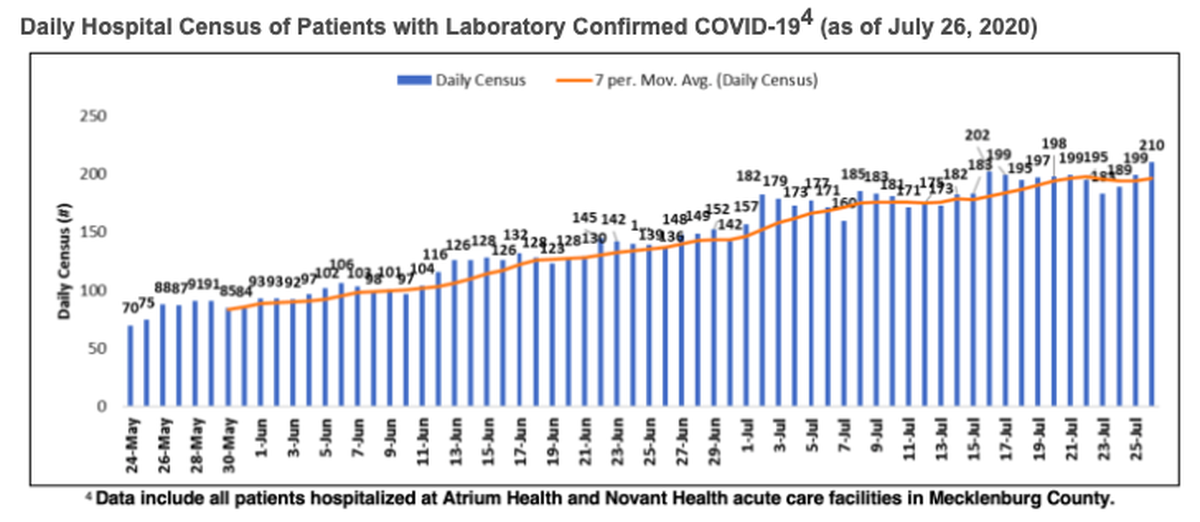
The good news from top doctors came as county commissioners have worried for weeks about the region’s ability to manage future COVID-19 outbreaks as case tallies rise and the infection rate stays elevated. Mecklenburg recorded a record high in countywide hospitalizations Saturday.
But Novant COVID-19 projections showed a peak — signifying the greatest strain on hospital resources to care for coronavirus patients — occurred on July 19, said Novant Health Chief Clinical Officer Sid Fletcher.
Novant recently has seen a plateau in hospital admissions, followed by a decrease, Novant infectious disease specialist David Priest said.
There is no need, for now, to erect a field hospital to accommodate a possible surge in cases, as healthcare providers have learned how to expand the availability of intensive-care beds amid the coronavirus pandemic, Fletcher said.
“We’re managing patient volumes really well,” Fletcher said, even as hospitals resumed elective procedures in early May.
Dr. Gary Little, Atrium Health’s chief medical officer, reminded commissioners that the COVID-19 pandemic remains a “fluid” situation. Residents must continue to follow public health guidelines, including wearing masks and social distancing, to mitigate the spread of the virus.
“Right now, we are in good shape,” Little said. “As long as people do the behavior that we’re asking of them, I think we’ll be fine.”
County commissioners have asked staff to provide a tighter enforcement plan surrounding mask wearing, as well as alcohol and food restrictions, during their Aug. 5 meeting. Commissioner Susan Harden, who introduced the proposal Tuesday, said officials need to act urgently before the start of the school year.
County Manager Dena Diorio said Mecklenburg is limited with its enforcement options — and that certain changes may lack support from the six towns and law enforcement partners.
But the greater Charlotte area as a whole is still seeing a rise in hospitalizations, the latest county data shows.
An average of 197 people were hospitalized in the past week, representing an increase of more than 50 patients compared to county data from the end of June.
County COVID-19 trends
Mecklenburg County Public Health Director Gibbie Harris said public and private gatherings — including those at churches, restaurants and bars — can spark new COVID-19 clusters in the community.
But Harris didn’t outline which businesses in Charlotte, beyond long-term care facilities and childcare centers, may already have become hotspots for the virus.
There have been 19,539 confirmed coronavirus cases and 195 related deaths among county residents as of Tuesday afternoon, Mecklenburg officials said. The majority of cases are among adults ages 20 to 59, with one in three cases seen in Hispanic residents.
“Our indicators are showing some signs of stabilization, and that’s a good thing,” Harris told county commissioners during their virtual meeting Tuesday afternoon. “But I want to remind us of our goal here, which is to continue to reduce the spread of COVID-19.”
Officials say another crucial coronavirus trend, the percent of people testing positive for COVID-19, saw a “slight decrease” in the past 14 days. The latest rate, 10.1%, is nearly double what state leaders are targeting to slow the spread of the virus.
But Harris said Mecklenburg is not using that same benchmark to lower its infection rate.
“I hesitate to put one number out there to shoot for at this point,” Harris said. “We don’t have a single number that we are trying to reach...The focus has to be managing what’s on our plate.”
County Commissioner Susan Rodriguez-McDowell said the health director’s response was troubling.
“I hope that we are being really proactive in what we are trying to reach,” Rodriguez-McDowell told Harris.
About 3,500 tests are administered in Mecklenburg daily through Atrium Health, Novant Health and CVS health, but turnaround times are now spanning more than five days, Harris said.
“We’re not where we need to be,” Harris said of testing volumes.
The county had intended to test about 12% of its residents by the end of July to gauge the scope of the virus. Yet Harris told county commissioners she was not sure if Mecklenburg was on track to reach that goal.
Late-night alcohol ban
Gov. Roy Cooper announced a ban on late-night alcohol sales Tuesday afternoon, days after Mecklenburg County put a similar ban into effect. The statewide ban will go into effect Friday, prohibiting restaurants from selling alcoholic drinks after 11 p.m.
Mecklenburg’s order only extends to unincorporated areas of the county, in the city of Charlotte and in the towns of Davidson, Matthews, Mint Hill and Pineville. Leaders in the towns of Cornelius and Huntersville had opted out of the restriction at the time, but those towns will fall under the statewide order.
On Tuesday, County Commissioner Trevor Fuller blasted Diorio for not seeking input from commissioners before announcing the emergency proclamation regarding the limit on alcohol sales. Diorio said the county’s policy team, which includes town managers from across Mecklenburg, helped draft the order.
“There seems to be no mechanism for accountability. I think we need to change that,” Fuller said. “We are falling short of the mark as a board, and we are falling short of the mark as a county.”
Charlotte-Mecklenburg Police Department visited at least 21 restaurants, bars and nightclubs over the weekend to enforce the county’s new late-night alcohol ban, according to an email County Manager Dena Diorio sent to commissioners Tuesday morning.
And Harris said it’s important for Mecklenburg residents to avoid large gatherings, and to continue social distancing and wearing masks, especially at public businesses like restaurants.
“People are incredibly interested in getting back to normal these days,” Harris said. “Normal is not what it was before COVID...That’s what people want to see, but unfortunately that’s not what we’re going to see for some time to come now.”
This story was originally published July 28, 2020 at 5:12 PM.