
Cooper says local leaders can open elementary schools for daily, in-person classes
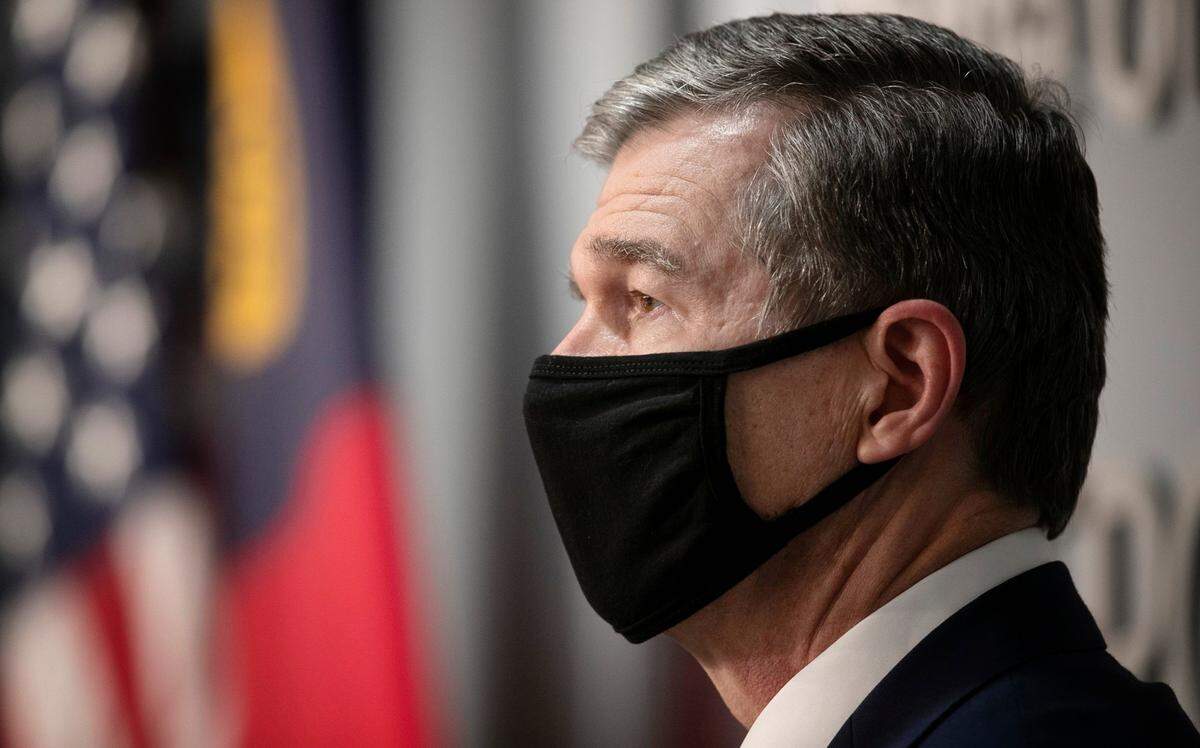
North Carolina Gov. Roy Cooper announced Thursday that school districts can reopen elementary schools for full-time, daily, in-person instruction starting Oct. 5.
Most of the state’s elementary school students are only getting online classes or a mix of in-person and online classes now because of the state social-distancing restrictions put in place to slow the spread of COVID-19. Many students haven’t had face-to-face classes since mid-March.
But Cooper announced that elementary schools can reopen under a “minimal social distancing” plan that allows all students to be on campus every day. Cooper, a Democrat, said at a news conference Thursday that the state’s coronavirus metrics have improved enough to ease restrictions on elementary schools.
“We’re able to open this option because most North Carolinians have doubled down on our safety and prevention measures and stabilized our numbers. The science of lower viral spread among younger children also backs up this decision,” Cooper said Thursday.
The announcement comes as a growing number of parents and Republican politicians have demanded that elementary schools offer daily in-person classes. Critics have argued that online classes are not helping young students.
Cooper said middle schools and high schools are still subject to his “moderate social distancing” requirements that limit how many people can be on campus. The capacity limits are a major reason why many school districts are still only offering online classes for the start of the school year.
It’s not immediately clear whether school districts will take the new reopening option for elementary schools or still say it’s not yet safe to have those children return for in-person classes.
Cooper’s announcement comes as Wake County, the state’s largest school district, has been looking at bringing some students back starting Oct. 26. But that target date was under the restrictions that are being dropped for elementary schools.
“We are reviewing the newest information from the governor’s office,” Lisa Luten, a Wake spokeswoman, said in a statement Thursday. “Our school board is tentatively scheduled to meet next week, and we expect this will be part of those discussions.”
NCAE criticizes reopening decision
The state’s largest teachers group was not happy with the decision. The North Carolina Association of Educators normally is a vocal supporter of Cooper.
“Local school districts already have significant flexibility to open for in-person instruction, and loosening guidelines further is flirting with danger,” NCAE president Tamika Walker Kelly said in a statement. “Maintaining a minimum six-foot social distance at all times is a critical safety measure for both educators and students, and we will not recommend for any educator to enter a non-distancing classroom without a properly fitted N-95 mask to protect their health, and the health of everyone around them.”
Cooper previously allowed school districts to reopen under the Plan B option, which has “moderate social distancing” restrictions that limit the number of students who can ride school buses and be on campus. But he also allowed districts to use Plan C, which is online classes only.
Younger children less at risk
Until now, Cooper had not let school districts open on Plan A, which has “minimal social distancing” and no capacity limits on campus. Elementary schools would still need to follow new rules such as requiring face coverings to be worn and having students and staff pass daily temperature checks and health screenings.
“This is a science and research-based decision, not an opinion,” Dr. Mandy Cohen, the state health and human services secretary, said Thursday.
Cohen said the state is only allowing districts to consider Plan A for kindergarten through fifth grade because there are more benefits to getting younger children back in the classroom and also lower risks from the virus.
“As we look at the risk, there also seems to be just a different way that the virus is interacting with our younger kids,” Cohen said. “They seem to get COVID less often, they get less severely sick and they transmit it less often.”
But Cooper and Cohen said they understand why some families won’t want to return for in-person classes at this time.
“Plan A may not be right at this time for many school districts, and for every family,” Cooper said. “Opportunities for remote learning need to be available for families who choose it.”
The majority of school districts opted to start the school year using Plan C, although some are beginning to transition to Plan B. But the Plan B capacity restrictions mean students would not get the five days a week of in-person classes allowed under Plan A.
School buses, Cohen added, pose both logistical challenges and the same questions about health protocols that schools do.
In addition to requiring masks on buses, state health officials are recommending that districts choosing to open in-person classrooms under Plan A reconsider how they run school buses to allow for fewer students and more social distancing.
The change for elementary schools comes after complaints from families that online learning isn’t working for young children. Working parents have also complained about paying hundreds of dollars per week to YMCAs and childcare centers because they can’t leave their children home alone during remote learning.
“Of all the disruptions COVID-19 has created, education is the most challenging to address,” Cooper said Thursday, adding that parents are being asked to perform a “nearly impossible balancing act.”
Cooper also said he will not hesitate to reverse course if the state’s COVID-19 metrics begin moving in the wrong direction. The governor said he is hopeful, though, that trends will continue to decline, allowing for more reopening.
GOP calls for school reopening
On Wednesday, Republicans put pressure on Cooper to give students in the state’s public K-12 school system the option of going back now to in-person, full-time learning.
Republican Senate leader Phil Berger called virtual learning “a slow-motion train wreck,” The N&O previously reported.
In an emailed statement Thursday, Berger said that Cooper’s announcement was “a step in the right direction.”
“His new plan ignores the needs of low-income and exceptional students in middle and high schools for in-person instruction. We continue to hear that these decisions are being made based on ‘science.’ What is the science that says it’s safe for fifth-graders to be in school full-time, but it’s not safe for sixth-graders?” Berger said.
“It’s puzzling to me how the governor can insist that only he can make decisions about smaller issues like playground openings, but then pass off political responsibility for something as important as schools. That’s not leadership — it’s avoiding the tough calls in an election year,” Berger said.
Cooper also got pressure Thursday about spectators at college football games.
Earlier Thursday, parents of N.C. State University football players delivered a petition to the governor’s office at the Administration Building asking him to adjust COVID-19 restrictions, The News & Observer previously reported. Under Phase 2.5, outdoor size gatherings are limited to 50 people. That’s not enough for parents of all players to watch the game.
Asked about it during the news conference, Cohen said the football spectators issue is something state officials will consider as trends improve.
According to data reported by the N.C. Department of Health and Human Services on Thursday, the 14-day trend for new COVID-19 cases is about 19% lower than in the two weeks before.
At the same time, the number of new cases has risen each of the past three days. Thursday’s 1,552 new cases was the highest since Sept. 5.
The World Health Organization recommends that states maintain a positive COVID-19 rate under 5% for two consecutive weeks before fully reopening. On Tuesday, the latest day for which data is available, North Carolina reported a 5.6% positivity rate.
“We’ve made progress, but as we keep talking about, that progress can be fragile,” Cohen said. “It takes intentional work to keep those trends moving in the right direction. It’s why we’re going to keep talking about masks, it’s why we’re going to keep talking about social distancing as we move through this.”
Staff writer Ben Sessoms contributed to this report.
This story was originally published September 17, 2020 at 2:41 PM with the headline "Cooper says local leaders can open elementary schools for daily, in-person classes."
.jpg)