North Carolina’s new COVID-19 cases are among the highest in the country, data show
North Carolina is reporting more coronavirus cases each day than it did during the first wave of the pandemic over the summer, pushing it into the top 10 states with the highest recent caseload, data show.
Backlogs in state databases can lead to misleading data dumps — such as when North Carolina health officials included the results of months of previously unreported antigen tests in the daily case count on Sept. 25, leading to a spike of more than 6,000 cases.
But health officials say that’s not what’s happening now.
“Our numbers are higher than we want them to be right now,” Gov. Roy Cooper said Thursday during a news conference. “There’s not one geographical area or industry to blame. I know we’re all tired of this. It’s frustrating to feel confined and to do the things we need to do to slow the spread of the virus.”
How North Carolina fits into the national picture
Data from The New York Times show North Carolina reported a total of 14,552 COVID-19 cases in the past week — the sixth highest in the country behind Texas, Illinois, California, Florida and Wisconsin as of Oct. 19
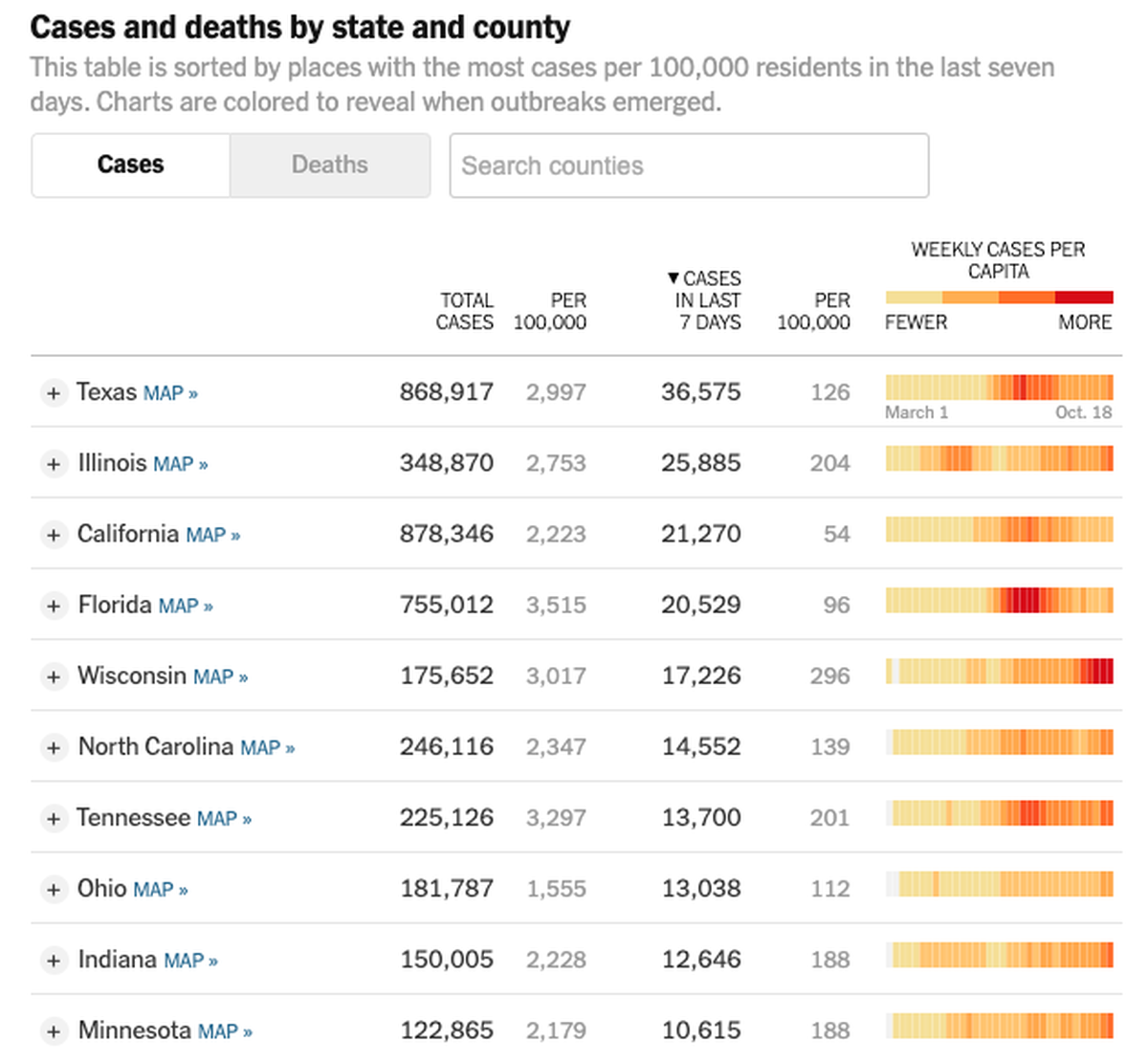
Daily case counts in the state climbed well past 2,000 on Oct. 15 and Oct. 16, setting a new record for the number of single-day cases since the pandemic began in March. The White House Coronavirus Task Force has also designated North Carolina in the “red zone,” meaning there were more than 100 new cases per 100,000 residents.
North Carolina is one of 26 states in the same predicament.
The number of new coronavirus cases nationwide jumped by 18% last week — a spike indicative of the U.S. entering the “third surge of the COVID-19 pandemic,” the COVID Tracking Project reported on Oct. 15.
According to an analysis of Johns Hopkins University data by USA Today, the country is on track to “set a weekly case count record within the first few days of November.” But if the rate of growth picks up, the newspaper reported that record could be set sooner.
“It’s from a relatively high watermark that we’re starting this third resurgence,” Caitlin Rivers, an epidemiologist at Johns Hopkins, told USA Today. “We’re seeing hot spots all around the country, and that really concerns me because it makes it more difficult to control.”
What’s driving the spike
North Carolina’s largest counties — such as Mecklenburg, Wake and Guilford — have reported the highest number of new cases in the last week. But that’s to be expected given their size and population density, and officials in Mecklenburg County have said the metrics are stable, The Charlotte Observer reported.
Data show rural areas, where the virus was slower to reach, are now being hit hardest.
According to New York Times data showing the number of new cases per 100,000 people over the last seven days — a metric better suited to comparing areas with varying population sizes — Avery, Hyde, Green, Edgecombe and Swain counties in North Carolina have had the largest proportionate increase.
The White House Coronavirus Task Force report found “though more rural areas of the state were spared early in the pandemic, community mitigation efforts in these counties need to intensify,” reported ABC11, The News & Observer’s media partner.
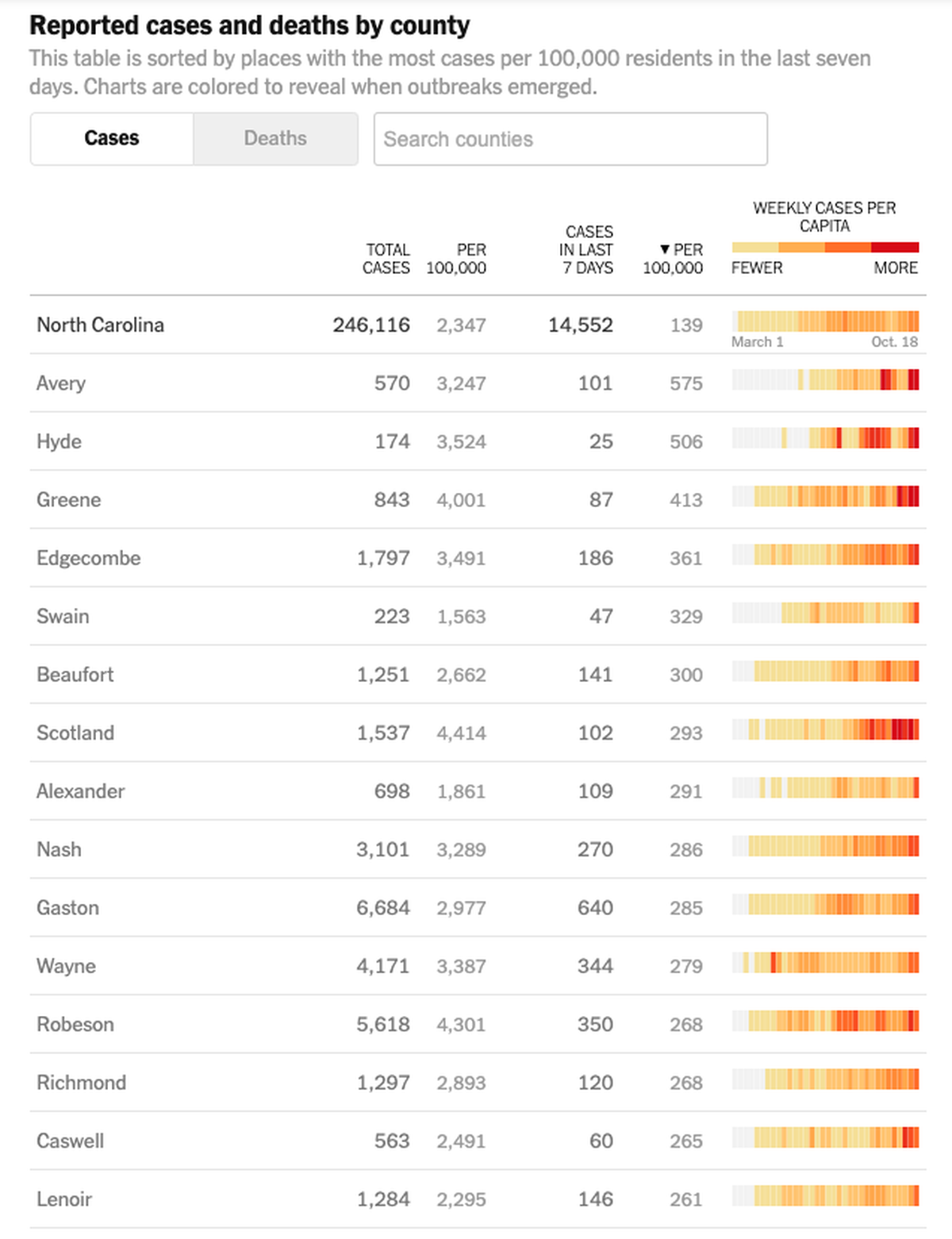
Death rates and hospitalizations have also increased in those areas.
In Gaston County — which had the 10th highest number of new COVID-19 cases per 100,000 people over the last seven days, according to The Times — hospitalizations have ticked upwards.
CaroMont Health spokeswoman Meghan Berney told The Charlotte Observer the number of people hospitalized with confirmed or suspected cases of COVID-19 climbed from 15 to 65 last month. The caseloads in nearby Lincoln and Cleveland counties have also jumped by more than 200% in the last month, the Observer reported.
Stanly County, about 40 minutes east of Charlotte, had a death rate from COVID-19 that was almost three times higher than Mecklenburg’s in September, according to an analysis of North Carolina’s coronavirus data by the Observer.
The same held true for most of the state’s 80 rural counties, where “about 33 of every 100,000 residents had died from COVID-19 as of Sept. 9,” the Observer reported.
The death rate per 100,000 in suburban and urban counties was 26 and 24, respectively.
“I hope people don’t assume this is just an urban problem,” state epidemiologist Zack Moore told the Observer. “This is something affecting all parts of the state. And rural areas are in no way immune to this problem.”
Impact on North Carolina’s tribal communities
Case counts have similarly increased on tribal lands and in communities largely comprised of Native Americans where access to quality health care has been historically limited.
Swain, Jackson and Clay counties in Western North Carolina are home to the Eastern Band of Cherokee Indians — the only N.C. tribe officially recognized by the federal government. They had between 27 and 47 new COVID-19 cases per 100,000 people over the last week, The Times’ data show.
Scotland, Robeson and Hoke counties in central North Carolina, where the Lumbee are concentrated, had between 25 and 42 cases, and Caswell — home to the Occaneechi — had 38.
For comparison, Mecklenburg and Wake counties had 17 and 8.9 new coronavirus cases, respectively, per 100,000 people over the same time frame, according to The Times.
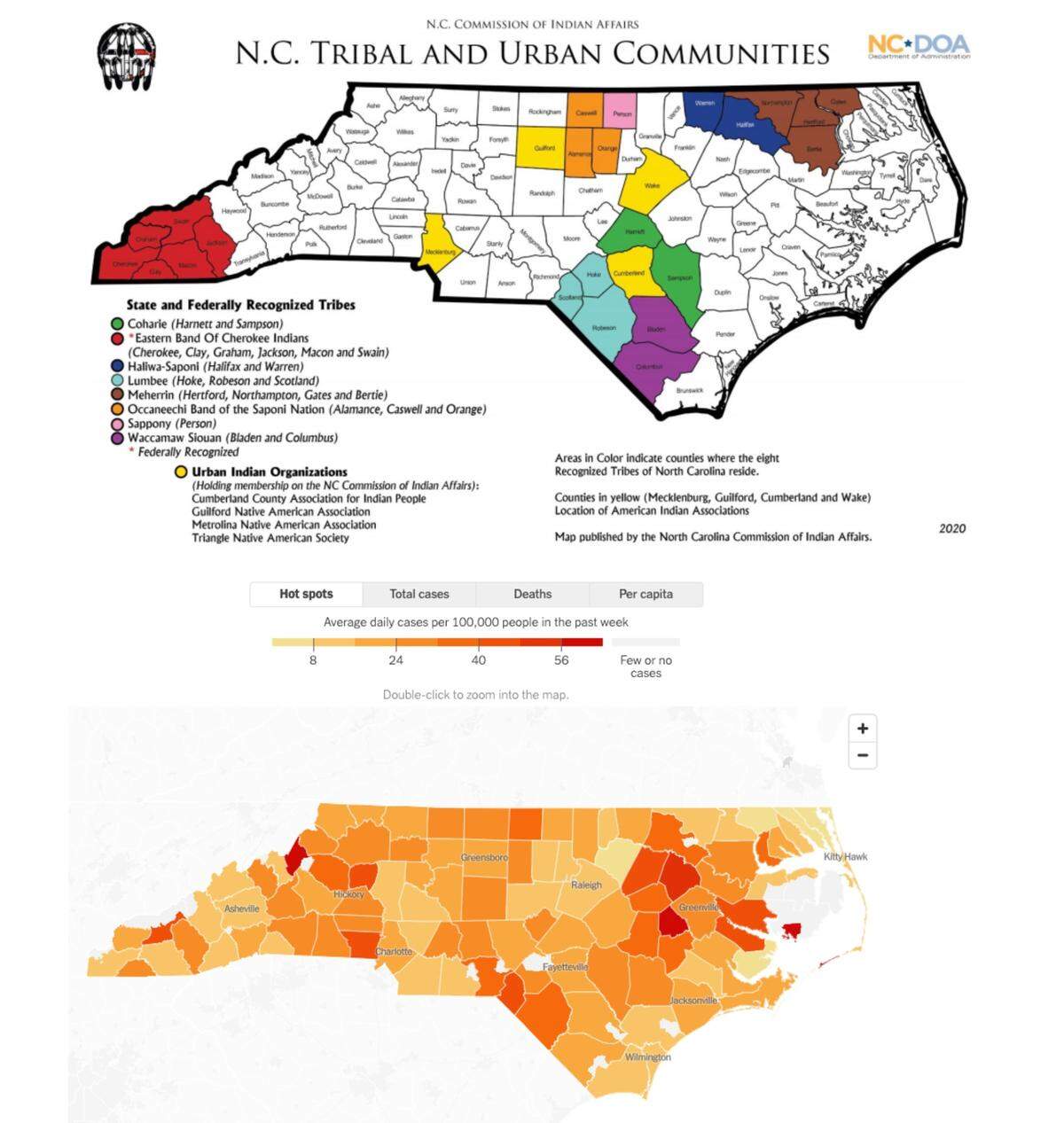
The U.S. Centers for Disease Control and Prevention released the first data in August detailing COVID-19’s impact on American Indians or Alaska Natives, which found they were 3.5 times more likely to contract the virus than white people, NPR reported.
Sarah Hatcher, one of the researchers on the CDC study, told the news outlet there’s a notable reason for that.
“This disproportionate impact is likely driven by persisting social and economic inequity, not because of some biological or genetic difference,” she said.
This story was originally published October 19, 2020 at 3:33 PM.