NC’s Latino COVID-19 vaccination rate is still low. Here’s who’s trying to fix it.
When local Latino activists knocked on Lidio Membreño’s door on a sunny March afternoon in a west Durham trailer park, he was surprised to learn that he was eligible to be vaccinated for COVID-19.
That’s because it was the first time that anyone had told him anything substantial about the vaccine in Spanish and how he and his family could receive it.
”I do think the vaccine is good and that it’s for the good of all,” he said in Spanish. But, he said, no one had ever given him any information on the vaccine, much less in his native language, so he didn’t know much about it.
Across North Carolina, Latinos haven’t received the same vaccine education in their community as other people have — even though they are often front-line essential workers — and the numbers reflect it. Of the 1.96 million people who have received at least one shot of a COVID-19 vaccine in NC, just 3.8% identify as Hispanic or Latino, while 9.8% of the state’s population identifies as Hispanic, according to state data released recently.
In addition to the language barrier, experts told The News & Observer that factors such as lack of trust in governmental institutions, lack of information about how to sign up for a shot and the same lack of access to medical care that played a factor in the pandemic’s disparate impact on Latinos all make it more difficult for them to find the vaccine.
Dr. Edith Nieves Lopez, a Durham pediatrician, has helped recruit Hispanic people for vaccine events around Durham. Many people who are seeking the shot don’t have an email address or an electronic medical record, Nieves Lopez said, and it is frustrating to be put on hold while the person on the other end of the line finds a translator or a person who speaks Spanish.
And in particular, when Latinos who are immigrants are making appointments, Nieves Lopez said, “They want to get vaccinated, but they want to get vaccinated in places there’s trust that’s been established.”
In February a group of Durham-based organizations hosted a vaccination event at the Latino Community Credit Union. To find people eligible for the shot, the credit union’s employees helped by calling customers who are at least 65 years old.
Yazmin Garcia Rico, the N.C. Department of Health and Human Service’s director of Latinx and Hispanic policy and strategy, said that while it is important to work to overcome language barriers and build trust in the vaccine, she is hopeful that front-line essential workers becoming eligible in Group 3 and essential workers in Group 4 will help increase the proportion.
“The Latinx community is relatively young, and so since we started Group 3 is when I was anticipating that the numbers would start increasing, based on knowing that a lot of the people in the Latino community are front-line essential workers,” Garcia Rico told The N&O.
Vaccination information is private and confidential, Garcia Rico said, and will not be shared with immigration authorities for any reason. Those who receive the shot will not be required to produce identification, and the vaccine is free.
The proportion of Hispanic people receiving the vaccine has steadily increased in recent weeks, rising from 5% the week of March 1 to 9% the week of March 8 to 10% so far this week.
Latino community challenges
In a survey done by advocacy group Siembra NC, organizer Reyna Gutiérrez told The N&O she personally asked 16 people outside of a Latino grocery store about the vaccine. None knew details on how to get vaccinated and many thought they would be charged for doing so, she said.
Of 836 Hispanic people surveyed, 64% said they’re interested in getting vaccinated but 73% said they don’t know how to sign up to be vaccinated. Another key finding of the Siembra survey was that 52% of respondents wanted to make their vaccine appointment over the phone, while only 19% preferred the internet.
Kelly Morales, Siembra NC’s executive director, said part of that finding was due to older people who are more comfortable with the phone being the first to become eligible.
“There’s also a reality around just the ease of being able to call on your break versus having to navigate trying to find a link and trying to figure out what it says in English,” Morales said. “I think there’s a convenience in being able to pick up the phone.”
Siembra recommends that DHHS fund Spanish-language scheduling in every county. A DHHS spokeswoman said funding allocated to local health departments can be used to pay for translation, while statewide contracts for COVID-19 staffing also include access to people who speak Spanish or translators.
Many Latinos are immigrants who speak little to no English and are wary of the government officials often involved in the vaccination effort. They’re uncomfortable with or unable to travel to large sites like the mass vaccination clinic in Greensboro.
La Semilla, a Hispanic Methodist church and activist group based in Durham, sends staff to the Greensboro clinic to offer a sense of familiarity, said Rev. Edgar Vergara Millán, the church’s pastor.
“It’s quite a thing — seeing the place full of soldiers and the place full of people wearing government-issued attire might seem intimidating for some members of the immigrant community, right? So it helps having community members there to welcome them and give them the support they need,” he said.
Garcia Rico is hopeful that the vaccine coming to the state through the Greensboro site will provide a boost in other ways. For instance, Alamance County has been selected as a “spoke site” of that hub, offering enough vaccine for 7,200 people starting this week and focusing specifically on the area’s Hispanic community
“We have high goals of making sure the vaccines go to historically marginalized populations, but specifically to the Latinx community,” Garcia Rico said.
Trusted information
Other Latino-focused vaccine events have been held at churches throughout the area, with some of those hosted by La Semilla. To promote its vaccination events, La Semilla uses social media, but its team of 24 community health workers also visits local stores frequented by Hispanic people to find those who may be missed on social media.
“It’s not that the vaccine is not promoted or that the information is not made available by the county or state agencies or the health systems, but the challenge is to get that information to the people in a way that is well received,” said Vergara Millán.
State officials and community organizations alike see those community health workers as an important part of the effort. Across the state, 429 people are being paid as community health workers in 55 counties the state selected due to high rates of COVID-19.
“A lot of communities might not have that trust in the health care system,” Garcia Rico said, “and so partnering with community-based organizations and churches that already have that trust and relationship and meeting communities where they are is key to making sure that we are addressing equity.”
Siembra NC activists going door-to-door in Latino neighborhoods directly share vaccine information as part of a multi-county grassroots education campaign.
In-person engagement in Spanish is how Siembra is seeking to educate people and dispel myths and misinformation, and it’s what often works best for the community, said Gutiérrez, a Siembra organizer.
“In Spanish we have the saying, ‘Why should I look for three legs on a cat when I know it has two?’ as in, ‘If I’m not sick, I don’t need to get vaccinated,’” Gutiérrez said in Spanish. “What I’ve been hearing is that the community still doesn’t have much confidence because they aren’t seeing many Latinos getting vaccinated and they’re following the example.”
Making sign-ups easier
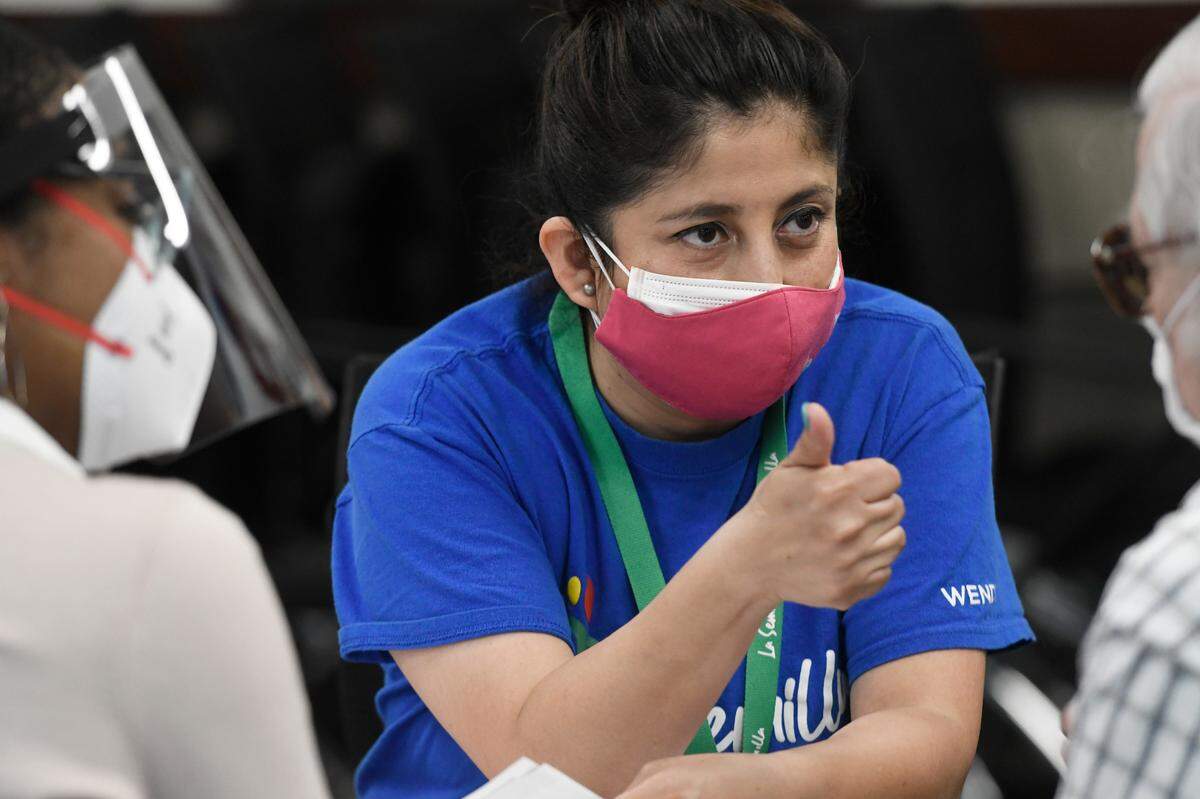
Wendy Tenorio is one of La Semilla’s community health workers. On Saturday, she wore two masks while working inside a vaccine clinic in Garner, providing translation for those receiving their second dose of the Pfizer vaccine.
Tenorio recalled being hesitant to get the vaccine initially, but deciding she had to because having asthma made the risk of contracting COVID-19 too high.
“And after getting my second dose and everything, I feel better,” Tenorio said. “I feel more secure that I can be more helpful to the community.”
That means going into Hispanic grocery stores and small businesses to help answer people’s lingering questions about the vaccines and navigate an often-complex sign-up process.
“The system that is used sometimes is very confusing for the community, so getting another person to help them ... is easier, is faster,” Tenorio said.
Victor Jiménez received his second shot at Saturday’s event. He had asked about the COVID-19 vaccine every time he went to Walmart to pick up his blood pressure medicine. Each time, the answer was the same: Not yet.
“Ever since this illness began spreading I wanted to get a vaccination, but it wasn’t available,” Jimenez said in Spanish through a translator.
Then, seemingly out of the blue, someone called Jimenez to offer him a shot at La Semilla’s first clinic in Garner. It wasn’t until shortly before the second clinic that Jiménez heard a Spanish-language advertisement about the vaccine, on the radio.
Without that phone call, Jiménez said, “Perhaps I would have found one, perhaps not.”
This story was originally published March 17, 2021 at 3:18 PM with the headline "NC’s Latino COVID-19 vaccination rate is still low. Here’s who’s trying to fix it.."