
All grass seed is not the same. Read fine print and watch out for these troublemakers
.jpg "Take precautions when overseeding this autumn. That bag of seed you’re purchasing may be filled with “other” grasses that can overtake those that grow well here in the Kansas City area.")
It’s about time for fall planting of cool season bluegrass and tall fescue grasses. Overseeding requires many steps, but one of the most important is choosing a quality seed.
All grass seed is not the same. If you don’t know what to look for, you may be introducing unwanted intruders into your lawn. You should be concerned with seed contaminated with orchard grass and/or rough bluegrass (Latin name, Poa trivialis, or Poa triv for short).
Both are perennial grassy weeds that cannot be selectively controlled once they are established in a lawn.
Orchard grass is a problem because it grows faster than fescue and bluegrass, is lighter green and unsightly. Rough bluegrass is fine-textured and forms circular patches. It blends in until summertime heat causes it to rapidly turn brown. If the rough bluegrass died in the heat, it would only be a temporary problem. Unfortunately, it only goes dormant and turns green again with cooler temperatures and rain.
Buying quality seed starts by deciphering the seed label. One of the most important things to look for is listed as “% other crop.” Other crop refers to any species that is intentionally grown for some purpose. That would include turf-grasses other than the one you are buying. Orchard grass and rough bluegrass both are listed as other crop seed.
Seed labels are required by law to show the percentage (by weight) of other crop in the bag. Unless a species constitutes 5% or more, the label doesn’t have to list the species. How much other crop is too much? It depends on what the other crop is, and your expectations.
Other crop may refer to something relatively harmless, like a small amount of perennial ryegrass in a bag of tall fescue. Or it may refer to something bad, like rough bluegrass or orchard grass.
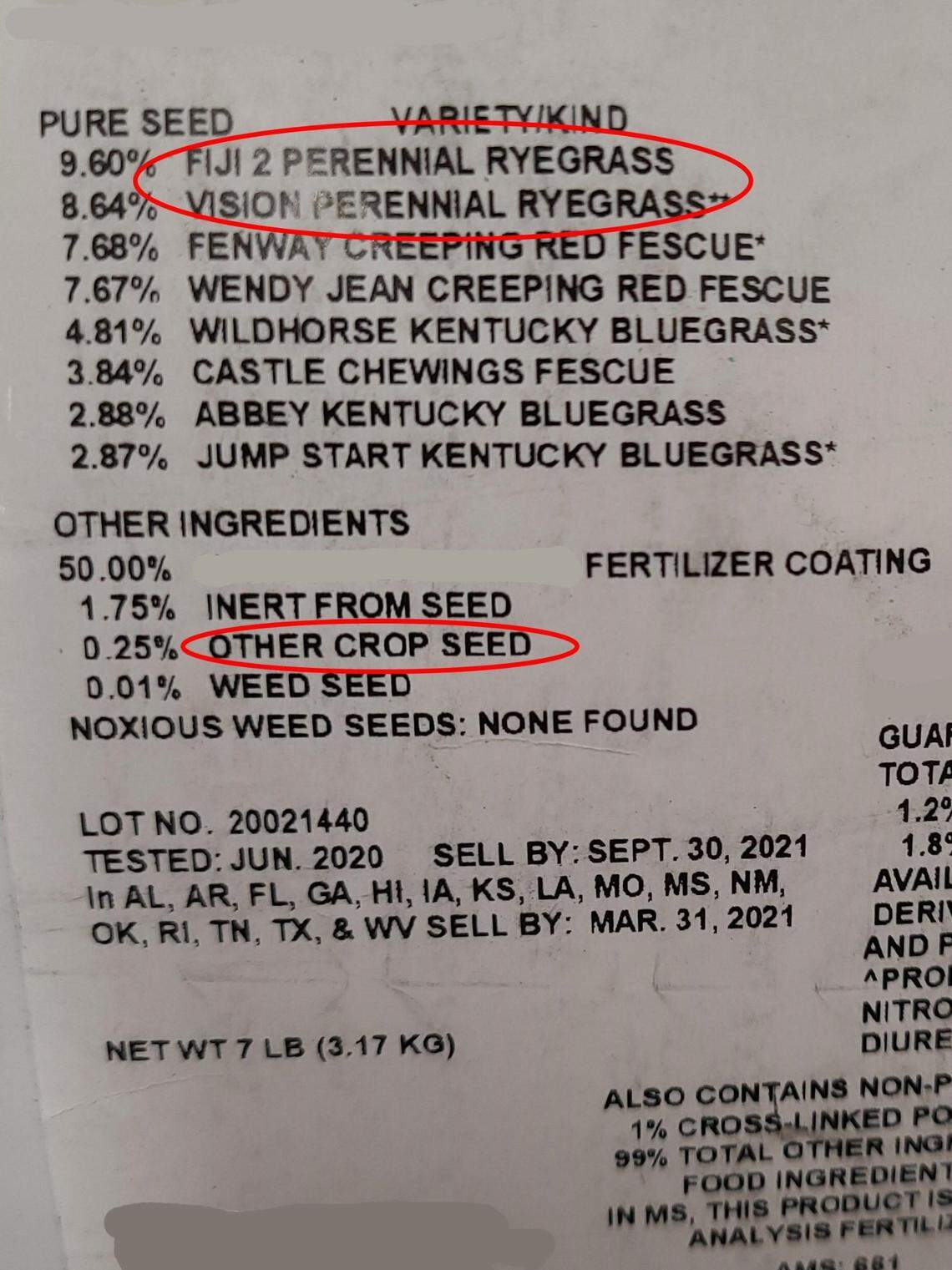
A homeowner has no easy way of knowing what the other crop is. If it is something bad, less than one-half of 1% can ruin a bag of seed. For example, if a bag of tall fescue seed contained 0.5% orchard grass, the buyer would end up planting 12 to 16 orchard grass seeds per square foot.
Similarly, planting Kentucky bluegrass seed containing 0.5% rough bluegrass would result in about 25 to 35 rough bluegrass seeds per square foot of lawn. If your quality expectations are high, you want the other crop to be as close to zero as possible. Good quality seed often has 0.01% other crop or less.
Check the label carefully for inexpensive mixes laced with other turf species. Many times, bluegrass or tall fescue will have perennial rye in the bag. Rye germinates quickly but dies out under harsh summers. If you are buying bluegrass, buy all bluegrass; there is no need for filler seeds. The same is true for tall fescue. Buy tall fescue seed only, not rye grass or some other fluff.
When it comes to grass seed, you get what you pay for, so buyer beware. Read the label and always purchase from a reputable garden center. One last tip: Avoid most bagged seed mixes sold for a regional or national market, as often they don’t withstand our Kansas City climate.
Dennis Patton is a horticulture agent with Kansas State University Research and Extension. Have a question for him or other university extension experts? Email them to garden.help@jocogov.org.
This story was originally published August 19, 2022 at 6:00 AM with the headline "All grass seed is not the same. Read fine print and watch out for these troublemakers."