
Gulf Fritillary butterflies are a sure sign of fall in the Lowcountry
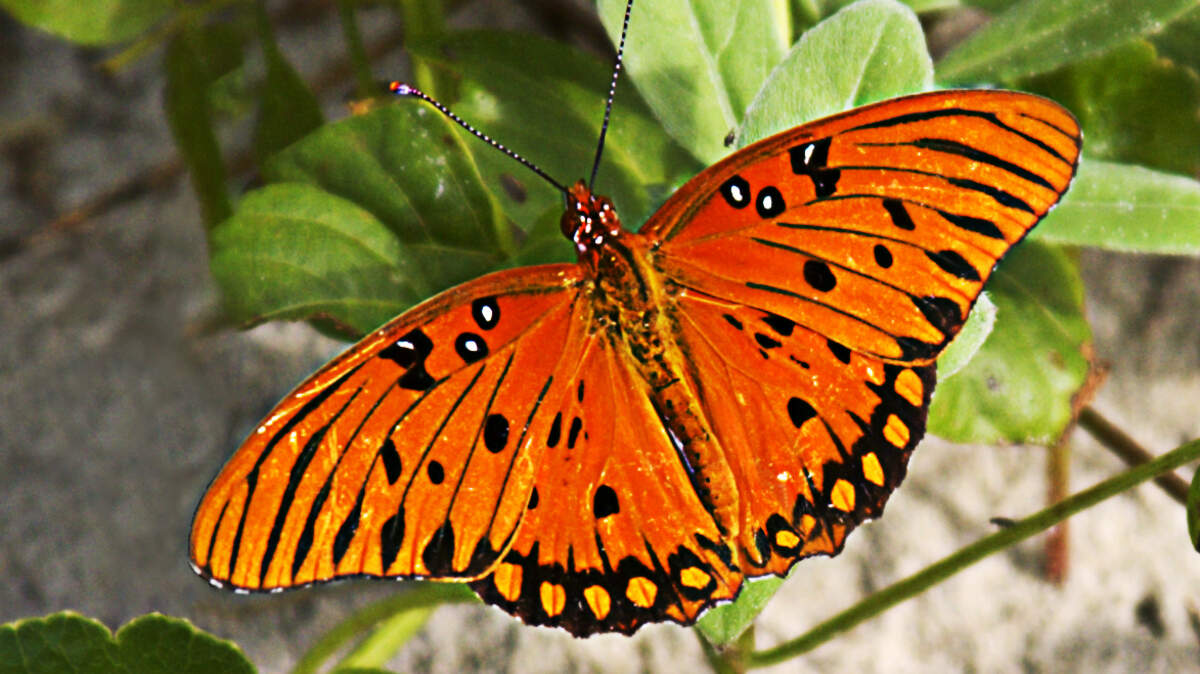
Fall is the season of Gulf Fritillaries in the Lowcountry.
These medium-sized orange butterflies are often confused with Monarchs (Danaus plexippus), but it’s fairly easy to tell the difference.
Monarchs have prominent black “veins” on their wings, and the wing edges are black with numerous white spots.
By contrast, Gulf Fritillaries (Agraulus vanillae) are somewhat smaller, with black spots and streaks on the upper wing surfaces and three black-rimmed white spots on each forewing. The undersides of the wings are brownish with large, silvery patches.
Gulf Fritillaries seem almost everywhere right now, cruising over lawns, golf courses, fields and roadsides. They’re common visitors at gardens, sipping nectar from lantana, asters, zinnias, pentas, verbenas and other flowers.
Males are also attracted to patches of wet sand or soil. If you look closely, you can see them extending their strawlike mouthparts into these substrates to suck up liquids. This “mud-puddling” behavior provides sodium, amino acids and other nutrients that are otherwise lacking in their sugar-rich, nectar diet.
During mating, males transfer these supplements to females, which in turn benefit by increased egg production.
During the caterpillar stage, Gulf Fritillaries feed on passionflower vines, including maypop (Passiflora incarnata), a native species common in the Southeast. A single, sprawling vine may be covered with dozens of the spiny, orange caterpillars chomping away on all parts of the plant.
Although maypop and other passionflowers contain bitter-tasting alkaloids, Gulf Fritillary caterpillars tolerate these toxins and even sequester them in their bodies. As a result, they’re unpalatable to many predators — a protection that persists through adulthood.
It doesn’t take long for a dozen or more fritillary caterpillars to defoliate a passionflower vine. The plant does eventually sprout new leaves, however. And once fully grown, each larva forms a pupal case (chrysalis) that looks remarkably like a withered brown leaf. Within this camouflaged container, and over some five to 10 days, the caterpillar morphs into an adult.
Butterfly pairing-up and mating often occur near the larval food plant. Male Gulf Fritillaries attract potential mates by perching, flicking their wings open and closed, and releasing pheromones. These volatile chemicals are picked up by the females’ antennae.
After mating, females lay yellow, ribbed eggs singly on the plant’s tendrils or leaves. Once hatched, the caterpillars spend two or three weeks feeding before they enter the pupal stage.
Gulf Fritillaries can persist here well into late fall, and sometimes you’ll see a few butterflies (often with tattered wings) fluttering around weakly on mild winter days. However, they can’t survive freezing temperatures. Once the weather starts to cool, most eventually migrate from the Lowcountry to overwinter in southern Florida.
This story was originally published October 4, 2022 at 10:28 AM with the headline "Gulf Fritillary butterflies are a sure sign of fall in the Lowcountry."