
Homeless man in shed illustrates Charlotte’s toughest cases
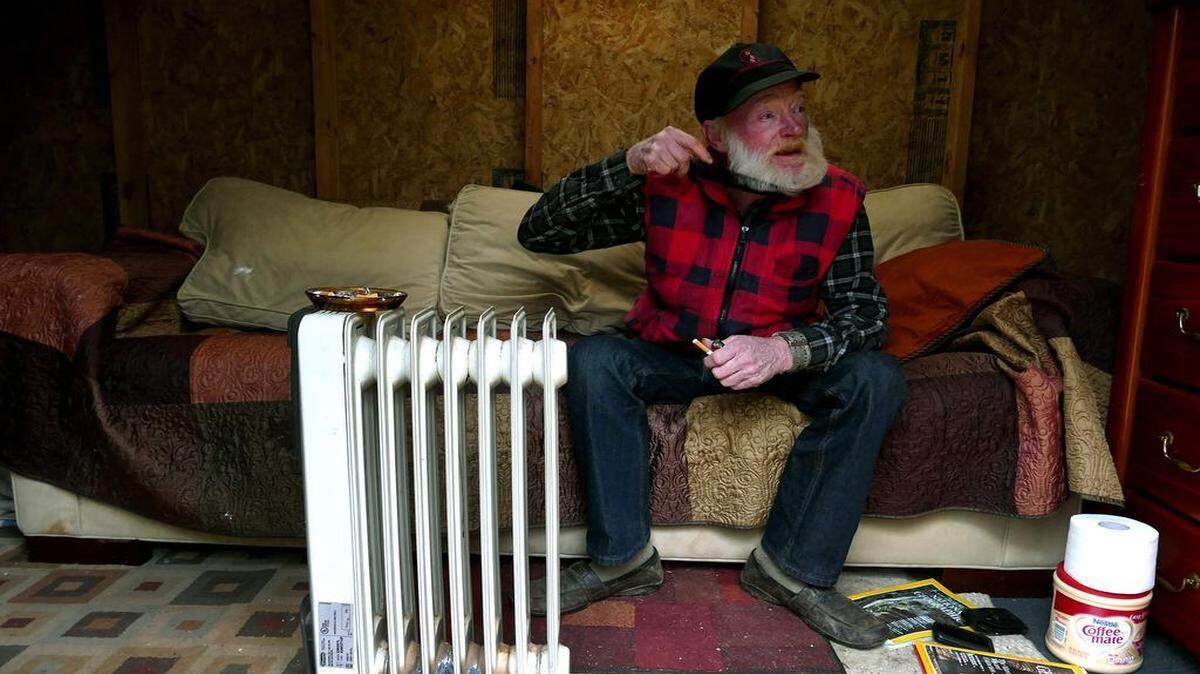
Ronnie “Dancing Bear” Pierce has emphysema and a bad back, so he seldom strays from the east Charlotte yard where he lives in a kind woman’s toolshed.
Yet Pierce, 63, represents a problem for community leaders who have vowed to end chronic homelessness in Mecklenburg County by the end of 2016.
Their $11 million housing solution doesn’t work for men like Pierce.
He’s one of Charlotte’s so-called chronic inebriates – a small but notorious group of homeless men and women who’ve been kicked out of multiple housing programs because of their alcohol-related antics.
Pierce has been booted from not one, but two such charity programs, including the extremely accommodating Moore Place, an 85-apartment community that lets formerly homeless people continue to drink alcohol in the privacy of their rooms.
About 5 percent of Mecklenburg County’s chronically homeless population is like Pierce: Disruptive middle-aged men with lifelong addictions and histories of exiting treatment programs with no success. They cost taxpayers hundreds of thousands of dollars annually, because of petty crimes and drunken accidents that result in jail time or hospital visits.
“I drank and I screwed up,” says Pierce, admitting he was disruptive at Moore Place. “I got up at 3 in the morning and was banging on doors, screaming and carrying on in the halls. I was trying to wake everybody up, ’cause I couldn’t get any sleep myself.”
Chronic inebriates have few alternatives, which is how Pierce ended up living in someone’s shed in the Merry Oaks subdivision.
But now some cities are turning to a controversial option known as wet shelters or chronic inebriate housing.
Wet shelters are apartment communities where everything is unbreakable and alcoholics can drink in designated gathering places, not unlike open-air bars. There is no requirement to enter rehab, get treatment or submit to counseling.
It’s the opposite tack of Charlotte’s other homeless programs, but advocates say wet housing is about preventing accidental injuries and deaths. The approach is similar to needle-exchange programs used to reduce disease among IV drug users.
Two of the five chronic inebriates who were removed from Moore Place in the past three years have turned up dead; the most recent was a man found last summer in the woods. He fell while intoxicated and struck his head, officials said.
A wet shelter has not been proposed for Charlotte, but at least some supporters are lining up.
So are critics.
“It’s not saving a life,” said Alice Harrison of Hope Haven, a program for recovering homeless addicts and alcoholics. “It’s just helping them die more comfortably from a chronic, progressive disease.”
Hobo luxury
Pierce got kicked out of Moore Place in 2013, and he says he left with the intention of spending his final years drunk on vodka, living in the woods.
An alternative came at the suggestion of Sheila Robinson, 60, a Wells Fargo employee and widow who has lived 22 years in the Merry Oaks community.
Robinson knew of Pierce’s troubled times at Moore Place and agreed to let him stay temporarily in an 8-by-12 shed behind her home.
It has since become permanent, as Pierce has added a couch, nightstand, carpeting, cable TV, a VCR and a hot plate for cooking Chef Boyardee. He cut two windows into the walls, put on new shingles and has a heater for cold mornings.
When the weather turns extreme, Robinson lets him sleep on a couch in the house. He also showers and uses the restroom in the house, and he gets a share of the meals Robinson cooks for her 83-year-old mother, Patricia Dew, who is recovering from multiple strokes. Dew was in on the decision to take in Pierce from the start.
Pierce accompanies the two women to church most Sundays and to 5 a.m. prayer services on Fridays, but he’s not always sober. At least three times, he has danced down the aisle, smelling of alcohol, Robinson said.
In return for their kindness, Pierce gives Robinson some of his Social Security money to cover food and utilities, and he does all the yard work. He also tends a pack of 10 feral cats that Robinson insists on feeding, one of which has only three legs and goes by the name Kitty Kitty.
This arrangement has not been without its struggles.
Pierce still drinks to extremes, which means he occasionally passes out in the yard or in flower beds. Sometimes he builds campfires in the wee hours and stands in the yard, staring at the moon. And Robinson recalls once being awakened at 3 a.m. by police, a fire engine and an ambulance in her driveway.
“They got a 911 call from my address, and I was standing there in my nightgown, trying to convince them it wasn’t me,” said Robinson, who calls Pierce by the nickname Bear. “It was only after they asked me if someone else lived on the property that I realized it might have been Bear. I sent them around to the backyard.”
Yes, Pierce had called them. And yes, he was wildly drunk. So drunk that he accused a paramedic of trying to strangle him in the ambulance on the way to the hospital.
“He is not permitted in the house when he’s drinking like that,” Robinson said. “I tell him: ‘You get back there to your building or I’ll call the police on you.’ He always leaves. We’ve never had a problem out of him.”
Robinson and Pierce are trying to raise enough money to add insulation to the shed, to keep out the winter cold.
He likens his shed to a log cabin, which he says is not so different from the home where he lived as a boy outside of Danville, Va. It had no indoor plumbing, either.
A troubled life
Pierce guesses he’s been homeless nearly 40 years, if you include the nine years he spent in prison for burglarizing the home of a neighbor who was both his boss and his parents’ landlord.
It was at age 15 that he began smoking and drinking alcohol, and at 17 he dropped out of the 10th grade.
Pierce says he was raised on a tobacco farm, which is why he prefers the woods behind Robinson’s home rather than the fancy buildings used by the city’s shelter programs.
His alcoholic father was so physically abusive that Pierce says he and his brother considered killing the man more than once. “Once, my older brother got my dad’s gun and tried to kill him, but wasn’t strong enough to pull the trigger. He was just 10. I’d have done it, but I was 8 and I couldn’t pull the trigger either.”
Pierce says both his parents are dead now, along with his older brother. He has an ex-wife, whom he married at age 22, and the couple had two kids whom he hasn’t seen in years.
He says that 19 years ago, he came to Charlotte from Caswell County looking for work. Things didn’t pan out, so he has spent most of his time here living in motels, homeless housing programs or the woods.
Like many of Charlotte’s chronically homeless, Pierce has a long history of being arrested, and he says he has been hospitalized more than once after being beaten and robbed by other homeless people.
Records show he has been charged with 89 crimes, 39 of which resulted in convictions for violations such as breaking and entering, trespassing, public intoxication, panhandling, violating open container laws, resisting arrest and larceny. None of those arrests occurred while he was at Moore Place, from Feb. 14, 2012, to Sept. 27, 2013.
Robinson says she’s aware of Pierce’s criminal record.
He went to detox after moving into her shed, she says, but it didn’t help. He uses much of his Social Security check to buy beer and cigarettes, and he panhandles when that runs out.
She’s trying to convince him to sober up and even made arrangements for him to be baptized at her church, the Charlotte Immanuel Church of All Nations near uptown. She hopes his baptism will happen this summer.
Drinking eventually will kill him, Robinson believes, but at least he’ll die someplace other than the streets. Pierce has emphysema, scoliosis and other physical ailments that have whittled him to 105 pounds. He still smokes two cartons a week.
“I don’t believe I’ll be going to heaven when I die,” Pierce says. “God has given me too many chances already. I think he’s given up on me for repeating my sins.”
An inspiring pair
Moore Place says it removed Pierce only after trying multiple strategies to curb his drinking, including awarding him certificates for every day he was sober.
Caroline Chambre-Hammock, head of Moore Place, says Pierce was one of the first people to move into the apartment project when it opened in 2012.
She’s aware of Pierce’s new housing and believes Robinson’s requirement that he do yard work has added badly needed structure and purpose to his life.
“I was shocked at first, but it almost makes sense,” Chambre-Hammock said. “Sheila knows his good, bad and ugly sides. She also knew not to be afraid of him, based on the false idea that the homeless are violent.”
Chambre-Hammock said she finds the pair’s 15-year friendship inspiring.
“She’s an African-American woman, educated and works a 9-to-5 job in the corporate sector. He’s an older white male with limited education, who grew up impoverished,” she said. “Their friendship seems to erase lines between race, class and gender in a way that is powerful.”
Pierce and Robinson first met when she was attending church at Community Outreach Christian Ministries, which was then working with the Harvest Center to house up to 20 homeless people. Pierce was in that housing program, but he was kicked out five times because of his drinking, she says.
“There is something about Bear, an almost childlike innocence that makes you want to help him,” she says. “That innocence got him taken advantage of a lot on the streets.”
Robinson’s friends say she has a reputation for bold acts of kindness, but many were surprised to learn she was allowing a homeless man to live on her property.
“I think maybe Sheila helps people to a fault, but that’s how God made her,” said Deborah Brewer, who has been a friend to Robinson for 30 years.
“I wonder about safety any time you are dealing with people who are homeless and may have mental health concerns, but she made a decision that it was safe, and I have to trust her. I’ve known Bear about 15 years, both drunk and sober, and that’s two different people.”
Robinson concedes it would be easier on Pierce if she let him stay in a spare room, but she says she is too old-fashioned to have a man as a roommate. Plus, she says Pierce would probably drive her crazy.
Police have escorted him home twice in the past year, after he was found dancing or lying in the middle of road.
Patricia Dew, Robinson’s mother, says he dances just about everywhere when he’s drinking, hoping to draw an audience of admirers. He jabbers a lot, too.
“And it goes on and on. And then he forgets what he said and starts over. He torments me with his mouth,” Dew says. “And if I tell him to get back down the hill to his shed, I’ll see him out the window, still talking. He says he’s talking to God.”
Robinson says most of the neighbors ignore Pierce, but one man across the street recently complained to her that Pierce knocked on the door in the middle of the night, asking for money. “I told him to call the police the next time it happens,” she says.
Friends like Brewer believe what Robinson is doing is an act of heroism: Saving a man’s life.
And Pierce is not the first homeless person she has taken in. Robinson says she once sheltered a homeless vet for a few days, and later invited a young couple to stay with her, after she found them living in a park.
Pierce’s situation is more complicated, but his story of addiction is similar to that of someone Robinson loved dearly, but prefers not to speak of. This man from her past was addicted to crack, and she says she gave him countless ultimatums to quit, none of which were heeded. The addiction ended their relationship.
Robinson says she learned a painful but important lesson about unconditional love.
That man died of a heart attack at 53, but he was sober his last four years. And that makes Robinson hopeful for Pierce.
“It doesn’t feel to me like I’m being heroic,” she says of her arrangement with Pierce. Pressed to explain, Robinson uses a quote from author James Baldwin’s 1954 play “The Amen Corner.”
“To love the Lord is to love all his children – all of them, everyone – and suffer with them and rejoice with them and never count the cost.”
An alternative
Moore Place, which is expanding to 120 units, doesn’t count as a wet shelter for a number of reasons, including the fact that it’s not just for homeless alcoholics.
It was built as permanent supportive housing for the chronically homeless, a tough-to-help segment of the homeless population that suffers from mental or physical disabilities, as well as addictions. As a result, they stay homeless for years. Most are in fragile health and spend a lot of time in emergency rooms, hospitals and jails at taxpayer expense.
Experts estimate 15 percent to 20 percent of the chronically homeless don’t work out in housing programs like Moore Place.
Community leaders unveiled a plan in January to end chronic homelessness in Mecklenburg County by the end of 2016. A key part of the plan is to build another facility like Moore Place, with 100 apartments.
In January, a survey found 516 chronically homeless people living in the county, which means there could be two dozen or more men like Pierce who’ll stymie the community’s effort to house everyone.
Chambre-Hammock’s dream is for Charlotte to have a wet shelter like St. Anthony’s Residence in St. Paul, Minn. Built in 2007 with public money, St. Anthony’s has 60 beds for chronically homeless men who have failed rehab treatment six or more times.
The men are given a room and three meals a day. They are permitted to drink as much as they want while sitting at picnic tables in a courtyard. Big windows allow the staff to observe and prevent the men from hurting themselves or getting hurt by others.
The men must buy their own alcohol, and they are required to use their Social Security or other benefits money to pay toward housing.
Chambre-Hammock believes Charlotte’s version of St. Anthony’s should be no more than 25 beds. The men would pay rent, maybe 30 percent of their income.
However, she says talk of building such a shelter should remain on hold until after the fund drive is finished for the proposed 100-unit complex modeled after Moore Place.
That means late-stage alcoholics will continue to live on the streets for years, confounding the community’s big plan to end chronic homelessness by the end of 2016. Some of them will inevitably die there, too.
Pierce knows he’s among the lucky ones, even living in a toolshed.
He thanks Robinson and her mother incessantly on those days when he’s sober, assuring them that they’re the only family he has left in the world. Sometimes he cries.
“I’d be a dead man if it wasn’t for these two women,” he says. “I’d give myself six months on the streets and I’d kill somebody or they would kill me. And it wouldn’t be the cops. It would be another homeless guy. It don’t make no sense, but that’s just the way it is on the streets.”
Price: 704-358-5245
By the numbers: Chronic homelessness
An extensive three-day survey conducted in January found Mecklenburg, a county of 1 million residents, has 516 chronically homeless people. That is a 36 percent drop from five years ago, when the city last did a similar count.
The 2015 survey found:
6.32 Average number of years homeless
117 Number of people who reported 10 years or more of homelessness
28 People who reported 20 years or more
433 Men reported homeless; 82 female and 1 transgender
56 Homeless people who reported military service
This story was originally published May 3, 2015 at 2:00 AM with the headline "Homeless man in shed illustrates Charlotte’s toughest cases."