
A record number of pedestrians are dying on Charlotte streets
Charlotte is on track to break the city’s record number of pedestrian deaths — set just last year — as officials scramble to try to make the city’s streets safer for people who walk.
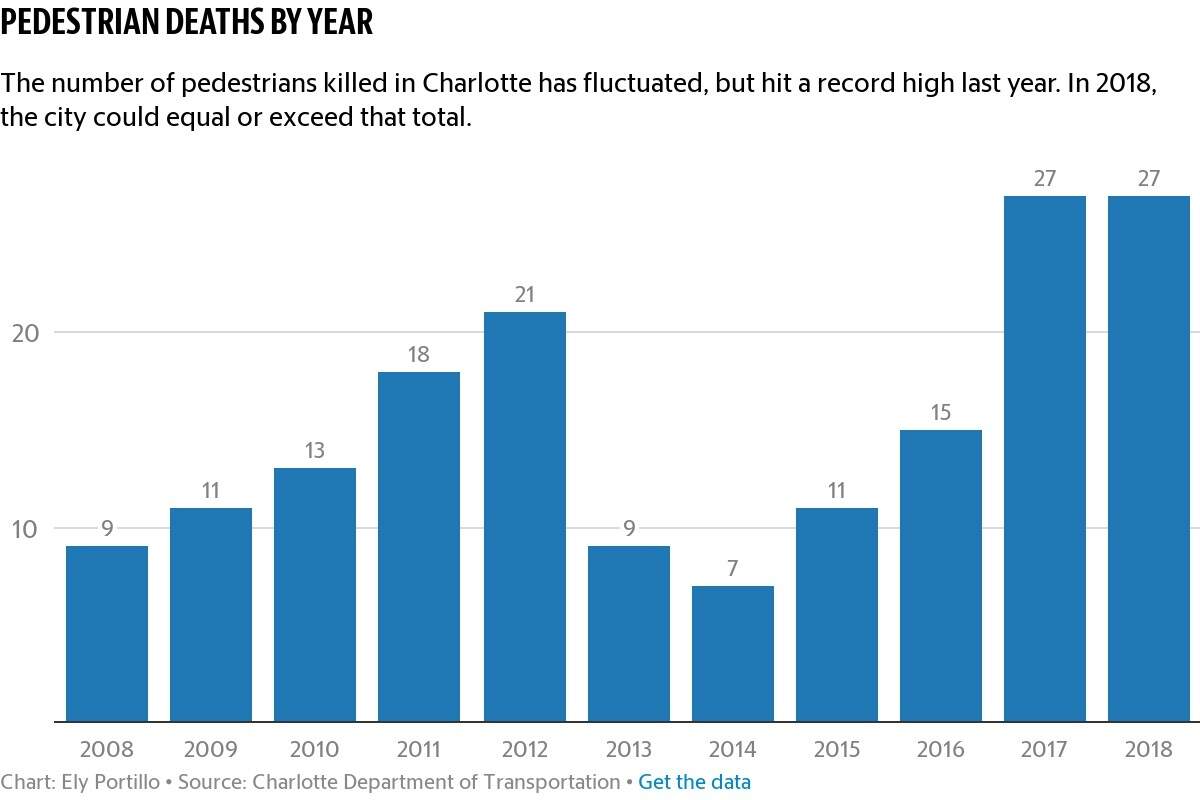
The city equaled a grim milestone this week: The 27th pedestrian killed in a traffic wreck. That ties the record set in 2017, and there’s still more than a month to go this year.
That means 87 pedestrians have died in Charlotte over the past five years, with a large majority of the deaths occurring in the past two years. It’s part of a nationwide trend that’s seen deaths surge in the past decade, especially in urban areas.
Experts don’t have an exact reason why, but point to several trends: People are walking more at the same time lower gas prices mean drivers are putting more miles on their cars. Cell phones might be distracting drivers and walkers. Deaths of passengers and drivers inside vehicles have been trending down for a decade, but auto safety features that have gotten better at protecting vehicle occupants have done little for pedestrians.
Two pedestrians have died in the last two weeks on Charlotte streets. The latest deaths include Michael Villasenor, a 54-year-old man hit while walking just before 2 a.m. on Queen City Drive, near Interstate 85, in West Charlotte. There are no sidewalks on the block where he was hit. Villasenor died Saturday, 10 days after the wreck. The driver was charged with DWI, felony hit-and-run and felony death by motor vehicle.
And on Sunday, 73-year-old Diane Babinec was hit crossing West Morehead Street near Bank of America Stadium during the Carolina Panthers game. She was crossing the street several feet behind her husband, Charlotte-Mecklenburg Police said. Babinec died Monday at the hospital. The driver has not been charged, and police said impairment and speeding don’t appear to be factors in the crash.
Charlotte leaders on Monday approved a new series of traffic-calming measures meant to make it easier to lower speed limits on neighborhood streets to 25 mph and simplify the process for residents to request speed humps and stop signs. But none of the city’s fatal pedestrian crashes this year have taken place on neighborhood streets — most are on busy arterial roads with higher speed limits that wouldn’t be impacted.
The city has also signed on to the global Vision Zero initiative, a program that’s meant to eliminate traffic fatalities by redesigning streets and changing driver behavior. Officials are planning to unveil Charlotte’s draft Vision Zero plan next month, which is expected to include proposals for redesigning streets, adding more crosswalks, lowering speed limits and stepping up enforcement.
Charlotte’s goal is to eliminate traffic fatalities by 2030. The city has allocated $2 million for Vision Zero so far, and the $118 million worth of transportation bonds Charlotte voters approved this month includes $30 million worth of funding for sidewalks and pedestrian safety. The city plans to build 10 to 12 miles of sidewalks and construct 15 new pedestrian crossings annually.
Binns said the city should accelerate those efforts and find more funding. The vast majority of pedestrian crashes in Charlotte happen outside crosswalks, but in many cases, they occur in areas where no crosswalk is available for a half-mile or so in either direction.
“We need to be investing more quickly in redesigning our streets for pedestrian safety,” said Binns. “We have a history of blaming pedestrians when they’re killed.”
A typical example occurred earlier this month, when 81-year-old Christa Frazier was killed trying to cross Sharon Road, near Sharon Towers, at about 6 p.m. on a Tuesday.
“The victim was not crossing in a crosswalk,” CMPD investigators noted. “However there are no crosswalks in the area.”
The nearest crosswalk is a half-mile away, and using it could have added about a mile to Frazier’s walk.
Most Charlotte fatal pedestrian wrecks in 2018 occurred on roads with similar features. More than 80 percent happened on two- or four-lane undivided roads, with 35 or 45 mph speed limits (National statistics show a pedestrian hit by a vehicle traveling 40 mph has a 90 percent chance of dying). Five people have died on Tryon Street, two died on The Plaza and busy roads like North Graham Street, Eastway Drive and Beatties Ford Road also claimed a life.
The remaining fatal pedestrian crashes took place on limited-access roads, Independence and Brookshire boulevards (The statistics exclude one person killed and run over in what police said was a robbery/homicide and two people killed by trains).
Charlotte City Council has spent hours at recent meetings discussing regulations for the new electric scooters people can rent from Bird and Lime. They’ve quickly become ubiquitous, zipping around Charlotte streets and sidewalks at 20 mph. There have been wrecks involving scooters, and even reports of people using them on I-277, but no one has died on one in Charlotte yet.
Binns said he worries the focus on scooter safety is overshadowing the pedestrian fatality crisis that’s claiming two to three lives a month on Charlotte streets.
“I feel like the council is maybe focusing too much on a problem that isn’t as serious as the pedestrian deaths,” said Binns. “The city would do better by focusing more on the existing problem of pedestrian fatalities.”
This story was originally published November 28, 2018 at 1:25 PM.