
For the first time, the Charlotte Marathon is sold out. It’s both a good and a bad thing.
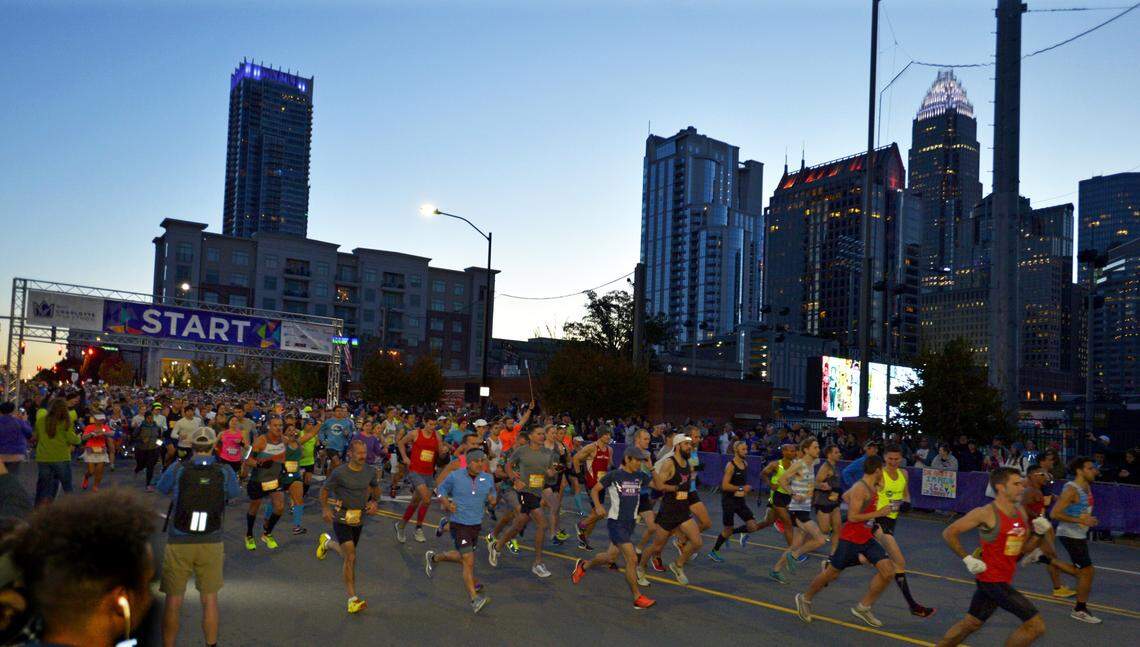
For the first time since the event was founded in its modern-day form 14 years ago, the Charlotte Marathon has had to stop accepting registrations from runners interested in taking a 26.2-mile jaunt through the streets of the city this Saturday.
“THANK YOU!” the Novant Health Charlotte Marathon’s Facebook page wrote in a post touting the news of the sell-out, next to a smiley face. “What overwhelming support! ... This will be the most people ever!!!”
But despite the decidedly positive spin that was put on it — and despite the fact that overall participation in the event is expected to exceed 6,000 (there’s also a half marathon, a 5K, a marathon relay and a one-mile fun run), marking a nearly 20 percent increase over last year — race director Tim Rhodes was not necessarily as thrilled to make the announcement as you might guess.
“We want everybody to be able to participate,” he said, “and it’s frustrating because, from a dollars and cents standpoint, you’re turning sales away. You’re turning money away and saying, ‘Sorry, we can’t take you.’”
To at least some extent, he and his staff have only themselves to blame — they were perhaps being overly conservative.
To explain: Rhodes says that as his staff monitored registration trends over the summer, all signs were pointing to participation numbers in line with recent years. So in the months leading up to the race, Rhodes’ staff ordered a typical number of finisher medals from the manufacturer it does business with in China. (Yes, it’s true: Every marathon finisher receives a medal, not just the winners.)
“We were following the registration trends, and trying to be responsible from a financial standpoint, too,” says Rhodes, 57, who is also known in the running community as the owner of the Run For Your Life stores in the Midtown and Piper Glen areas.
This is a tricky thing for a race like the Charlotte Marathon for a few reasons, Rhodes says.
Whereas an event that always sells out can place an order for a set number of medals and not have to worry about it again (e.g., the Boston Marathon, or the New York City Marathon), Rhodes and his staff are working with much tighter budgets and cost controls, and have to guess on how many medals to order. And it can be nerve-racking guesswork, he says, because if you over-order, you lose money; but if you under-order, you don’t have enough medals to give out to all the finishers.
Here’s why the latter is such a potentially huge deal:
“With medals, you’re not handed out medals by when you register; you’re handed out medals by when you finish,” Rhodes says. “And guess who that medal is most important to?
“You know, if you could start at the back and hand them out from the last finisher to the first finisher, it’d be a lot easier, because the ones up front are like, ‘Eh, I don’t need another medal.’ But it’s that runner who’s just happy to be there who’s like, ‘Where’s my medal?’ If you say, ‘Uhhhh, we ran out ...’ those aren’t great conversations.”
This, of course, is just another in a long line of challenges Rhodes has faced since he put on the inaugural running in December 2005. Over the years, he has continuously tinkered with the event in hopes of hitting on some sort of breakthrough that will move it toward being on par with marathons in similarly sized cities.
According to the website FindMyMarathon.com, the Charlotte Marathon ranks 100th in size based on total number of marathon finishers, which is way out of sync with the population at large. (The Observer explored the history of the event and the challenges it faces for growth in a story last year.)
In 2018, the results included 1,083 individuals for the 26.2-mile distance, with 1,904 in the official count for the half marathon. That’s down significantly from the event’s peak year; in 2009, back when it was called the Thunder Road Marathon, more than 1,400 completed the full marathon and nearly 3,000 completed the half.
For this year’s event, Rhodes’ tinkers included the addition of an elite runners’ program (he provided free race entries for runners who met certain time standards and is offering a a total of $2,700 in prize money) and a revamped registration system that gives participants a host of new self-service options that they didn’t have before.
Those don’t seem like added features that would drive a late registration surge. Yet something caused one recently, and last week, Rhodes was alerted to the fact that the numbers for the marathon had been unexpectedly ticking up. As much as this was something he liked to see, he wanted to try to avoid those awkward situations he mentioned.
On Friday evening, the announcement that the 26.2-mile race had sold out was posted on the event’s social media channels.
Most of the response was positive, although there was a little bit of grumbling about the lack of a warning. Oftentimes, events will use social media or email blasts to announce that registration is close to filling up, but the Charlotte Marathon’s announcement came completely out of the blue.
“That’s a regret I have,” Rhodes says. “It doesn’t mean that we still wouldn’t have ended up in the same place, it just wouldn’t be a surprise. ... In other words, if I know a month out that it’s close to selling out, and I wait, and then I get left out, that’s kind of on me.”
But if you surprise people, he realizes now, that’s going to leave those who figured they could wait with a bad taste in their mouths.
It’s worth noting, he says, that those still hoping to find a spot in the marathon field can try to connect through the event’s Facebook page with someone who has a bib to transfer. There’s also a waiting list, and Rhodes says his staff is trying to get as many people off of it and into the race as possible, as current registrants defer to next year or switch to other distances.
Meanwhile, he hopes to do better next year — on multiple levels.
“It’s nice to be able to say that (we’re sold out),” Rhodes says, “but at the same time, it’s not like we’ve achieved our goal. 1,200 runners ... is not our goal. I mean, we could take on 3,000 runners in the marathon if we wanted to. It’s just a matter of calculating the right projections and making sure that we know when people are gonna register, and how many people are gonna wait.”
“I’m hopeful we don’t have a cap next year. I’m hopeful we can plan well. ... It’s all about, how can we improve? How can we take what we have and make it better? How can it be a better experience for participants? How can it be better for the community? And what can we do to be more appealing to the runners that participate?”
This story was originally published November 12, 2019 at 5:23 PM.
