
‘A bold building’: Charlotte Mecklenburg Library’s new main branch seen as tech hub
The Charlotte Mecklenburg Library’s new main branch is poised to become a technology hub when it opens in uptown’s North Tryon corridor by early 2024, re-imagining the innovative role — and responsibility — of community spaces in the 21st century.
Library and local leaders envision the $100 million architectural marvel as a place where county residents can spend hours sifting through digitized collections on interactive screens, experiment with 3D printers in a technologically savvy maker space, or enjoy the bustle of Charlotte from a fifth-floor outdoor terrace.
Lee Keesler, the library system’s chief executive officer, said that one day, the 115,000-square-foot building could be a prime destination for friends to gather before catching a show at the nearby Blumenthal Performing Arts Center — or exploring new retail shops that advocates hope will open in North Tryon as the area sees a flurry of development projects, including efforts to restore the Carolina Theatre with an Intercontinental Hotel above it.
In the last decade, North Tryon has seen stagnant economic growth compared to the south end of uptown.
“Anything we can do with the space to celebrate the cultural community, we will do,” Keesler said in a recent phone interview. “That will also be the impetus for collaboration with others.”
Earlier this month, architects from the Snohetta design firm unveiled their ambitious plans for a replacement main branch at 310 N. Tryon St., the historic site of the library since 1903. The current 157,000-square-foot building dates to the 1950s, and it was expanded and renovated in 1988.
An overhaul of this scale, aimed at rejuvenating the library with modernized technology and robust community programming, calls for a $135 million investment. Of that target, $100 million is designated for the main library building itself, Keesler said, with half coming from county dollars and the other half from the library foundation’s fundraising campaign, called CommonSpark.
About $15 million in county financing is allocated for a separate Support Services Center, an approximately 60,000-square-foot space located outside of uptown that will handle distribution and back-end operations for the library system. CommonSpark intends to raise an additional $20 million to support technology and programming across the library system, Keesler said, as well as bolster the library foundation’s unrestricted endowment and annual operating costs.
Keesler said design and technology plans for Charlotte are heavily inspired by the James B. Hunt Jr. Library at N.C. State University.
The 230,000-square-foot building, also a Snohetta project, opened in Raleigh in 2013 replete with a visualization lab that incorporates interactive screens on three walls, a technology showcase filled with exhibits ranging from 3D holograms to 360-degree virtual reality videos, and a game lab used for both research and play.
“A few years ago, you’d go into a public library or academic library and there may have been a lot of space, but not a lot of differentiation,” said Patrick Deaton, an associate director at N.C. State University Libraries. “Nowadays, a public library is so often the center of the community. There is no other public building where a person can walk in and stay as long as they want.”
A technology overhaul for the 21st century
Charlotte joins a steady trend of public libraries across the country that, in the past decade, have spent millions to revitalize outdated infrastructure.
For example, the new central public library in Austin, Texas, opened in 2017 and cost $125 million. And in Cleveland, the library system is launching an over $165 million endeavor to renovate its 27 branches and main library, according an August report in The Plain Dealer.
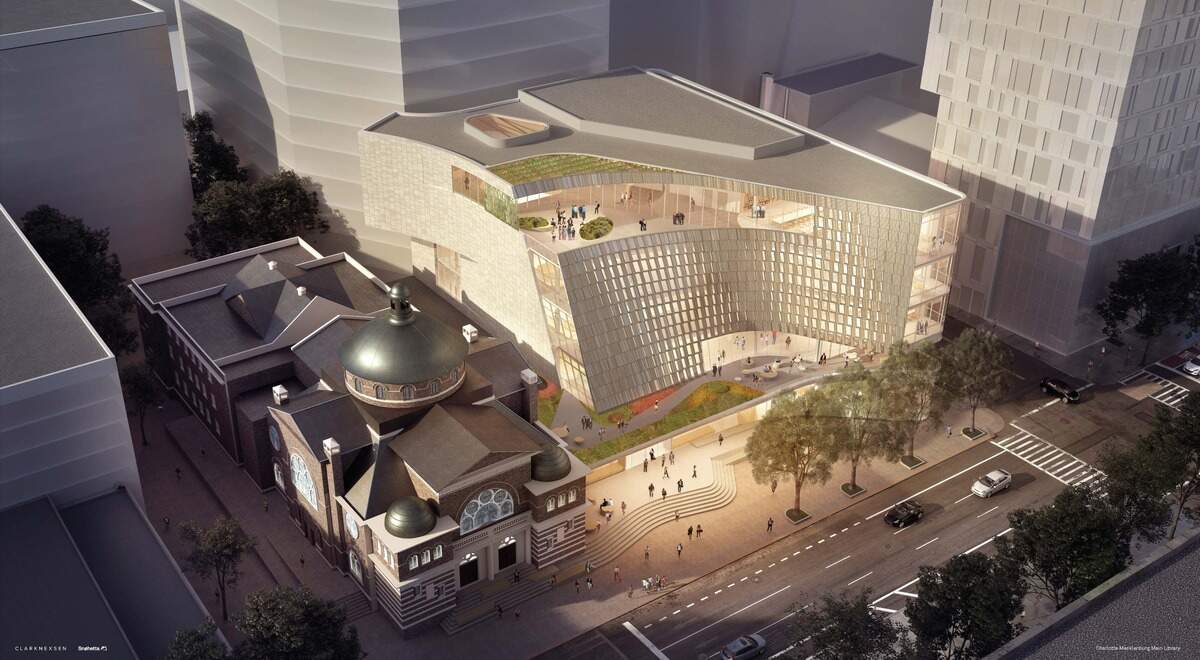
The renderings for uptown’s Main Library outline five levels of flexible spaces and two outdoor terraces that can accommodate technology upgrades and community needs, Keesler said. The first floor would include a cafe, immersive theater, open lobby and a signature spiral staircase that climbs the center of the building.
The second floor would house what Keesler describes as the “high-value interactive technology,” including a job training center, computer lab and recording studios. Upper levels morph into more traditional library spaces, such as reading rooms and special collections, mixed with meeting areas, offices and a writer’s studio.
“It’s hard to predict how technology will evolve, so we need to create spaces that are very flexible ... to incorporate new and emerging technology,” Ramiro Salazar, the president of the Public Library Association, said in a recent phone interview. “It speaks to equity, as well. In large cities, there are many communities that not have access to opportunities to utilize technology that is now part of the 21st century.”
The new Main Library’s front entrance on North Tryon would be purposely pulled back from the street, creating a pedestrian plaza and terraced sidewalk that complements the building’s dramatic curved facade. It’s a smaller, sleeker structure, though the overall footprint represents a more efficient use of space not cluttered with shelves upon shelves of books, said Nick Anderson, a senior architect with Snohetta.
“It’s a compelling building, it’s a bold building. That’s by intent,” Anderson said.
Keesler said design concepts for the revamped Robinson-Spangler Carolina Room underscore the digital thrust of the library replacement. It will feature an immersive theater, he said, with multiple screens that visitors can customize to display historic images and other archives.
He also anticipates a blend of permanent and pop-up galleries — potentially, even shortened version of performances happening elsewhere in uptown — at the new Main Library.
“Hopefully, we are able to capture this public commons feel that we’re aspiring to offer, and this is a place where people from different backgrounds can come together, learn together and explore together,” Keesler said.