
‘A hell of a drug’: How partisanship is infecting the debate over coronavirus response
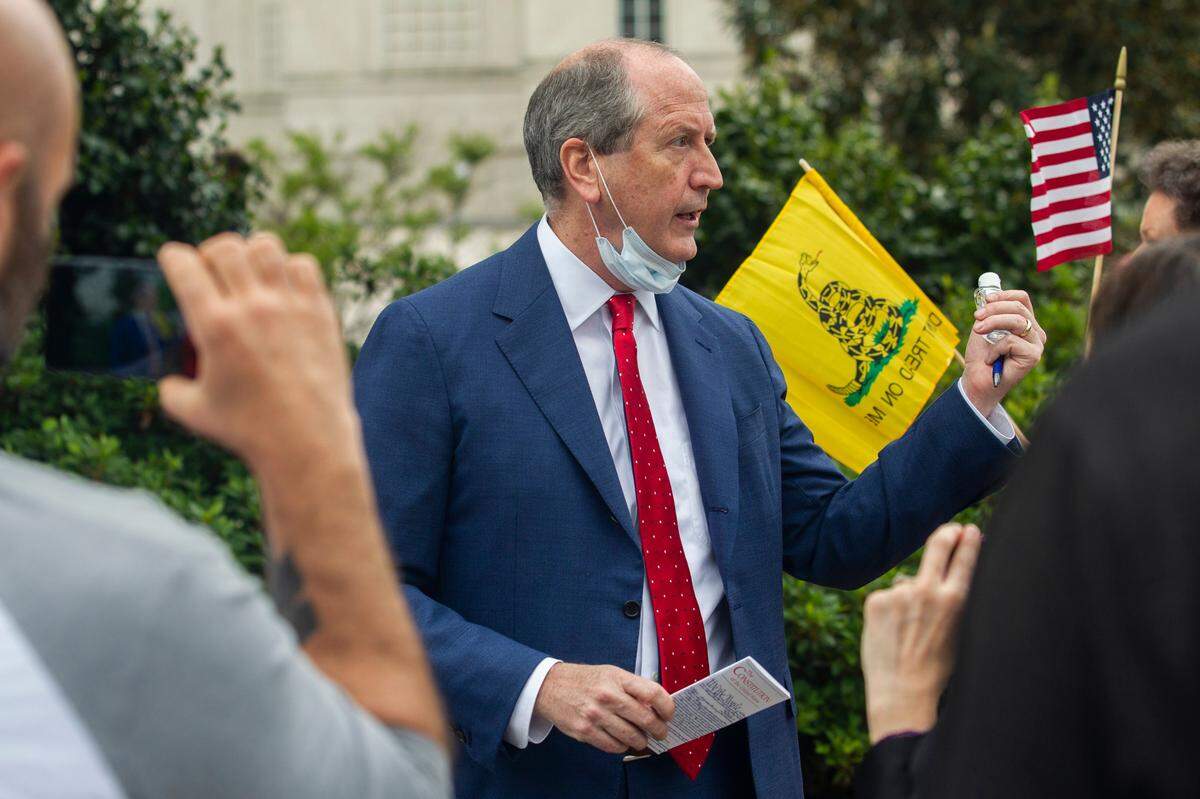
Tuesday’s “Reopen NC” protest in Raleigh had many of the trappings of a conservative rally: Signs bearing President Donald Trump’s campaign slogans. T-shirts for the gubernatorial campaign of Lt. Gov. Dan Forest, who didn’t attend. “Don’t Tread On Me” flags. A Republican congressman giving interviews.
Disagreements over North Carolina’s stay-at-home restrictions are falling increasingly along partisan lines, as some Republicans call for loosening restrictions soon and Democrats back Gov. Roy Cooper’s call for a slower, more cautious approach. The debates range from whether to hold a NASCAR race, to unemployment benefit hassles, to rules on what Walmart can sell.
U.S. Rep. Dan Bishop, a former state senator, has been one of the most vocal Republican critics of state government’s response to coronavirus. On Tuesday, he donned a mask and joined the Reopen NC protest.
Bishop posted a poll on his campaign website asking people when the order should be lifted, with options ranging from the current April 30 expiration date to July 31. “I think all of these are too late,” he tweeted.
In a news release last week, he criticized limits on church services and the arrest of protesters. “We cannot allow the First Amendment to our constitution to become this virus’s next victim,” he said. State Sen. Vickie Sawyer, R-Iredell, attended the protest as well, holding a sign that said “I am listening.”
Without mentioning Bishop or any other names, Cooper fired back at critics during last week’s press conference.
“I think it’s irresponsible for some politicians to use faith in order to lure people into endangering themselves, their families and their congregations,” he said. “I want very much for us to be able to ease the restrictions as quickly as we possibly can, but we have to keep public safety at the forefront.”
Cooper said Tuesday that he’ll announce in the coming days if he’ll extend the stay-at-home order into May. He says relaxing restrictions will depend on trends in the number of cases and the availability of testing and tracing resources to tackle future outbreaks.
Bishop is hardly the only Republican ramping up criticism in recent days. Raleigh businessman Bob Luddy, a major conservative political donor, blasted Cooper in the publication The American Spectator. He called on Cooper to lift restrictions so that everyone who’s healthy “must return to work immediately.”
“For every COVID-19 case in North Carolina (4,500 estimated), 125 people have lost their jobs (500,000 unemployed across the state). You created this tragedy,” he wrote.
Rep. Keith Kidwell, R-Beaufort, shared the article on Facebook and wrote that “truer words have never been spoken.” And Sen. Joyce Krawiec, R-Forsyth, wrote an op-ed titled “Is the cure worse than the disease?,” in which she argued that “we have destroyed a roaring economy in three weeks that took three years to build. ... The president understands and his instinct is to reopen the country. Let’s hope that Gov. Cooper has those same instincts.”
Meanwhile, legislative Democrats have taken to social media to urge caution and explain and promote the Cooper administration’s actions. “There are apparently a lot of folks that believe the worst is over,” House Democratic Leader Darren Jackson tweeted. “I am not sure that’s true. I believe social distancing and staying at home is in fact showing promise that it is working.”
Political scientists say the partisan split is a predictable one, thanks to each party’s core ideology and base of support.
“From a Republican perspective, this is pretty much the antithesis of big government telling people what they can and cannot do,” said Michael Bitzer, a political science professor at Catawba College. “From the Democratic side, it’s that government should be protecting citizens, particularly in health aspects. It’s kind of a natural ideological divide.”
Republicans also count small businesses — some of the hardest hit by the economic fallout — as a key component of their base, according to N.C. State University political scientist Andrew Taylor.
Meanwhile the Democratic Party base includes a heavy concentration of professions like doctors, attorneys, academics and tech workers. “They’re the ones who aren’t feeling the heat anywhere near as much as small businesses,” Taylor said.
The impact of coronavirus varies between demographic groups, with African-Americans accounting for about 40% of COVID-19 cases even though they make up only 23% of the state’s population. Many African-American voters tend to favor Democrats.
Politicians also take their cues from party leaders, so Republicans are more likely to back President Donald Trump’s support of reopen protests, while North Carolina Democrats support the actions of their party’s governor.
“Things are going to break down along partisan lines because party loyalty is a helluva drug,” Bitzer said.
Overturned orders unlikely
In Pennsylvania, the partisan divide between the Democratic governor and the legislature has prompted Republican lawmakers to vote to overturn restrictions on businesses in the governor’s executive orders. Lawmakers there want to reopen some businesses such as car dealerships if they follow social distancing guidelines.
A similar fight over executive orders is unlikely here, House Speaker Tim Moore suggested in an interview last week.
“You’ve got some states around the country where the governors have gone really far,” Moore told the Insider. “As I’m talking to you today, what we have in place does seem to be working.”
Like Senate leader Phil Berger, Moore says he wants to see better research and statistics about the virus to help guide a reopening plan.
“I would like to see North Carolina up and running the first part of May,” he said. “We need to have the data to show that it can be done. ... I think there’s a way to get there in May assuming that the trends continue the way they are.” Moore was referencing the improvements in the “doubling time” of new cases as well as the lower-than-projected strain on hospitals.
Moore said some restrictions will need to be eased gradually, with limits on crowd capacity in restaurants and requirements that people wear masks in hair salons and barber shops.
Cooper made similar comments last week outlining what a “new normal” might look like in the coming months. Moore said the governor’s administration is providing frequent briefings to legislators, typically outlining new executive orders and actions before they’re announced in news conferences. And legislators working on a relief package have largely found bipartisan agreement so far.
Some Republicans may be reluctant to criticize Cooper’s overall response because he’s polling well. A poll from the conservative Civitas Institute found that 84% approve of the governor’s handling of the crisis, including 78% of Republicans and 89% of Democrats.
By comparison, 95% of Republicans polled approved of President Donald Trump’s coronavirus response but only 22% of Democrats.
Local orders draw fire
Republicans have had stronger criticism for local stay-at-home orders that have been more restrictive than Cooper’s order. Moore blasted a now-revised New Hanover County order that required big-box stores like Walmart to ban customers from buying “non-essential” merchandise.
“It’s not the job of some bureaucrat to decide what that business can sell,” he said.
And Wake County’s decision to allow drive-in church services but restrict communion and monetary offerings drew the ire of Senate Republicans. Sen. Warren Daniel, R-Burke, said in a news release that churches shouldn’t face “different, more restrictive rules than retail businesses.”
Republicans are also demanding that the Cooper administration release more data about coronavirus cases and the modeling used to determine when it’s safe to reopen. Lt. Gov. Dan Forest, Cooper’s re-election opponent, called last week for a series of data points, such as local data on hospital capacities and case numbers by zip codes, to be released.
Department of Health and Human Services officials have said patient privacy laws limit the information they can release, but Forest said continuing to hold the information back “leaves the public and policymakers without the critical data necessary to reopen our state.”
Some Republicans want to blame Cooper to backlogs in processing unemployment claims, since the agency is part of his administration.
Legislators including Rep. Lisa Stone Barnes, R-Nash, and Sen. Bob Steinburg, R-Chowan, have social media posts that say “Roy Cooper won’t answer? Call me” and pledge to help constituents navigate the process. Division of Employment Security officials say they’re processing claims as fast as possible, and they’re adding more staff, but the volume is unprecedented.
Bitzer says the partisan rancor will only “get worse” in the coming weeks as states chart varying paths toward reopening. On Monday, some state lawmakers and State Treasurer Dale Folwell brought NASCAR into the debate, calling on Cooper to allow the Coca-Cola 600 to take place without fans on Memorial Day.
“That is very much emblematic of what we’re going to be confronting in the next couple weeks,” Bitzer said.
And with November’s election approaching, the partisanship is likely to continue. Disagreements over coronavirus and how to handle its economic effects could be key campaign issues.
“We’re not going to forget this by November,” Taylor said. “It’s even possible that some public health restrictions may still be in effect.”
This story was originally published April 22, 2020 at 11:29 AM with the headline "‘A hell of a drug’: How partisanship is infecting the debate over coronavirus response."