In a small, mostly white NC town in Trump country, support for George Floyd, black lives
It was, most folks in these parts would agree, an extraordinarily rare sight.
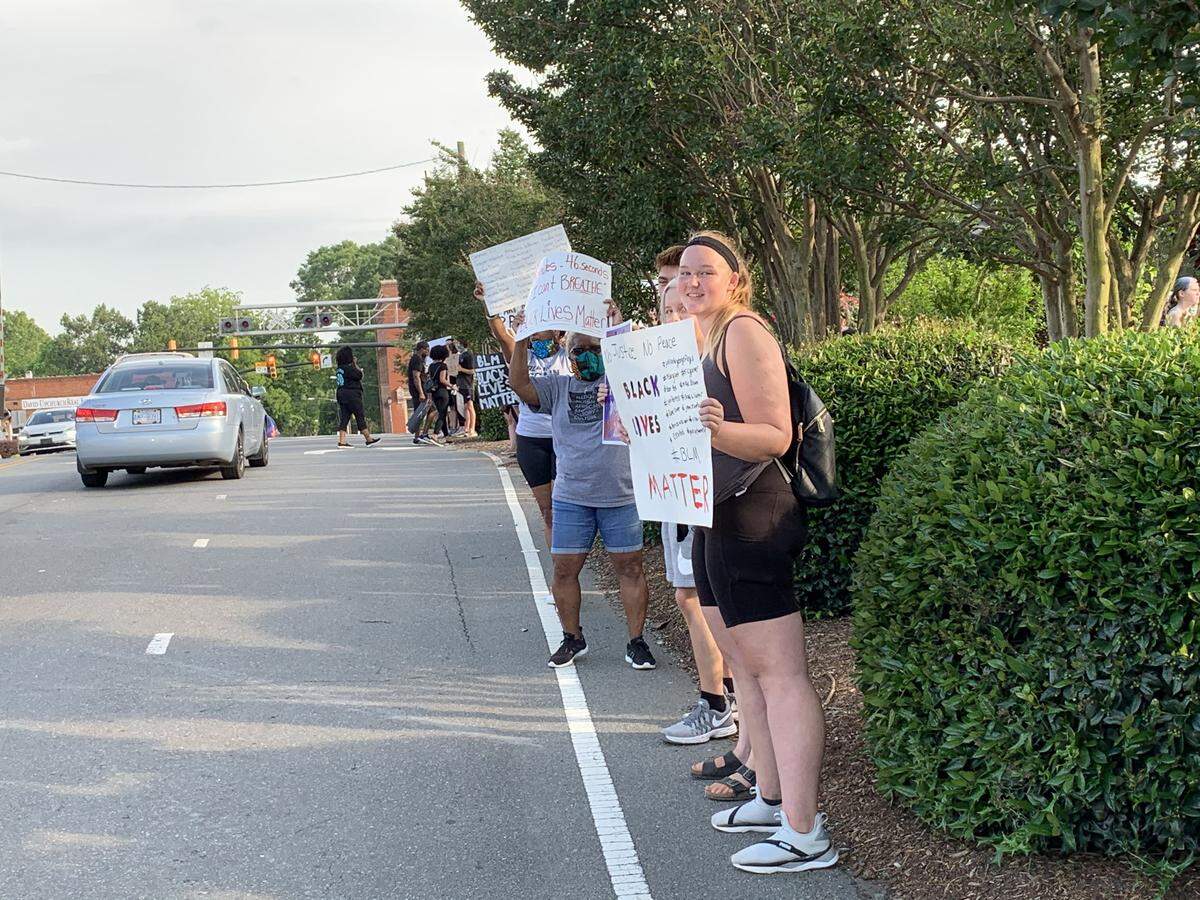
In fact, it’s possible the downtown area had never borne witness to one exactly like it before Thursday evening: Two young, blonde-haired white women, hustling across West North Main Street in Waxhaw, Union County, each clutching a corner of the same big piece of poster board covered with the words “Black Lives Matter.”
This is, after all, a town of barely 16,000 people on the western edge of a county that went two-thirds for Trump in 2016, and with a population roughly 80% white and just 10% black.
So this is not where you’d normally expect to see a fairly sizable civil rights demonstration in support of African Americans.
But there it was on Thursday as the hot sun started sinking in the sky — a crowd of several hundred. They assembled around the gravel lot that sits in the shadow of the big old water tower to support the Black Lives Matter movement and to remember George Floyd, the man who died under a police officer’s knee in Minneapolis 10 days earlier.
A crowd that was absolutely more than 80% white, and positively less than 10% black.
“In Union County, it never occurred to me that this many white people would come to this,” said Kasey Monroe, 72, who is white, and was holding a sign that read “Color Is Not a Crime.”
Thursday’s demonstration in Waxhaw continued a trend this week that has seen grassroots enthusiasm for support for the civil rights of black Americans spread beyond large, diverse cities and into small, unexpected places that in the past probably would have stayed out of it.
Former president Barack Obama pointed this out the other day during a virtual town hall; that, unlike in the 1960s civil-rights movement, when marchers were predominantly black, the George Floyd-era protesters now represent a cross-section of races.
In the Charlotte area, for example, there were “Black Lives Matter” protests in predominantly white communities of Indian Trail and Davidson on Tuesday, then Mount Holly and Cornelius on Wednesday.
Like the event in Cornelius — which was organized by three Hough High School students — Waxhaw’s sprang from the mind of a teenager: Ariana Juarez. She is a student at Cuthbertson High who recruited three black students from rival Marvin Ridge High and a black pastor — Quintell Hill of Multiply Community Church in Monroe — to deliver impassioned speeches to the mostly white throng.
(Obama pointed this out, too. That young people have helped pave the way for nearly every major social change in modern U.S. history. That he’s encouraged to see them at it again in the wake of Floyd’s death.)
At least four and maybe even five times the expected number of people showed up in Waxhaw.
Which actually created a bit of a problem, in that the guest speakers often found themselves shouting into a megaphone that didn’t have the amplification to be heard over the gusts of wind and the engine-braking of trucks as they rolled toward the center of town.
“Speak up!” and “We can’t hear you!” were as familiar refrains as “No justice, no peace!”
At the same time, there was close to zero hostility in the crowd. The day before, Waxhaw Police Chief Michael Eiss suggested he almost seemed to be anticipating it.
“Those who are intent on violence and destruction directed towards our citizens, as well as our officers and our community property, will be arrested,” Eiss posted on the department’s Facebook page. “We will not tolerate any selfish lawlessness in the Town of Waxhaw. Waxhaw deserves better than that. George Floyd deserves better than that as well. We do not, have not, and never will bow to chaos or fear in our great town.”
But while there were a small handful of signs that exhibited profanity (which made for some awkward moments because of the presence of so many young children), there were no objects thrown, no fireworks detonated, no arrests made and — perhaps surprisingly — practically no police presence.
On Thursday, in fact, there was only one visible uniformed police officer in the vicinity, and he was half a block away, standing in front of his SUV cruiser on the curb by Mary O’Neill’s Irish Pub with a partially obstructed view of the demonstration. (Locals also said Eiss had been telling residents that he was going to have several plain-clothes undercover officers blended into the crowd.)
This is actually probably one of the main reasons that participation numbers were larger than expected: attendees felt confident it was going to be a safe environment.
“My children — two 12-year-olds, a 13-year-old and a 15-year-old — really wanted to find a protest they could go to that they would be safe at,” said Alison Schweizer, who is white, and had a sign that said “#ICantBreathe” under her arm. “Where they could say how they feel, because they’re over it.”
She and others in the crowd, many of whom said they’ve lived in Union County for decades, said they can’t remember having ever seen a civil rights demonstration held here.
And make no mistake: This was a civil rights demonstration.
No better proof of this came than at around 6 p.m. Thursday, when somewhere in the neighborhood of 500 people took a knee, raised a fist and stayed silent in honor of George Floyd for nearly nine minutes. Most of the people taking a knee and raising a fist were white.
Forty-five minutes later, a group that included several young white people led chants of “No Trump! No KKK! No racist USA!” and “We don’t get no justice, you don’t get no peace!” Several dozen demonstrators — the majority of whom were white — lined both sides of South Broome Street wielding signs that read “End Police Brutality” and “Make Racists Afraid Again,” hooting and hollering at cars as they fished for supportive honks.
“It’s encouraging,” said Charles Lipscomb, who is black, and whose high-school-age daughter Nia was one of the guest speakers at the event. “Because it shows that it’s an issue that’s facing our nation that’s not bound by color.”
“But it’s only the first step. I want to live long enough to see change. Certainly, as a father of four, I want my children to grow up in a different world. But this is a great first step. Now let’s turn it into action, and then let’s turn that action into change.”
This story was originally published June 5, 2020 at 8:23 AM with the headline "In a small, mostly white NC town in Trump country, support for George Floyd, black lives."