
‘It takes patience and trust.’ CMS teachers prepare for remote learning.
Before the coronavirus pandemic hit Charlotte last spring, kindergarten teacher Lakisha Mills already had enough challenges in the classroom.
At Devonshire Elementary School, Mills worked with high-energy young students, who tended to have short attention spans. In a traditional classroom setting, her job takes focus, patience and effort.
When COVID-19 forced schools to close, teachers and students transitioned to a remote learning platform. Mills now faced an entirely new set of challenges, determined to give her students the education they deserved through virtual learning. Mills says she’s been thinking hard about how to make her online classes the best they can be this fall.
“It’s going to be a lot of learning for myself, definitely,” Mills said, “I’m going to have to find interesting new ways to keep them engaged.”
Charlotte-Mecklenburg Schools announced last week that instruction will be fully remote in the fall, reversing a previous plan to begin the school year with a two-week, socially distanced in person orientation.
Superintendent Earnest Winston cited safety concerns and staffing shortages, the Observer previously reported, concluding that the in person orientation would not be viable.
Teachers, students and families can now expect an entirely virtual learning experience for the foreseeable future. Unlike last March, however, when the pandemic abruptly forced schools to close, teachers and administration have now had the chance to prepare for virtual schooling.
This means instructors have had time to optimize an online learning experience for their students, and they plan to make improvements upon last spring’s impromptu online model.
CMS teachers across the district and throughout different grade levels are focusing on a few key aspects of remote learning that they say will enhance the experience for both them and their students.
Teachers emphasize the importance of establishing relationships with students even when they can’t meet face to face, and making time for social emotional learning on a virtual platform. They also stress how vital it is to be prepared for each and every online school day, and say they are brainstorming new, creative ways to keep students engaged.
CMS parents share some of the same concerns that teachers do when it comes to online learning. How will student-teacher relationships be impacted? How will instructors find ways to incorporate hands-on activities while everyone is behind a computer screen?
The Observer spoke to various teachers and parents across Charlotte to find out what makes online learning work well, and what it will take for students and teachers to be successful this fall.
Engagement and active learning
Making sure students are involved, engaged and actively learning is one of the biggest challenges teachers say they will face in this unprecedented school year.
Lawrence Brinson, President of the Charlotte Mecklenburg Association of Educators and a high school social studies teacher at the Phillip O’Berry Academy of Technology, knows that it will take extra work to keep students involved through a screen.
“The goal for me is to make it as interactive and engaging as possible, and to give students something to look forward to,” Brinson said. “With so much screen time, you don’t want to just give students worksheets and readings. You want each day to be a different experience, you want it to be exciting.”
Brinson has thought hard about the strategies he will use to make his online classes the best they can be. Taking advantage of the breakout room feature in virtual meeting apps like Zoom will allow students to work in smaller groups and learn together, he said. In breakout rooms, the class can be temporarily divided into smaller video conferences.
Thinking back to his brief time teaching online last spring, Brinson also noted that assigning group projects and using virtual discussion boards helped keep his students involved and held them accountable.
“You want this to be something they can come home and talk to their family about, even though they’ll already be at home,” he said of his online classes.
Mills, the kindergarten teacher, faces the unique challenges that come with teaching young students online. But regardless of age, she says, engagement is still one of her top priorities.
She plans on giving her students plenty of “brain breaks” throughout the day, so they don’t get burnt out from hours of online learning. These breaks include getting the students out of their seats and moving around, and giving them the chance to speak with one another.
Mills believes that allowing the kids to unwind a few times a day will help their learning. “I’m really concerned about maintaining discipline when we’re not physically together,” she said. She hopes that keeping the lessons fresh and interesting each day will encourage students to be on their best behavior.
Keeping students disciplined and respectful in their online classes is as challenging as it is important. “I’m adamant about being just as strong and fair on the computer as I am in the classroom,” said Margueritta Brown, a teacher at Steele Creek Elementary.
One example of successful online engagement can be found in Project Scientist’s virtual STEM camp that’s running this summer. Project Scientist is a Charlotte-based non-profit that helps girls from all different backgrounds pursue topics in science, technology, engineering and math. Although they usually hold in person camps, the organization recently transitioned to a “virtual lab” experience.
Abby Dietly, a teacher for Project Scientist, said she prioritizes engagement when in the online classroom with her students. Especially for STEM subjects, “engagement is a teacher’s number one thing,” Dietly said.

Project Scientist students get science kits in the mail every week, with materials and experiments they work through during the online sessions.
Cynthia Hamilton, whose daughter is participating in the camp, said these kits have really bolstered the online learning experience. “That hands-on piece really keeps them engaged,” she said. “The students have to feel present.”
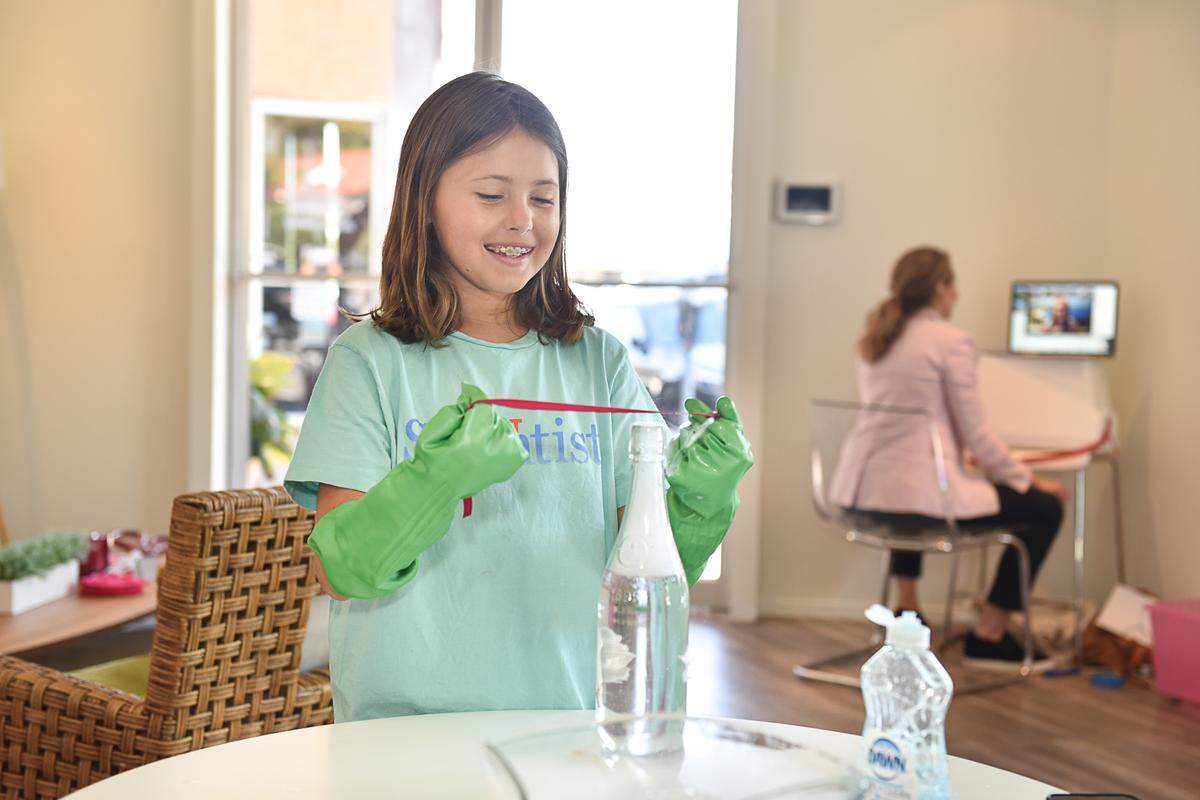
Chris Hardy, another Project Scientist parent, agrees and hopes that CMS’s virtual instruction will be similarly successful. “They were able to actually interact and teach these girls in a completely virtual environment,” he said, “They made it so the girls were really able to ask questions and feel involved.”
Communication and social emotional learning
With online learning, students are missing out on many of the experiences that used to be inherent, essential parts of their school days. They can no longer meet their friends for lunch in the cafeteria, stay after class to chat with a teacher, say hello to their principal in the hall, or cheer for school sports teams in the stands.
It may not be possible to replace all these things while teaching and learning from home, but teachers say they will do their best to foster relationships within their online classes. Not only do student-teacher relationships offer personal support and mentorship, but they can also improve the student’s in class learning experience, Dietly said.
“Students are going to learn from you if you have a relationship with them,” Dietly said, “Building that relationship virtually has its own host of challenges.” Dietly says it’s important to not skip over things that may appear to be small, like asking the kids how they’re doing that day and what they did over the weekend.
Creating fun traditions like spirit day and show and tell is possible online, she said, and probably even more important in a virtual learning environment than in a physical school building. When students have school pride and know that their teachers care about them, they’re much more likely to be excited to learn, Dietly said.
Brinson hopes he’ll be able to at least partially make up for the missed social aspects of in-person schooling. “When you go online, you kind of miss those teachable moments, things that happen in the moment. Where students can learn from each other and share experiences,” he said.
Encouraging his students to work in groups and making sure to check in on them individually will help, he said. But nothing will truly be able to replace the dynamics of bustling hallways and classrooms.
Brown also discussed the importance of social emotional learning. The Collaborative for Academic, Social, and Emotional Learning, or CASEL, describes social emotional learning as “the process through which children and adults understand and manage emotions, set and achieve positive goals, feel and show empathy for others, establish and maintain positive relationships, and make responsible decisions.”
These skills are essential for students to develop, Brown said, and are equally important for teachers. “Our social emotional well being is very important in order for us to be able to conduct remote learning. We’re trying to meet the needs of our students as well as the school system as best we can,” she said.
For Tonya Waldschmidt, a special needs teacher at Community House Middle School, social emotional support is vital for the students she works with. Waldschmidt typically co-teaches classes to support students who need more individualized guidance.
When classes transitioned to online last spring, Waldschmidt said communication with her students and their families was key. She made time to talk with her students regularly, about everything from school to vacations to family life.
One student she virtually met with every Monday at 9am to discuss the week ahead, she said. Other students she checked in with multiple times a week, and some she chatted one on one with every day.
In the fall, Waldschmidt said, the first 30 minutes of every school day will be devoted to “check in time,” where teachers and students can catch up with each other and make up for some of the socializing that is sacrificed with online learning.
S. Y. Mason-Watson is a CMS parent whose son finished 8th grade at Northridge Middle School this past spring. She knows teachers were trying their best to make things work when schools were closed, she said, but hopes the communication will be better come the fall.
While thinking about the challenges of online learning, Mason-Watson said, you can’t forget about the reason classes were moved online in the first place. The coronavirus pandemic has made life more difficult or more complicated for almost everyone across the country. For young students with a now-uncertain future, it is much harder to focus on school, she said.
“Middle school students listen to the news, they read online articles, they know what’s going on in the world,” Mason-Watson said, “and it’s very frightening for them. It’s frightening for us as parents. So to expect that they will just readily adapt when we as adults are having difficulty adapting…”
Students will need extra support from their teachers and mentors, Mason-Watson thinks. “These students have to prepare their heads and their minds for doing the work they’re doing. Some days will be better than others. And the local and national news has an impact on that,” she said.
Even though students and teachers have been separated from their peers and from each other, supportive relationships in a learning environment are vital, now more than ever. Waldschmidt knows that while remote learning will come to an end eventually, it requires great care and effort.
“The online learning isn’t forever,” Waldschmidt said. “We temporarily need to learn how to do school like this, and help everyone be as successful as possible. It takes patience and trust in the system.”
This story was originally published August 6, 2020 at 11:48 AM.