
Nowhere to call home after prison. Will Charlotte change its fair housing policy?
When Chablis Dandridge left a 13-year federal prison sentence, he didn’t exist on paper much beyond his record.
“I had no credit profile, I had no job history,” he said. And even though he’d built savings and earned a college degree while incarcerated, renting an apartment was “a nonstarter.”
“Nobody was going to take a chance on me,” said Dandridge, who was convicted of drug and weapons charges and released in 2017.
As Charlotte’s affordable housing crisis puts an increasing burden on tens of thousands of city residents, those with a criminal history face even greater financial and societal challenges to find and keep a roof over their heads.
Without stable housing, re-entry advocates say, people struggle to find employment, finish their education or support themselves and their families. Those factors increase the risk a person may be arrested or incarcerated again.
But supporters of new “Fair Chance” housing policy that would add protections for renters with criminal records to the city’s fair housing ordinance say it’s a crucial step to level the playing field and increase ex-offenders’ chances of staying out of the justice system.
It aims to stop blanket rejections based on criminal history, but rather have landlords consider tenants on their specific circumstances. Currently, it’s legal and common for rental property owners to weed out applicants based on past arrests and specifically disallow someone convicted of a felony from moving in.
Under the proposed changes, Charlotte landlords should defer inquiry about a potential tenant’s criminal record until after determining if the applicant is otherwise qualified.
Among the criteria landlords could use consider: how much time has passed since the conviction or whether the crimes pose a safety threat to people or property.
If a landlord does deny an applicant with a criminal history, the tenant is allowed to present evidence of rehabilitation or errors in the screening findings, such as charges that were dropped or didn’t result in conviction.
The proposal would also allow tenants to file complaints if they feel they have been discriminated against because of their record.
‘A hope killer’
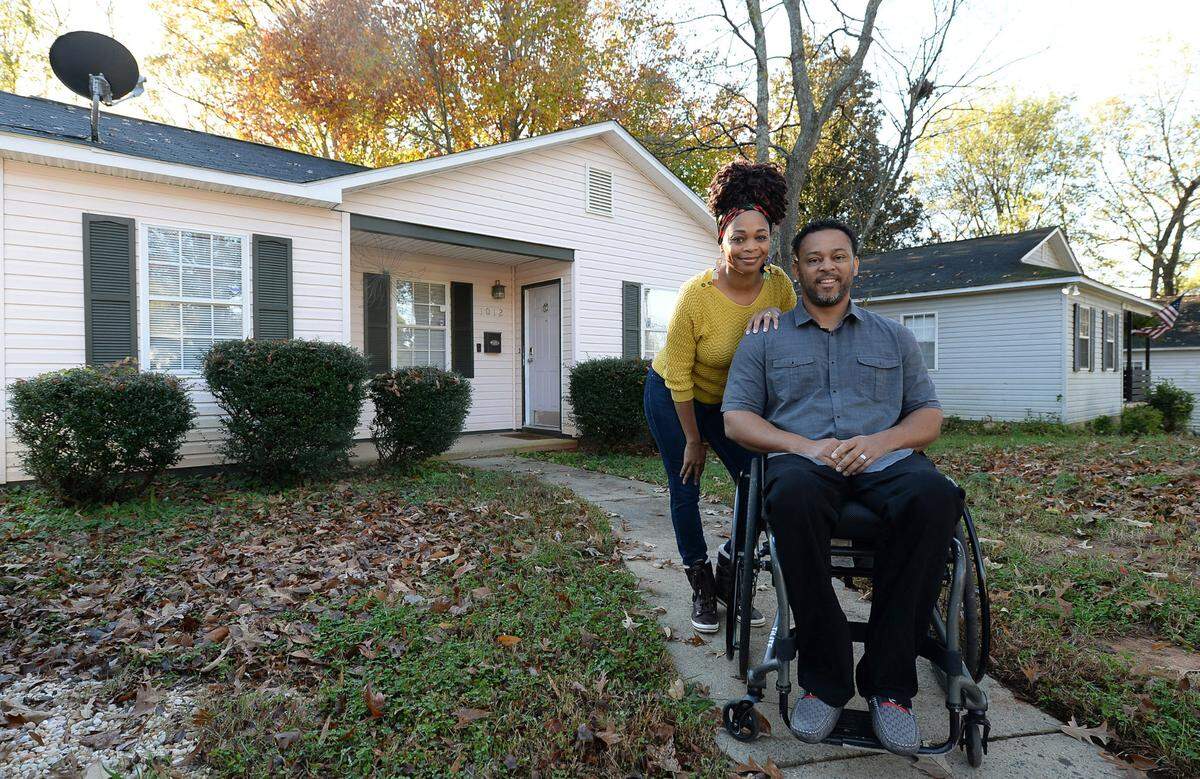
After release Dandridge, 43, lived with his mom and his girlfriend, now his wife, until the couple could buy their own house. For others, he said, it’s a discouraging cycle of paying rental application fees only to be rejected.
“It’s a hope killer,” said Dandridge, who now works with a nonprofit to keep youth out of the criminal justice system. “Five hundred ‘nos’ and you took my money for application fees saying ‘You probably got a good chance.’
“It comes to the point where frustration builds despair and hopelessness.”
Traletta Banks also sees the challenge to find housing every day as a career adviser with NCWorks, where she works with people leaving the Mecklenburg jail.
After she was convicted in 2005 of obtaining property under false pretense for cashing a check with a forged signature, Banks said her record came up repeatedly when trying to find a place to live with her then young children.
Now 43, Banks said housing is an essential piece to reducing recidivism and providing a possibility for a better life after incarceration. She was able to find a private landlord who took a chance on her, and said she’s grateful for others who offer that opportunity.
“They’re making a difference in somebody’s life,” she said. “They’re reducing the crime rate, and they’re making the city safer. They’re building community upward mobility, they’re allowing an individual an opportunity to become a successful returning citizen.”
The proposal
The proposal, championed by the Re-Entry Housing Alliance, would be the first of its kind in North Carolina.
But other communities, including Seattle and Detroit, have passed similar measures, sometimes described as a ‘ban the box’ measure for rental applications.
Those measures faced opposition from landlords there, who said it removes choice for how they operate as business owners.
Kim Graham, president of the Greater Charlotte Apartment Association, said her group is studying the issue.
“We understand that it’s an extremely difficult time to find housing, especially for folks who might have gone to jail or for any number of reasons,” she said. “It is hard to find housing in general in our area.”
Graham said it was too early to identify potential concerns about the re-entry proposal until hearing from her group’s members, but said they will discuss ways to eliminate barriers to housing, particularly for non-violent offenders.
Dandridge and Banks, both members of the alliance, call the local proposal “common sense” measures that give people leaving the criminal justice system a fighting chance to find stability. In an increasingly tight housing market, it can be difficult, if not nearly impossible, to find housing with a criminal history, they said. Renters with a record also may be forced toward less scrupulous landlords and substandard housing.
The U.S. Department of Housing and Urban Development in 2016 issued guidance that landlords who refuse to rent to all tenants with criminal records may violate the Fair Housing Act.
While criminal history is not a protected class under the federal act — those are race, color, national origin, religion, sex, family status and disability — HUD’s 2016 guidance stated because African Americans and Latinos are incarcerated at rates disproportionate to their share of the overall population, refusing to rent to people with criminal records has a disparate impact on those minority groups.
The Trump administration has tried to weaken the disparate impact standard to make it more difficult to prove discrimination in housing, which has prompted lawsuits from housing advocates. And landlords in North Carolina can reject potential tenants for a number of reasons, including criminal history.
The local proposal has the support of Charlotte-Mecklenburg Community Relations, which investigates housing discrimination cases locally.
Willie Ratchford, executive director for the community relations committee, told the city’s Great Neighborhoods Committee on Nov. 18 about a case of a woman who was denied an apartment in 2019 in Charlotte: A landlord refused tenants with “more than a parking ticket” on their record.
The woman’s only felony conviction was nonviolent, three decades old and from another state, Ratchford said. The Great Neighborhoods Committee is expected to resume discussion on this issue in the coming months.

Pamela Wideman, the city’s housing and neighborhood services director, told the committee in September the city attorney advises that “the most straightforward approach” would be to seek legislative authority from the General Assembly to change state law.
But supporters of the reentry proposal are still pushing to change the local ordinance, in part because of worries the matter will get bogged down in Raleigh.
Malcolm Graham, who chairs the neighborhoods committee, said last week the city staff are studying how to stay within “the guardrails” of the city’s authority on this matter.
Council member Renee Johnson said in the same meeting that many people have income but remain in unstable housing like hotels because their criminal history prevents them from renting with a traditional lease, calling it “a huge barrier.”
“We know that the criminal record is truly the new Jim Crow,” she said. “This is happening every day.”
This story was originally published November 25, 2020 at 6:30 AM.
%20Cropped.jpg)