
Charlotte’s trees are cool. Literally, they help reduce urban heat.
Charlotte is heating up, and not just with its usual summer warmth. One solution, though, may be as simple as planting trees.
“In Charlotte, I think our canopy is our greatest natural resource,” said Jane Singleton Myers, executive director of Trees Charlotte.
Charlotte’s tree canopy has been named by American Forest as one of the best among large U.S. cities, but those close to the issue say trees remain under threat.
Urban development, age and diseases are some of the main causes of tree loss in the city, said Kate Bolkin, community tree educator for Trees Charlotte.
“Development certainly impacts tree canopy,” said Tim Porter, the city’s chief urban forester. “Development plants a lot of trees, but also there’s clearing.”
The greatest threat, though, is single family homes. Infill development — when vacant land between existing buildings is developed — causes the most canopy loss, Porter said. When people take down trees to make space for home additions, those small removals add up incrementally.
Charlotte 2040 plan
In the recently passed 2040 plan, the Charlotte City Council placed an emphasis on improving the tree canopy.
The plan calls for:
▪ Slowing canopy loss on residential land
▪ Increasing the number of small parks/plazas in neighborhoods
▪ Prioritizing the preservation of existing trees
▪ Updating development regulations to mitigate tree removal
▪ Supporting tree maintenance on private land in under-served neighborhoods
▪ Funding a proactive tree planting program
Where is the problem?
Problems with tree loss are hurting the city on two ends.
The most tree loss is in primarily middle class to wealthy, predominately white areas like south Charlotte, Dilworth and Myers Parks. That’s because they have the most trees to begin with, Bolkin and Porter said.
Lower income communities of color have fewer trees than the rest of the city, they added.
“We’re definitely trying to focus more on the underprivileged, typically lower income communities, to get trees there because they historically have not had a lot of trees and therefore haven’t had a lot of the benefits that trees have to offer,” Bolkin said.
Between 2012 and 2018, Charlotte had a net loss of nearly 7,700 acres of tree canopy, according to a study by Trees Charlotte and the University of Vermont.
The city still has 45% acreage shaded by trees, but is a ways away from its 50% tree canopy goal by 2050.
That goal, adopted in 2011, may not be the right fit for the city’s future, Porter said. Rather than a “one size fits all approach,” he said, he’d like to see tree canopy goals targeted for specific areas of the city.
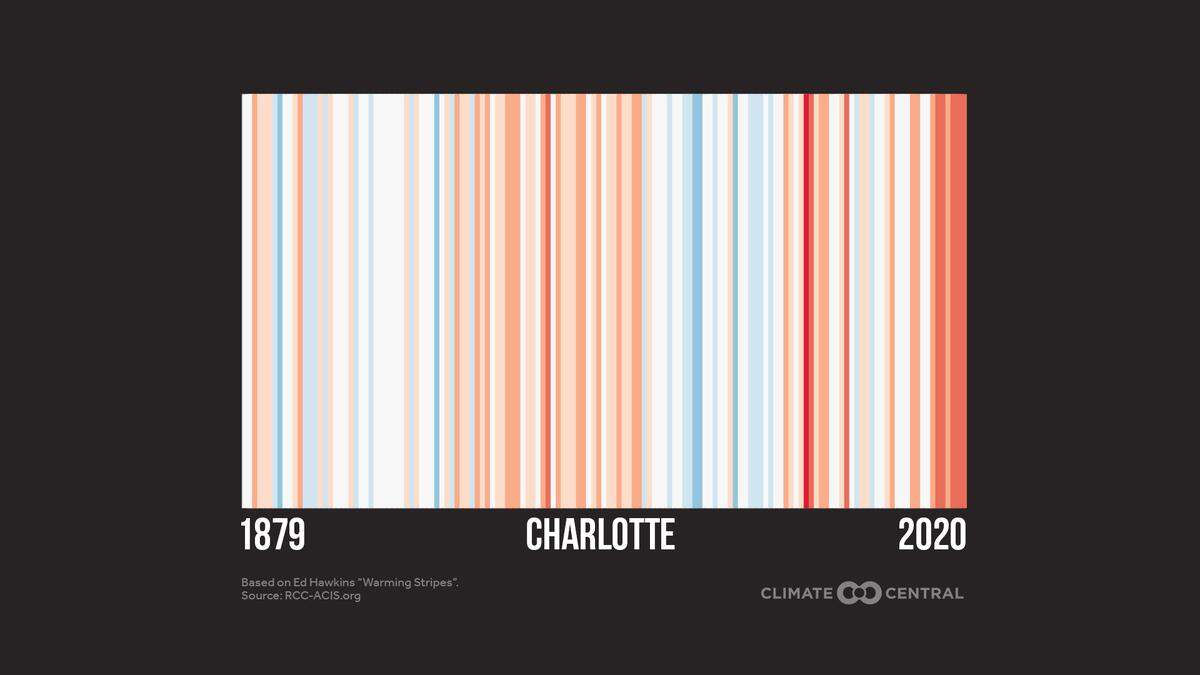
As the tree canopy declines, the city continues to heat up.
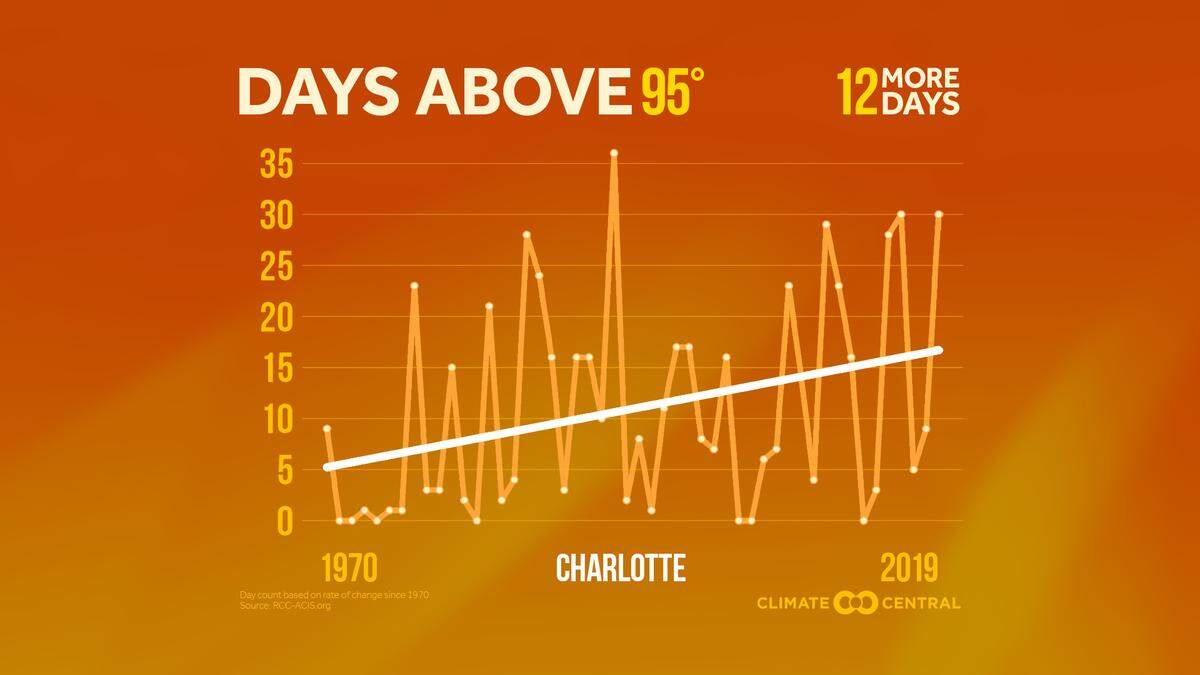
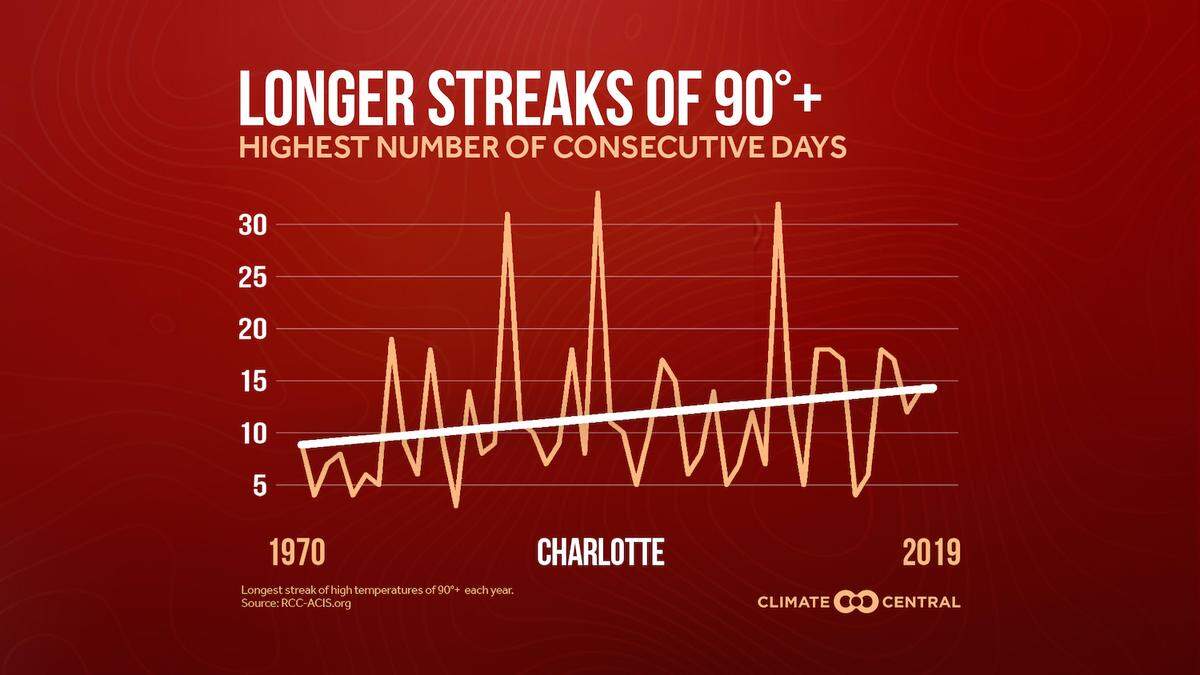
Charlotte has been steadily increasing its streaks of 90-degree-plus days, according to data analyzed by Climate Central, a research organization made up of scientists and journalists.
While the number of non-consecutive above-95-degree days has fluctuated year to year, the analysis shows that the amount has risen over time. Climate Central used data for Charlotte, and other cities, from 1970 to 2019.
How can trees help?
Large tree canopies provide many benefits, including lowering temperatures by helping to mitigate the urban heat “island effect.”
The urban heat island effect is essentially when there are warmer temperatures in urban areas compared to their surrounding rural locations.
Not only do trees provide greater shade, their foliage also helps cool the surrounding air, said Matt Easton, a UNC Charlotte professor who has researched the city’s urban heat island.
“That extra warming in the urban areas makes it somewhat unbearable for a good number of people,” Easton said.
Extreme heat is more than just a discomfort — it can cause heatstroke and even death. Since 1979 over 11,000 Americans have died from heat-related causes, according to the EPA.
Additionally, heat islands increase energy costs.
In Mecklenburg County, people from 50-99% of the federal poverty level — an income of about $13,100 to $26,200 for a family of four — spend nearly 15% of their income on energy costs alone, according to a UNC energy poverty study.
Lower income communities who have the least tree coverage, are also facing the stronger effects of the urban heat island.
“There’s an equity issue as far as availability to tree canopy and the benefits that canopy provides,” Porter said.
Looking forward
Trees Charlotte is in the process of developing a tree care program that will care for existing trees and subsidize those costs for homeowners.
“We definitely noticed with Charlotte’s aging tree canopy, a lot of tree care work needs to be done, especially in lower income communities,” Bolkin said.
In the past, the organization has largely focused on planting new trees. The planting season runs from late September to March and is all volunteer-driven.
The organization also works to help educate the community on the helpful effects of trees.
“Everyone will benefit from understanding more about the value and work that trees do,” Myers said.
This story was originally published July 1, 2021 at 6:00 AM.