
Protesters decry Meck DA decision to not charge deputy US marshal in Jennings killing
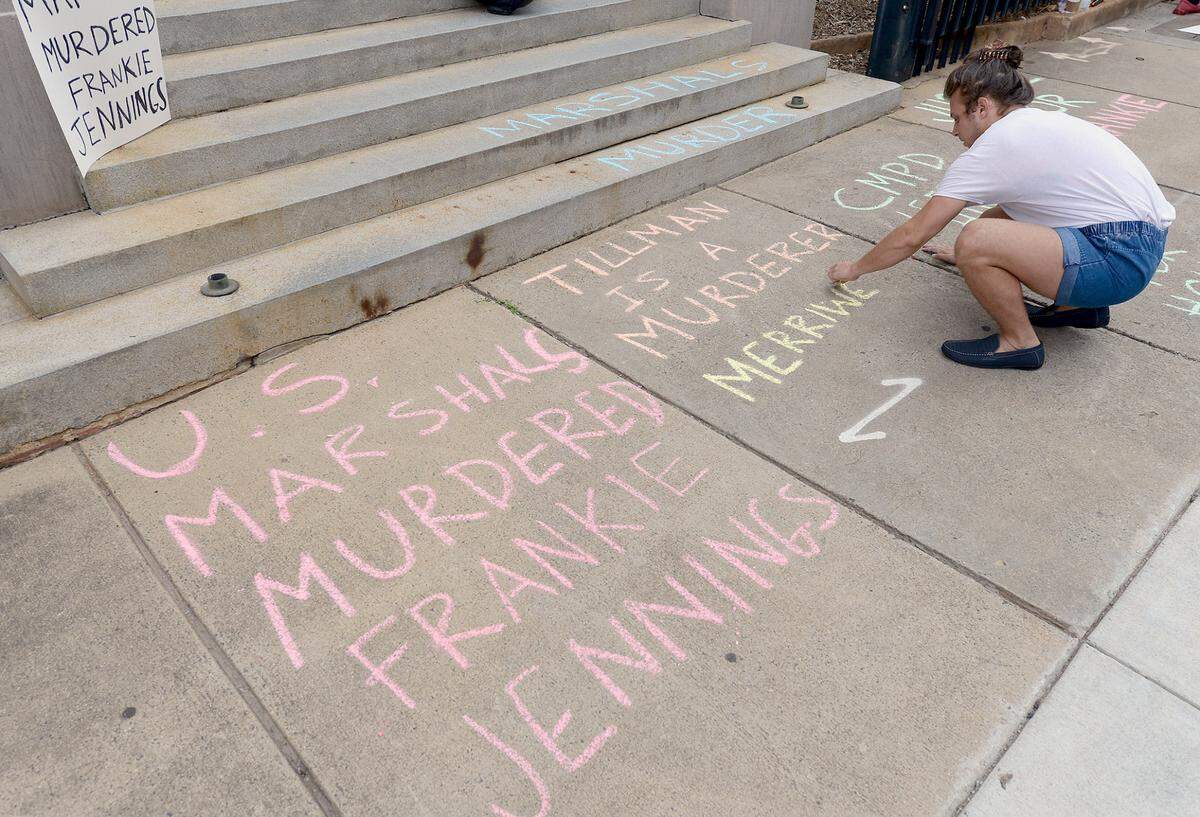
About a dozen protesters gathered outside the U.S. federal courthouse in uptown Charlotte on Tuesday morning to protest the death investigation of Frankie Jennings, a Black man killed by U.S. marshals in March.
Tanua Wallace, Jennings’ sister, said she was saddened but “not surprised” by the announcement last week that the Mecklenburg County District Attorney’s office would not pursue charges against Eric Tillman, the deputy marshal who shot Jennings.
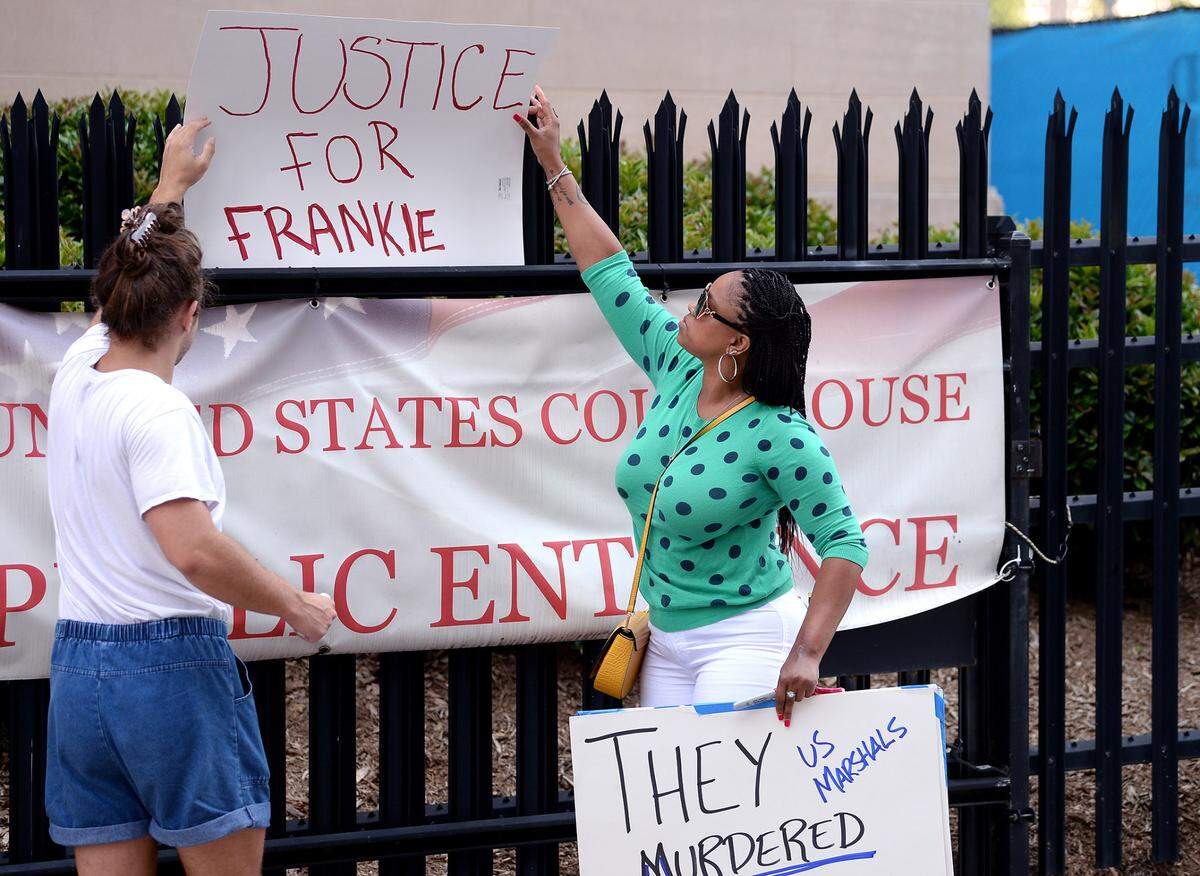
“I’m grateful for people like them,” Wallace said, referring to the protesters.
Tillman fatally shot Jennings during an attempt to serve multiple warrants at a gas station on The Plaza, Mecklenburg DA Spencer Merriweather III told Charlotte-Mecklenburg police Chief Johnny Jennings in a letter dated June 29.
During a brief struggle with Tillman, Frankie Jennings put his black Mercedes in gear and the car began to move forward, Merriweather said in the letter. Tillman then saw Jennings’ “hands reaching toward a gun in the center console cupholder,” at which point Tillman fired three rounds at him.
An autopsy found that Jennings was killed by a gunshot wound to the chest. He also had gunshot wounds in both arms. A loaded semi-automatic handgun was located in the center console of his car, Merriweather wrote.
Merriweather, in his letter, said Tillman feared for his life, and there was not enough evidence to prosecute.
Charlotte Uprising, which organized Tuesday’s protest, has called the shooting “a public execution.”
“The US Marshals get away with murder. The police get away with murder. Accountability looks like the police and the state not having the power to decide if people live or die,” the group said in a tweet Tuesday.
Wallace said surveillance video of the shooting does not show her brother threatening officers. She also disputed the veracity of a warrant for Jennings’ arrest, which charged him with assaulting a government official with a deadly weapon.
According to the DA’s report, the charge stemmed from an incident in Carolina Beach in March. Jennings, according to the report, grabbed an officer’s arm and drove away, “resulting in the officer being dragged approximately 30-40 feet before being thrown to the ground and causing injury to the officer.”
Wallace said her brother “was not trying to hurt an officer with a deadly weapon ... just trying to get away.”
Experts on police tactics weigh in
While protesters Tuesday were calling the Jennings shooting a crime, two experts in police tactics supported the district attorney’s decision not to press charges.
At the Observer’s request, Philip Stinson, a criminal justice professor at Bowling Green State University, and Seth Stoughton, an associate professor of law, criminology and criminal justice at the University of South Carolina, watched the shooting video and read Merriweather’s report surrounding Jennings’ death.
Both said Tillman had acted within the boundaries of the law when he opened fire on Jennings. The Supreme Court has ruled that the use of deadly force is legal if an officer reasonably concludes that he or others face an imminent threat of death or serious injury.
Stinson, a former law enforcement officer and now one of the country’s leading authorities on police use of deadly force, said in an email that Tillman acted legally based on the events at the scene and the marshals’ prior knowledge of Jennings’ alleged history of violence.
“I believe that Mr. Jennings was reaching for his handgun,” Stinson told the Observer.
“The warrants were for crimes including assault with a deadly weapon on a law enforcement officer (dragging a police officer with his vehicle while fleeing) and discharging a firearm into a vehicle. The task force members had reason to believe that Mr. Jennings was armed with a firearm, had a history known to the task force members of shooting into a vehicle, and was known to have a history of fleeing from the police.”
Stinson, a frequent police critic who says officers’ versions of shootings are often contradicted by video, said in this case that the surveillance footage from the gas station camera is consistent with the statements by Tillman and the other task force members of what occurred.
Stoughton came to a similar, if somewhat more conditional, conclusion.
“If (Jennings) was actively trying to go for a gun that they knew was there, and if they couldn’t reliably prevent him from getting it some other way (physically grabbing him), then my quick assessment is that there was very likely an imminent threat that justified the use of deadly force,” Stoughton said in an email Monday.
“There are a couple of things the marshals might have done a little differently on approach – basically pulling their car right up to his door to prevent him from getting in or pulling in front to keep his car from moving – but they seem relatively minor.”
As a general rule, according to Stoughton, officers should not reach into a car “precisely because of the risk of getting dragged.”
“But doing it to prevent the guy from grabbing a gun may be one of the narrow exceptions,” Stoughton said.
This story was originally published July 6, 2021 at 11:03 AM.