The Plaza’s little family: What’s behind the Giant Penny’s 30-year success?
It’s not a sprawling supermarket, but the Giant Penny is never quiet.
Even when only a few customers stroll up and down its aisles, the Charlotte grocery store is filled with the sound of laughter and greetings.
Friends who haven’t seen each other in a few weeks catch up in front of the freezer section, while family members stop to chat over grocery lists. Employees wave and say hello to their long-time customers when they walk through the door.
It feels like that for a reason, owner Loc Tran said. It’s because they’re all part of a family, and Tran is committed to serving each member.
The Giant Penny is a landmark on The Plaza. The store’s facade is emblazoned with its namesake, a giant penny, Abraham Lincoln and all, and it looks like a relic of times past with its checkered tiles and painted signs.
The store was one of the first along The Plaza to distribute and accept EBT, which stands for electronic benefit transfer, and continues to do so, even while the neighborhood has seen a drop in EBT-accepting stores. EBT — colloquially called food stamps — provides money for Supplemental Nutrition Assistance Program (SNAP) participants to buy food.
It’s an intentional choice, Tran said. He wants to continue serving the neighborhood’s original community.
“A lot of clients say they go to a big chain store and don’t get the treatment like they do at our store,” he said.
Keeping it in the family
The grocery store has been in Tran’s family for nearly 30 years.
Tran moved to the United States from Vietnam with some family members when he was 8 years old. He graduated from N.C. State University in 1994 and worked as a civil engineer for about 10 years — until buying the Giant Penny. His sister, Huong Tran, first bought it in 1992, and Loc took over a decade later, along with another sister Hai Tran.
“It was an opportunity for me to own my own business and be my own boss,” he said. “So I jumped on it.”
Still, despite the neighborhood changing, not much has changed at the Giant Penny.
When the family first bought the store, paper food stamps were distributed at the post office. The crowds became unmanageable, so a few places around town were selected as food stamp distribution sites. The Giant Penny was one, by the grace of God, Tran said.
“The business got a kick start,” Tran said. Many of their first customers were low-income, so that’s the demographic they have continued to cater to, decades later.
What the store is known for is one of the most extensive meat selections in Charlotte — it’s so well-known that people drive from miles away, from Salisbury and Rock Hill, to browse the Giant Penny’s coolers.
“When we first started out, we noticed that our clients loved to eat meat, so we picked up on that,” Tran said. “I would say we sell more meat or chicken than any chain store in Charlotte — and that’s why people come.”
But that’s not the only reason why they come, he said.
“We treat everybody that walks in the store the same way,” he said. “My customers all feel the same — they’re family.”
Neighbors forced out
The area around the Giant Penny has seen great change during the past 30 years — much of it concentrated the last decade as Charlotte’s population has grown and close-in neighborhoods become desired destinations for wealthy newcomers.
Though the grocery store sees many repeat customers, even generations of them, many of those families no longer live close by.
They’ve been forced out by development and gentrification — selling their homes and no longer able to afford to return to the area.
Right outside of uptown, the area between Central Avenue and The Plaza is growing fast. Food plays a significant role in gentrification and can catalyze development. When new restaurants and markets that cater to a different demographic show up in a community, it can signal that community is changing, increasing home prices and driving out the original residents.
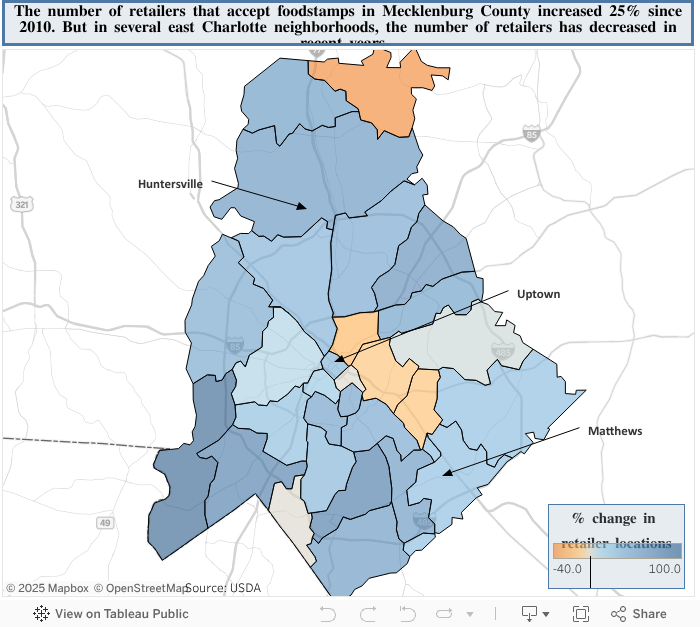
And though Charlotte has generally seen an increase in EBT-accepting stores in the past decade, ZIP code 28205, where the Giant Penny is located, has seen the biggest drop in EBT-accepting stores since 2010, according to U.S. Department of Agriculture data.
That ZIP code still has the highest concentration in the county of stores taking EBT and it includes Plaza Midwood, Villa Heights, Plaza Hills, Country Club Heights, NoDa and Windsor Park.
Nearby 28206 saw a drop, too, and is one of the country’s fastest-gentrifying ZIP codes, which includes neighborhoods like Druid Hills, Optimist Park, and some off West Sugar Creek Road. ZIP code 28213, which runs along North Tryon Street from Hidden Valley to near the University area, showed the biggest increase, with 18 new EBT-accepting stores.
Tran said he fields offers to buy the store nearly every week. But he is determined to hold on to it.
“We just want to keep it in the community,” he said. “That’s really important to us.”
Tran estimates that at least 60% of his customers use EBT to pay for their groceries. And during the pandemic, that percentage increased. The last available data from 2018 show that there are 116,295 SNAP benefits recipients in Mecklenburg County.
He was not surprised to hear that the number of stores that accept EBT have dropped in the area, but thinks it’s not the right call, business-wise.
“There’s no downside financially,” he said. “I think it’s dropped because of the clients…. I think that corporate stores try their best not to cater to the type of people they think use EBT, they want to cater to a more gentrifying population.”
“But we’re not like that. Everyone that comes here is a friend.”
Latrenda Reeder has been a customer of the Giant Penny for a decade. She doesn’t live close by, but she keeps coming back.
“The service is so good, and it’s affordable,” she said. “It’s just a great place.”
Tran said he plans on keeping the Giant Penny in the neighborhood for years to come.
“I think our time here speaks for itself.”
This story was originally published July 23, 2021 at 6:00 AM.