
Charlotte lacks a ‘true iconic urban park.’ Will the city ever get one?
Mecklenburg County Park and Recreation officials say they aren’t sitting idly by as developers gobble up land.
“Land is being bought up very quickly,” Park and Recreation Director Lee Jones told The Charlotte Observer in an interview at the department’s Brookshire Boulevard headquarters. “This is a very aggressive market, and we’re trying to work hard to be a player in that market.”
“I don’t think we’re running out of space,” he said. “It’s just when we have opportunities to get the space, we have to jump on it. We have to be very intentional and be able to move very quickly.”
In April, for instance, the county paid roughly $2.375 million for about 58 acres beside its 168-acre Berryhill Nature Preserve, near the Catawba River, an Observer search of Mecklenburg County land sales revealed at the time. The county bought the property for a future park, a spokeswoman said.
On June 9, the county paid $1.1 million for an additional 23 acres near the preserve, public records show.
And Mecklenburg County is spending an unprecedented $50 million in the fiscal year that began July 1 to buy land for more recreation, Jones said. It’s the largest one-year funding allocation by the county for Park and Recreation land acquisition, Jones said.
“Is it a priority?” Jones said. “Absolutely, providing public recreation spaces and dealing with the fact that almost 100 people are moving to Charlotte and Mecklenburg County every day. That’s a heavy lift. People are moving out, too, but more people seem to be moving in.”
Mecklenburg’s population, which tops 1.1 million, grew by 21% from 2010-20, according to population counts released by the Census in August 2021, the Observer reported at the time.
The influx requires more housing and public services, including recreation amenities, Jones said. “So we’re trying to stay in front of that,” he said.
The Observer asked top parks officials about the county’s commitment to more parks after years of Charlotte-Mecklenburg County finishing near or at the bottom in an annual ranking of large U.S. cities for parks, greenways and accessibility of outdoor spaces.
Charlotte-Mecklenburg County placed a lowly 83rd out of the top 100 most-populated U.S. cities in the latest annual ranking by the 50-year-old Trust for Public Land conservation group, the Observer reported in May. The park system has consistently ranked almost last across the country’s 100 largest cities since 2012.
And residents working to create a signature park called Queens Park north of uptown say Mecklenburg’s park system has a gaping hole.
“Charlotte lacks a true iconic urban park,” Eric Spengler, a Charlotte lawyer and director of Friends of Queens Park, told the Observer.
$297 million in new recreation sites
Catawba County made headlines with the June 18 opening of Mountain Creek Park north of Charlotte. The massive 606-acre park on the northwestern tip of Lake Norman includes everything from mountain bike and hiking trails to bird-watching, paddling and pickleball courts.
In Mecklenburg County, Park and Recreation maintains a total of about 240 recreation sites, including what Jones called a major park in each of Charlotte’s four wards, as called for by the city’s Civitas plan in the late 1990s-early 2000s, he said.
The county develops and manages Charlotte’s parks, greenways, preserves and other recreation amenities, and Mint Hill’s recreation offerings. Park and Recreation collaborates with Mecklenburg’s other municipalities — Cornelius, Davidson, Huntersville, Matthews and Pineville — on their recreation initiatives, Jones said.
Of the county’s 525 square miles, Park and Recreation owns just over 22,000 acres, including parks, greenways, nature preserves, nature centers, recreation centers and undeveloped properties, Jones said.
Jones and top staff highlighted how Park and Recreation started or finished the $297 million in recreation initiatives called for in the county’s 2019-23 capital improvement plan.
The 60-plus projects included the $40.5 million American Legion Memorial Stadium near uptown. The stadium opened in 2021 on the site of its historic namesake stadium, which was razed due to age-related structural issues.
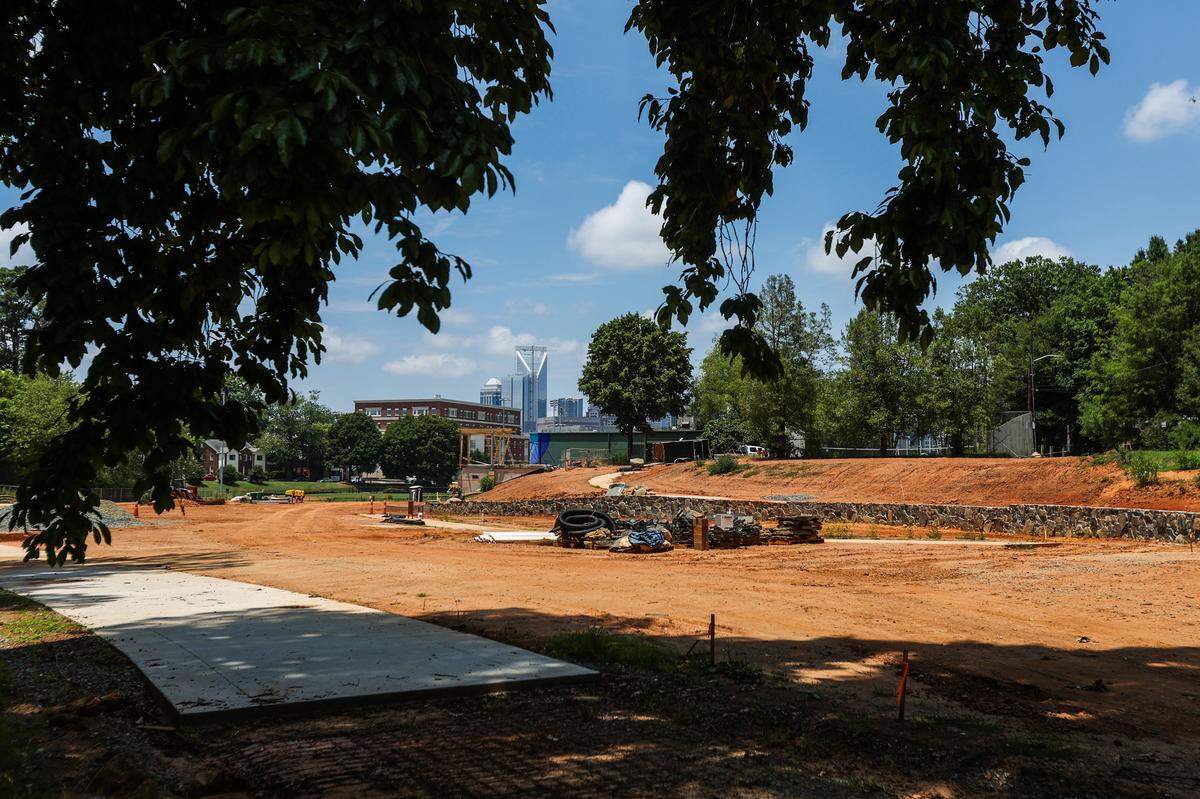
Charlotte’s oldest park, 115-year-old Independence Park at Hawthorne Lane and 7th Street, is getting a $6 million upgrade under the capital improvement plan. Wilmore Centennial Park opened in South End, and plans are progressing for Ezell Farms Community Park in Mint Hill and 114-acre Eastfield Park in the Huntersville area.
Park and Recreation officials have begun considering projects to include in the county’s planned 2024-28 capital improvement plan. As with the current plan, many will be new projects, others upgrades or retrofits of existing sites, officials said.
Equity, diversity and inclusion are important factors when the county scouts land for recreation amenities, Jones said.
Regarding the continual parcel search for new parks and other recreation, Jones said: “We’ve looked at what we call our priority areas — areas where we have not enough parks to meet the population, where we don’t have easy access to the parks in terms of travel to them.
“And we’ve done a lot of studies with regards to what impedes our ability to have access” to parks, he said.
Officials issue a caution
Despite all of the projects accomplished and planned, building new parks, greenways and preserves isn’t done overnight, cautioned Chris Matthews, the Park and Recreation official in charge of nature preserves and natural resources.
Mecklenburg County has one of the largest park systems in the U.S., so “we can’t just build new parks all the time,” Matthews said. “We have to take care of what we have. And what that means is, it can often take us 20 years to get around to finally building something.
Last year, the Observer reported that nearly 50 parks across Mecklenburg County were in poor condition — plus 21 recreation facilities and three greenways.
The starkest problems and costliest improvements were in lower-income neighborhoods, historically under-served, Peter Engels, chair of Mecklenburg’s Park and Recreation Commission, said at the time.
Thirteen parks had failing marks and 36 had “D” ratings, based on inspections spanning November 2019 to February 2020. A handful of those places are under construction now, including Pearl Street Park.
Makeovers of such parks are slow to accomplish, as the county balances maintaining existing facilities and improving those most in need, the Observer reported last year. And funding through Mecklenburg’s capital improvement plan is done in five-year increments.
As for new parks, Matthews said: “We have to plan for the future. “The county’s commitment to $50 million for land acquisition shows that everyone understands we have to get it while we can.
“I grew up here, born and raised here,” Matthews said. “I’ve seen the county change dramatically in the 56 years I’ve been alive. In the not-too-distant future, we’re going to be mostly built out, so that’s going to create a challenge for everyone.
“I think sometimes there’s an expectation that we can just buy land and build a park and it’s all good,” he said. “The reality is, it’s real money. It takes a lot of money to build high-quality stuff for people, and we just gotta plan for it because our needs are big.”
Said Jones: “We have to be intentional and comprehensive with what we do. That’s why we have short, intermediate and long-range planning, in order to be able to achieve those goals.”
Queens Park effort lives on
Queens Park supporters hope the county will consider their plans for a 27-acre park, too.
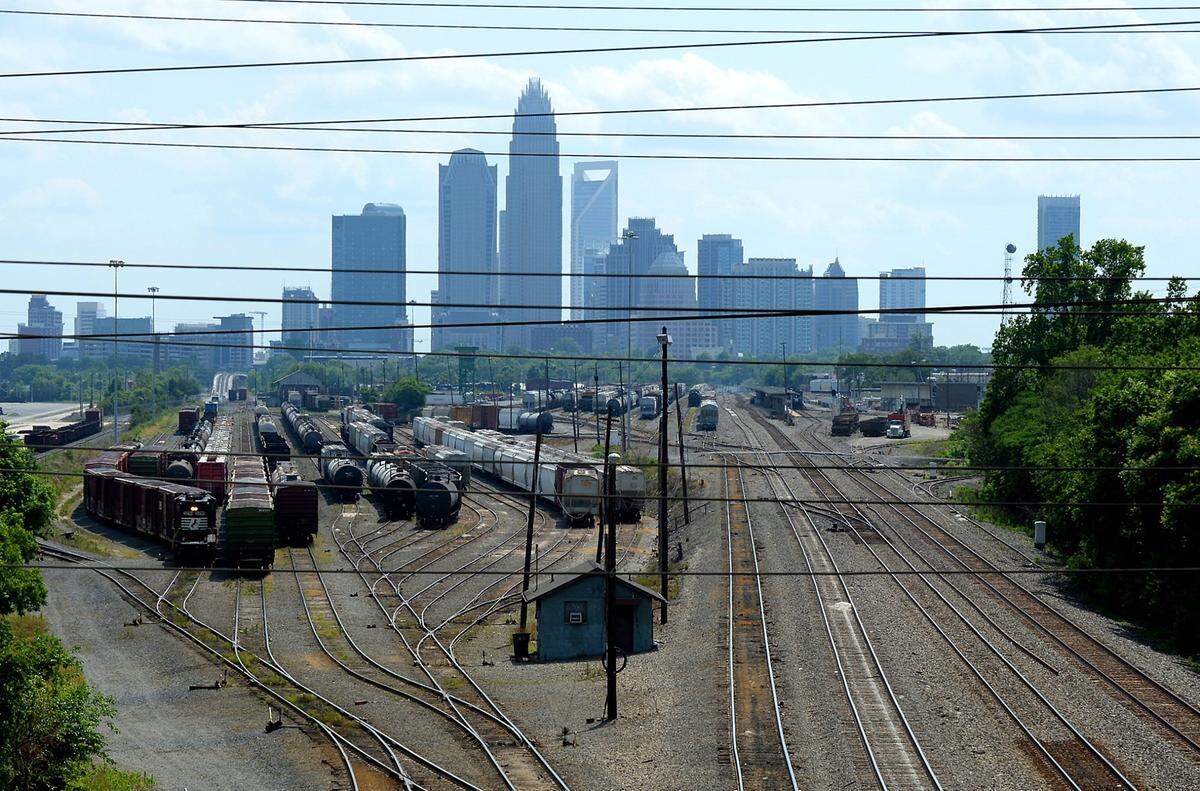
Supporters originally envisioned a 220-acre park that would have been the largest in the metro area, but Norfolk Southern declined letting the group convert a 110-acre railyard as part of the plan.
“As we’ve shared before, our railyard in Charlotte remains an active and critical part of our operation, supporting numerous rail shippers in the Charlotte area,” Norfolk Southern spokesman Connor Spielmaker told the Observer in a July 2 email. “It is not available for use as a park.”
Still, 25 acres “is a large urban park,” Queens Park board member Tony Kuhn said. Kuhn is president and founder of developer Flywheel Group and chairs the effort’s urban design committee.
“If we really want a city with proximity to urban design and urban living, we need something to connect them,” he said of the park.
The acreage includes mostly city- and county-owned parcels and some private ones, he said.
The Cross Charlotte Trail runs through the site, and the Matheson Avenue bridge “flies over” the city- and county-owned parcels, he said. The site has access to light rail.
“It’s a great space,” Kuhn said. “What type of city do we want to be and how are we spending our money?
“This is the future of great cities,” he said of such parks.
“I think that’s true,” Jones, the county Park and Recreation director, said about the potential of such urban parks.
“If you could get a large space that was not environmentally or infrastructure-compromised and you had the opportunity to develop it, sure it can be good,” Jones said.
“Every park we’ve built uptown has spurred three things: It’s been protective of the environment, it’s spurred wonderful recreation opportunities that put Charlotte on the map and third, it spurred economic opportunities.”
“But it’s a preliminary design,” Jones said about Queens Park. “We have not sat down to form a partnership, formulate a strategy to move forward and to see how that would happen. (More specifics) would be helpful.”
Officials question low rankings
As for Park and Recreation’s low annual Trust for Public Land rankings, officials acknowledged that access to parks isn’t up to that of their peers.
Mecklenburg, however, would have ranked highest if the trust placed greater emphasis on other key factors, they said.
This year’s 83rd-place finish continued a streak of dismal performances in the group’s ParkScore rankings.
In 2018, the Trust for Public Land ranked Charlotte dead last out of 97 cities, the Observer reported at the time. Only 28% of residents lived within a 10-minute walk to a park, the nonprofit said.
Now? Some 37% of us live within a 10-minute walk to a park, a percentage still deemed “below average” by the Trust for Public Land.
The trust bases its rankings on parks and recreation access, investment, acreage, amenities and equity.
Charlotte-Mecklenburg scored “below average” for the amount of land dedicated to parks and recreation — 6% of its land — but “above average” for the $106-per-capita spending on parks and recreation and “about average” for park amenities, the trust found.
Spaghetti-like road network blamed
Charlotte’s bowl-of-spaghetti road network over the past century put the city at a disadvantage in the Trust for Public Land rankings, Park and Recreation officials said.
Access to parks was a top consideration in the rankings, Park and Recreation officials said they learned after contacting the trust. Charlotte’s dizzying road network makes it more difficult to get to parks than in other cities, officials said.
Matthews said he sees a park from his home but it takes 10 minutes to get there due to roads in the way.
Chicago, New York City, Washington, and other top-10 cities in the rankings were developed in grids with frequent parks, Park and Recreation officials said.
Still, in 2012, when the county placed last among 40 cities in the rankings, the National Recreation Park Association named Mecklenburg Park and Recreation best in the U.S., Jones said.
Park and Recreation receives customer satisfaction scores of 98% and 99% and tops the other cities for median acreage per resident, according to Liz Morrell, Park and Recreation manager of strategic planning and historic, cultural and community resources.
Charlotte also would rank near the top for climate resiliency, “because we do so much from an impervious-surfaces, sustainability standpoint,” she said. “We have such large green spaces, but that’s not the focus of the study.”
“It’s just about what you measure,” Matthews said.
Observer staff writer Gordon Rago contributed.
This story was originally published July 7, 2022 at 6:00 AM.