Sued after two deaths, SouthPark builders warn they can blame men for not escaping fire
Companies building the SouthPark apartment complex where two workers died in a massive fire last year have issued a warning.
If they are labeled negligent in the deaths, they will make a case that the men who died were negligent for not escaping alive, says a court filing by an attorney representing companies being sued over the workers’ deaths.
Other workers in the building, including some on the same and higher floors, “were able to hear, (heed) and follow evacuation warnings and instruction,” reads the filing for the companies, some of which were cited for state safety violations after the men died.
In making the argument, attorneys are threatening to use a defense allowed only in North Carolina, three other states and Washington, D.C.
It is called the contributory negligence defense. It states that if victims helped cause their injuries — even in the slightest way — then the victims or their families get no financial compensation at all.
Some call the defense fair. Others call it archaic and draconian.
Efforts to change the North Carolina law have failed, including one led by powerful state Senate Republicans in recent years.
Faith Fox, the Charlotte attorney who is representing the families of Reuben Holmes and Demonte Sherrill, declined to comment on the defense’s argument.
But in a court document filed this month, she wrote: “The circumstances surrounding the fire on May 18, 2023, demonstrate conclusively that at no point did Sherrill and Homes have the ability, awareness, or practical opportunity to alter the course of events leading to the tragic outcome of their deaths.”
Trapped on the sixth floor
In May 2023, Holmes and Sherrill were hanging windows on the sixth floor of a 239-unit apartment building under construction on Liberty Row Drive.
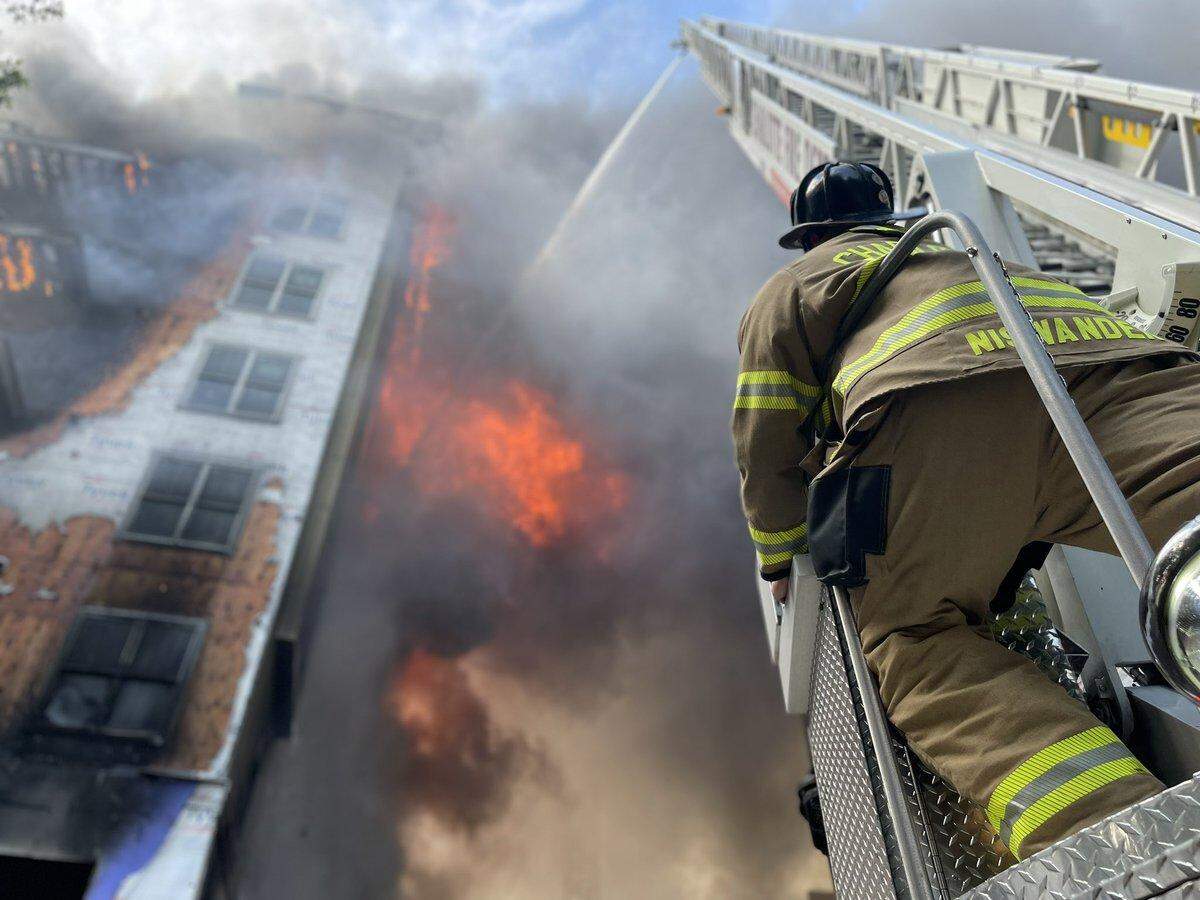
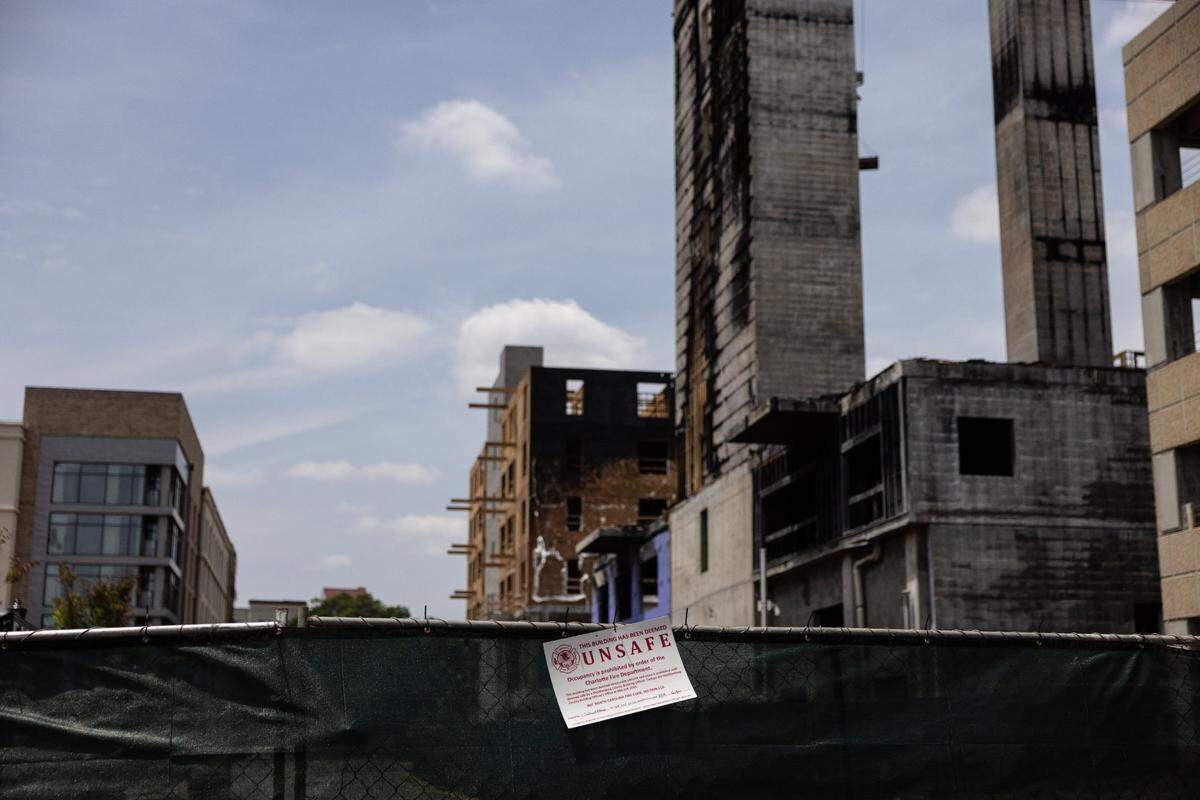
In the parking garage below, a generator’s diesel engine in a trailer filled with spray-foam chemicals failed, a N.C. Department of Labor investigation found. The trailer ignited, sending flames racing up the mostly wood-framed building under construction.
Holmes and Sherrill were about 460 feet from the building’s lone stairway when Holmes called his boss, owner of KS Windows and Doors of Atlanta, a state Department of Labor investigation found. He said they were trapped, the state records show.
Firefighters made it to the sixth floor and could hear Holmes and Sherrill crying for help, according to a lawsuit filed by the men’s families. But rescuers got lost in the heavy smoke and called a mayday before they found the building’s stairway on their own.
In May, the families of Holmes and Sherrill sued Mill Creek Residential, the site’s developer; MCRT Carolinas Construction, the contractor; and its subcontractors alleging that a series of their failures led to the workers’ deaths.
Safety precautions taken by MCRT Carolinas at the site the day of the fire steps didn’t match the construction site’s written emergency action plan, state labor officials found. The plan described three exits from upper floors, but only one existed the day of the fire, for instance.
The building lacked code-required water connections, which would have helped firefighters suppress the blaze and rescue Sherrill and Holmes, the families’ lawsuit alleges.
And an air horn — a loud warning device commonly found at construction sites — never sounded, labor department records state.
“The violations prevented egress, impeded firefighter rescue efforts and thwarted fire suppression efforts, thus allowing the Fire to spread, effectively unchecked, until it killed Demonte Sherrill and Reuben Holmes,” the families’ suit alleges.
In answering the complaint, an attorney for MCRT Carolinas wrote this month that if his clients are found to be negligent, then Holmes and Sherrill were also negligent for failing to care for their own safety and evacuate, court records show.
Other workers on the sixth and seventh floors followed evacuation orders and left the building safely, wrote Christopher Derrenbacher, attorney for MCRT Carolinas.
“Unfortunately, Decedents did not evacuate the building…,” Derrenbacher wrote.
In an email to The Charlotte Observer, a Mill Creek Residential spokesman declined to discuss the filing, saying company officials “do not/cannot comment on pending litigation.”
All or nothing defense argument
Accusing workers of contributory negligence is common in North Carolina, said Camille Payton, a Charlotte lawyer who has represented the victims of workplace accidents.
And it often works, she said.
The threat of the all-or-nothing argument can convince injured workers to settle a case or settle for less money than a jury might award, Payton said.
If a case with a contributory negligence defense goes to a jury, the jury is first asked if the defendant’s negligence caused the person’s injury.
If it answers yes, it’s asked if the victim behaved in a negligent manner that contributed — in any way — to the injury.
“If they check yes to that one, it’s all over,” Payton said.
The argument is effective among jurors due to a natural human tendency to think that they would have acted differently or somehow prevented an injury, said Charlotte attorney Vernon Sumwalt.
But it’s a defense that blames victims, he said. And in the SouthPark case, he said, that’s a bold move.
“You’re not going to sit there in a burning building and say, ‘This is pretty’,” Sumwalt said. “If you can evacuate, you’re going to evacuate.”
Few states are like North Carolina
Only North Carolina, Alabama, Maryland, Virginia and Washington, D.C. allow the contributory negligence defense, which would bar victims from any financial compensation if a jury says that the victim’s negligence played even a small role in the injury.
All other states have a variation of a different standard, which, for instance, states that if a victim is 1% at fault for the injury, then the victim would receive 1% less than the total award.
Nine times since the 1950s, lawmakers here have tried shifting to the standard that might reduce compensatory payments rather than eliminate them completely, said John McCabe, a Cary attorney and member of North Carolina Advocates for Justice, a nonprofit organization of trial lawyers.
All failed, including two recent attempts.
In 2021, three Republican lawmakers filed the Victims’ Fair Treatment Act, a bill that sought to allow those who were injured to to be compensated even if they were partially responsible for the accident.
Among the sponsors were highly influential legislators: The former Senate Majority Whip Jim Perry of Lenoir County and Danny Britt of Robeson County, chair of the Appropriations on Justice and Public Safety.
McCabe, who called North Carolina’s contributory defense law “inherently unfair” to victims, expected that bill might finally end it, he said.
“When you have prominent, powerful people looking to change this law that’s a big deal,” he said. “And they’re in the majority party.”
The fairness act died in a Senate committee.
In 2023, House Democrats filed a bill that would have allowed victims of injury or death — or their families — to be compensated if their negligence was less than or equal to the defendant’s negligence.
That, too, failed.
Efforts to ban the contributory negligence argument has met stiff opposition from influential industry groups, including the N.C. Chamber of Commerce and the Insurance Federation, McCabe said.
The contributory negligence argument is based on the long-held belief that people have the responsibility to keep themselves safe, said Kate Payne, spokesperson for the state Chamber of Commerce.
Outlawing the defense “would incentivize plaintiffs’ lawyers — who can collect nearly half their clients’ settlement costs — to target the largest conceivable number of defendants with every lawsuit,” Payne said in an email to The Observer.
But one of the sponsors of the 2023 bill, Rep. Tim Longest of Wake County, said he believes it is only a matter of time until North Carolina lawmakers outlaw the defense argument.
“It offends our basic sense of fairness,” Longest said. “I’m confident that we will abolish contributory negligence eventually, and we will catch up with the other 46 states.”
This story was originally published October 22, 2024 at 5:30 AM.