Gaston County’s only homeless shelter closed last fall. Without it, ‘Where do they go?’
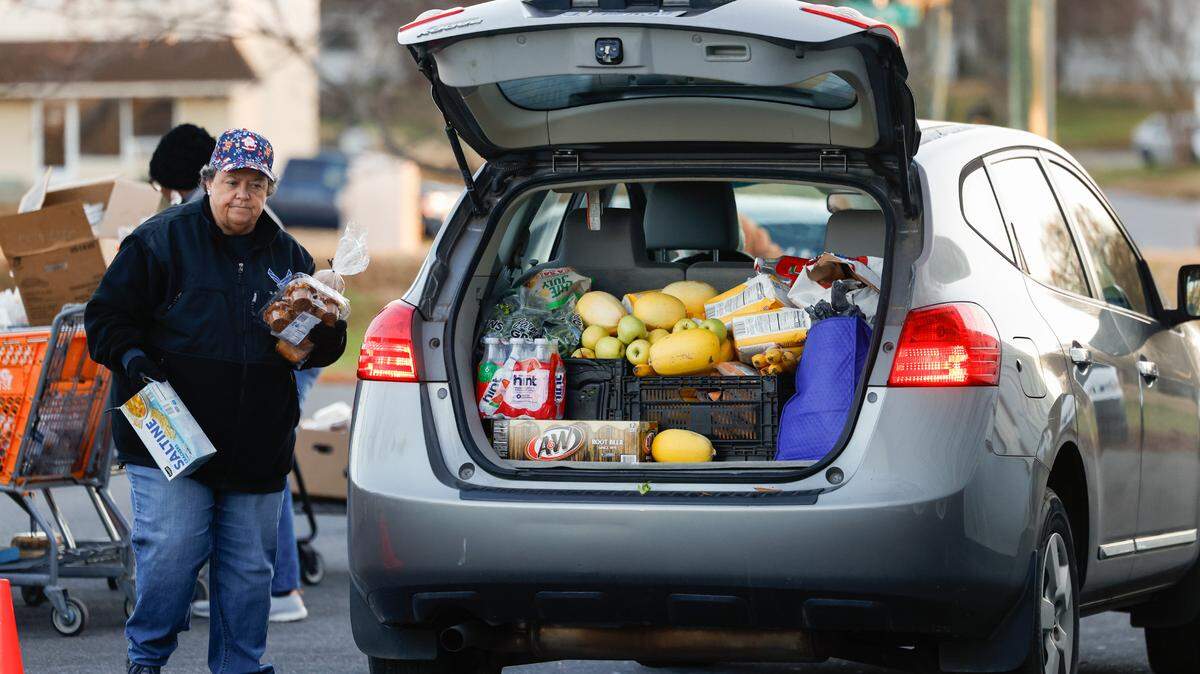
Early on Thursday mornings — just as daybreak’s hues of pink and orange illuminate the sky — the grounds of Mt. Zion Restoration Church transform into one of the largest hubs of resources for low-income and unhoused people in Gaston County.
Out front, Pastor Rodney Freeman and several volunteers — bundled up in thick winter coats, huffing out little clouds of breath — rush to set up the Bountiful Blessings food pantry. They unload a semi-truck full of food and organize pallets of fresh produce and groceries. Just a few steps away, a van operated by Atrium Health sets up to provide health care to the community.
Across the street, partner organizations set up stations for showers, laundry and clothing for the homeless. Volunteers man tables and tents and greet unhoused folks as they pass by.
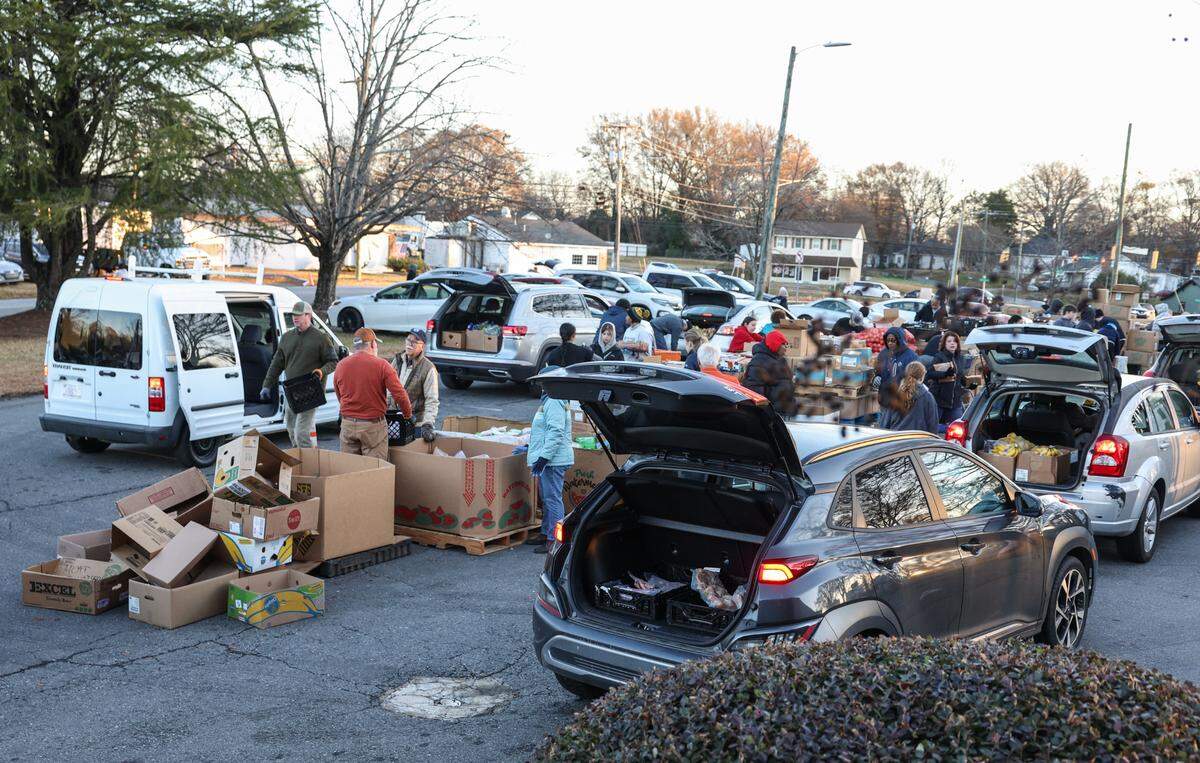
Behind the church, hundreds of cars wind through the adjacent neighborhoods, waiting to gain access to this hub of vital resources. Some of the cars — which sit with their trunks open wide in anticipation — have been parked and waiting in line since the evening before, Freeman said.
The need is great for help like this in Gaston County, advocates say. Freeman said his organization alone is feeding 2,800 families a week and in the past year, they’ve given away 2.8 million pounds of food.
Their work has never been more vital following cuts in homeless services by Gaston County government and the Salvation Army.
In August, the Salvation Army closed the county’s only homeless shelter — putting a homeless person in Gastonia up to a six-hour walk away from the nearest shelter. Two months later, the county announced it was eliminating a department dedicated, in part, to homeless prevention.
Without a shelter, “Where do they go?” Freeman asked.
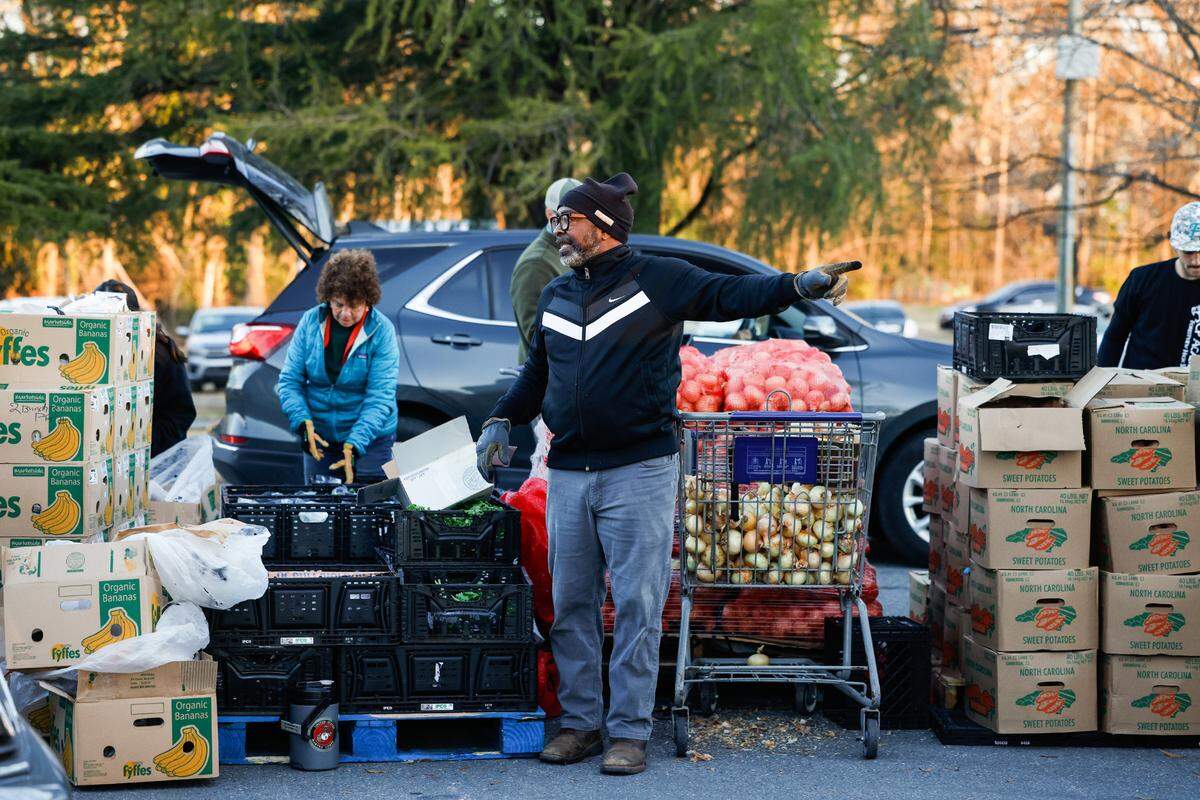
For advocates, the issue is two-fold. While they are happy to help, they need support. And without a shelter, their efforts are just a Band-Aid on the lingering problem of homelessness without consistent housing.
Advocates say elected officials view homelessness as a community issue, not a government one.
“I think that the other entities within the community have really stepped up and taken it over,” Freeman said of homeless assistance efforts. “I don’t think the government (even) wants to be a player. I’ll be honest with you.”
A county official, however, says that sentiment is unfair.
“Gaston County has spent over … $2 million on homelessness, and we’re not charged to do so,” county commissioners Chairman Chad Brown said. “I’d like to see how much anybody else has put in compared to what Gaston County has put in.”
A county without a shelter
Carie Quates found out she was going to be homeless just before her 50th birthday.
The money she’d handed over to her roommate, whom she’d known since they were young girls, to pay rent and bills hadn’t been going to the intended place. Instead, unbeknownst to Quates, her money was being used to fund her roommate’s fentanyl and gambling habits, she said.
Without payment, their landlord wanted them out. And the $925 a month from her late husband’s VA pension isn’t enough to pay rent and bills by herself.
She spent a few nights at the Salvation Army, but it closed not long after she found herself on the streets.
Now, she sleeps in a tent in the woods, relying on the hub of resources at Mt. Zion Restoration Church every Thursday and waiting for the day she can have a home again.
‘I’m gonna get off these streets one day,” she said. “There’s a reason I’m out here. God’s got me out here for a reason.”
The Salvation Army’s closure of its shelter eliminated the only emergency shelter option for people like Quates in Gaston County. But the organization’s leadership says the decision reflects current and future demand.
Gaston’s Salvation Army leadership did not make themselves available for an interview, but responded to emailed questions from the Observer.
The decision, they said, was informed by the Salvation Army’s 2023 Mission Planning Study. The study concluded that an emergency shelter was not the most cost effective way to address homelessness. In lieu of the shelter, the Salvation Army would shift to a “homeless prevention” program.
The shelter had 64 beds. On average, only half were filled each night, said Maj. David Phelps, the Salvation Army Officer for the Gastonia branch. In the email, Phelps said housing someone in a shelter bed costs $10,000 annually to cover room, board and case management and social services costs.
The first step of the Salvation Army’s new homelessness prevention model was to place the shelter’s remaining 34 residents into “sustainable housing” before it closed August 31. Phelps said this was done in partnership with the county Department of Social Services.
When asked what the housing looked like and whether the 34 residents were still housed, Phelps directed the Observer to the county.
The county paid more than $506,000 from the Emergency Rental Assistance Fund to put the shelter residents into hotels. But as of November 19, the residents were no longer being housed, a county spokesman said.
Phelps did not respond when asked if the Salvation Army considered that it was the county’s only shelter before it decided to close.
Chairman Brown said he didn’t have any issue with the Salvation Army’s decision.
“We don’t have a dog in the fight, so to speak,” he said. “It’s a private entity. We hate to see any type of help go away. But you know, those are business decisions for the Salvation Army to make.”
Another shelter?
According to the most recent Point-In-Time count, 388 people were counted as homeless in Gaston County. But national experts have long warned that the count is not the most accurate snapshot of homelessness in communities.
While the Salvation Army says its aim is to prevent homelessness, some advocates have seen the opposite.
Dwayne Burks is the executive director of Gateway Gaston, an organization that connects people with resources. He said since the shelter closure, he has seen an “explosion” of homeless encampments. But he doesn’t see a desire from elected officials to make another shelter happen.
“There’s no real appetite to do it here,” he said. “Our elected officials have taken the posture of, well, if you’re poor, it’s probably because you just won’t work. So if you get a job, it’ll be all right.”
Brown, the commissioners chairman, said that the county would look at available resources and see if the private sector would want to be involved in creating a new shelter.
But as far as the county taking on that responsibility: “It’s a hard line to say that the county bears the burden for that.”
Brown said he’s grateful for community partners who’ve stepped up to help address the issue, but also thinks those who are unhoused should give back to the community that has helped them.
“They’re not going out and helping those who were providing them with food,” he said. “They’re not helping, you know, it’s basically the handout system is one way.”
Overhead costs shutters department
In early November, Gaston County announced the closure of the Community Support Service department. The department was created in January 2023 and housed a variety of social services.
A press release announcing the closure said the county’s work supporting the homeless would be shifted to the Health and Human Services department. The department will officially shutter in mid-February.
“We remain committed to working on these issues with existing staff, but by also doing more to partner with nonprofits, the faith-based community and all our municipalities,” communications director Adam Guab said in an email.
County Manager Matt Rhoten declined an interview with The Charlotte Observer. In an email, Guab said while the department was intended to expand the county’s social services work, it created more overhead costs than the county wanted.
“Overall, we must evaluate such spending as part of the larger budget landscape. The county has limited funds that must also support other priorities, such as education, public safety, and other essential public services,” Guab said in an email.
When it comes time to look at the budget, much of the money is spoken for, Brown said. That leaves commissioners with only a portion of that money and decisions on where to allocate it.
“I think a lot of people try to pigeon hole our conversations around homelessness,” he said. “If we could deal with just homelessness, if that was the only burden we had to do, then we’d probably be a lot more successful.”
Despite county commitments, some advocates see the department’s closure as part of a move to rely on the community to address the problem.
“I totally disagree with that,” Freeman said, “because I believe that it has to be a partnership.”
‘I’m just a person’
Each week Jeannine Beert and a volunteer named Devon Ballew take turns unloading clothes from their yellow truck and placing them on white folding tables. Unhoused people pulling wagons or with extra room in their backpacks quickly stop by to peruse this week’s selection.
Beert runs an organization called Hearts2Home which provides furniture to people transitioning out of homelessness. But each week, she adds clothing outreach to her portfolio as she unloads garbage bags of donated garments.
The organization is largely funded out of Beert’s pocket. As a Realtor, each home she sells is another opportunity to pour into her nonprofit.
But she finds herself exasperated by requests to do more without resources.
“I get a call weekly from a police officer (or) somebody in the city or county, asking me if I know how to get somebody a house or shelter,” she said. “I’m just a person. I started this non-profit. It’s me and Devon that do this. We’re making an impact, but we’re just individuals that don’t get any money from the city or government.”
Homeless prevention efforts can’t happen without a shelter, advocates say. The average rent in Gaston County is nearly $1,600 a month, more than what many unhoused people can afford on pensions and Social Security checks.
Churches do what they can, but asking them to convert into a full-time shelter amongst all their other responsibilities can be a challenge, Gateway Gaston’s Burks said.
“It’s not either-or, it’s both-and,” Burks said. “You have to have the chronically unhoused cared for in a dignified, safe way. And (for) the people who can get rehoused and remain housed, you have to have support structures for them.”
Beert peers over the heads of the unhoused grabbing clothes from her tables and watches the masses come from every direction to take advantage of the resources that surround her.
“We’ll be able to keep sustaining this. What you see here, that’s not going to be an issue,” she said pointing her hand in front of her. “It’s just (that) we’re not solving anything here. We’re taking care of basic needs, and that’s not a solution.”