Mecklenburg hits record number of adults, kids living on the street, report finds
The number of people living on the street in Mecklenburg County has reached an all-time high. And that includes families with children, according to data collected from the county’s annual survey of the homeless population.
January’s Point-In-Time count showed that 444 people were experiencing unsheltered homelessness in the county. That’s the highest number of people the county has seen living outside since 2010.
Of that group, six people were minors, another record. That’s the most children the county has seen living outside since 2008.
The Point-In-Time, or PIT, count is an annual nationwide event where volunteers survey and count individuals experiencing sheltered or unsheltered homelessness every January.
The data is considered the minimum number of people experiencing homelessness. The count isn’t an absolute number, especially when surveying people living outside.
But even with the temperatures dipping into the low teens on the day of the count, the numbers for the unsheltered population were extremely high, pinpointing a need for more services, county officials said.
“I feel like I’m oversimplifying by saying there’s still more work to do, but there is,” said Karen Pelletier, a division director with the Mecklenburg Housing Innovation and Stabilization Services. “This data supports that. There’s a continued need to fund street outreach. There’s a continued need to expand emergency shelter and we know we need more housing in our community.”
Mecklenburg County’s unsheltered population
Overall, 2,101 people were experiencing homelessness during the PIT count, a six-person increase from last year.
The numbers are broken down into people living outside and people living in either emergency shelters, transitional housing or safe havens, which is a shelter for veterans.
The unsheltered population increased by 16% from last year, going from 384 people to 444.
.png "image (23).png")
Of this group, 116 people were newly identified to the county, meaning they had never had an interaction with any homeless service provider in the county.
“We had never engaged with these people before,” said Mary Ann Priester, Mecklenburg’s Housing and Homelessness Data and Research Coordinator and PIT count coordinator.
“They had not touched our system,” she said. “Even though we’ve invested heavily in street outreach, there’s still not enough resources to do the work to help everybody that’s sleeping outside.”
Of those living outside, there was also an increase of people experiencing chronic homelessness — meaning they have a disability and have experienced either a continuous year of being homeless or four periods of homelessness that equate to a year.
Chronic homelessness increased by 6% overall. More than half of the people living on the street were chronically homeless, which is a 10% increase from last year.
“We do see higher rates of people with severe persistent mental illness, higher rates of people with HIV, AIDS and higher rates of people that report that they’re survivors. So the people that are outside and are living unsheltered are really our most vulnerable group of people,” Priester said.
Mecklenburg County’s sheltered homeless population
The number of people in shelters decreased by 5%, going from 1,711 people last year to 1,657 people this year.
There’s a caveat to that number, however, according to Priester. The number of shelter beds has decreased since last year, especially with the renovation and closure of Booth Commons, a Salvation Army shelter in a former hotel.
Less shelter space means fewer people in the shelter.
“There were no beds available for people to be in shelter even if it was cold and even if they wanted to be inside,” Priester said.
That caveat also applies to the number of households counted with children. A household is considered a grouping of people. There was a 30% decrease in the number of households with minor children experiencing homelessness compared to last year.
However, there is only one shelter in the county that serves families with minors, according to the county report. That shelter also serves single women and there are more single women utilizing that shelter, leaving less space for families.
Of the 1,657 people living in shelters, 308 were minors.
The cause and solutions to Meckleburg’s homeless issues
Issues relating to housing are some of the broader reasons for the county’s increase in homelessness. There’s the rise in housing costs, the lack of affordable housing and the numerous barriers stopping someone from entering housing, such as evictions, low wages and mental health needs.
Looking at these issues:
▪ In the past decade, average rent in Charlotte increased by 43%, according to data from CoStar, a real estate research firm.
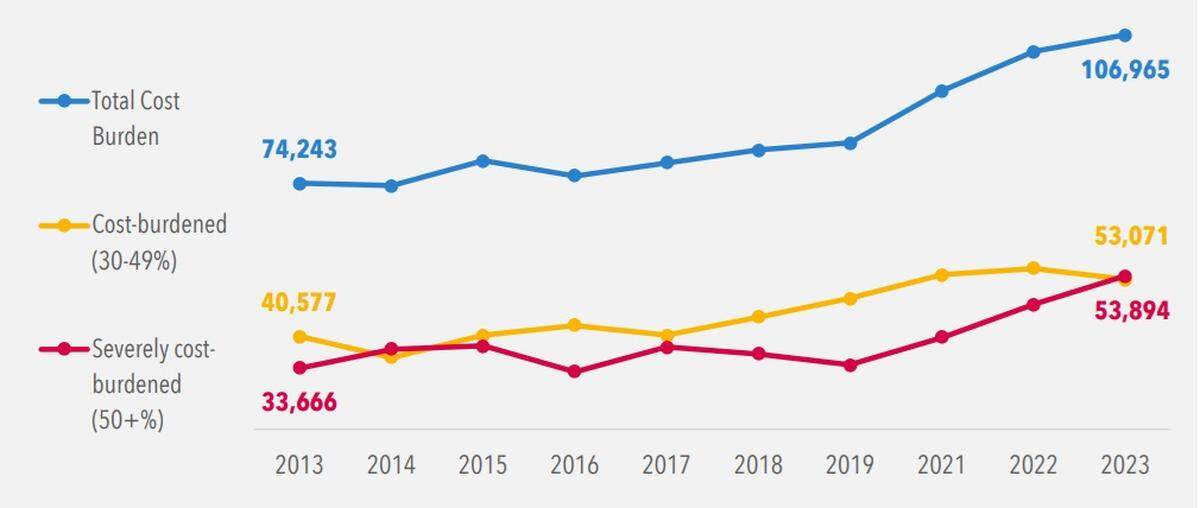
▪ Nearly half of renters in Mecklenburg County pay more than a third of their income toward housing costs — meaning they can’t sustainably afford rent, according to census data.
▪ In the Concord-Charlotte-Gastonia metro area, there are 31 affordable and available rental homes for every 100 households in need, according to the National Low Income Housing Coalition.
▪ About 46,026 families faced an eviction filing in 2024.
▪ Around 11% of Charlotteans live in poverty.
But again, housing is a broad need.
So, the county is taking a targeted approach in addressing the needs of those experiencing or on the cusp of homelessness.
To move people off of the street, the county is looking at purchasing a hotel to use as the area’s first non-congregate shelter. The move would add much needed shelter space to the region but would also quell concerns from some shelter-resistant people who may need or want more privacy, safety and autonomy.
The shelter’s creation is also part of the “unsheltered” pillar within the “A Home For All” initiative spearheaded by United Way of Greater Charlotte.
The plan, which started in 2022, seeks to address immediate needs like shelter, and long-term needs such as affordable housing, mental health and workforce development.
The county is also working on increasing preventative measures to stop families from entering into homelessness. The city awarded the county $190,000 in Emergency Solution Grant dollars to help fund and create preventative programs.
Those programs are in the works and will be created in partnership with Community Solutions, a nationwide nonprofit working to end homelessness, Pelletier said.
The county is also seeing some successes with existing programs. There’s been homelessness reductions among veterans, domestic abuse survivors and unaccompanied minors, Priester said.
But even with the successes, more people are always in need.
“Sometimes it can feel like we’re not making any progress,” Pelletier said. “I’m very proud of the work our community does but the need continues to escalate.”
Why does homelessness data matter?
It’s going to take all of Mecklenburg County to help decrease the number of people experiencing homelessness, Pelletier said. And looking at the data helps the county and its partners explain the issues to people as well as help buttress funding requests.
“Homelessness is complicated,” Pelletier said. “When we think about the approximately 3,000 people we have on our homeless list, every single number is a human being with a human experience.”
Sharing stories is another way to help, like the story of Abdul Wright.

Wright was found dead on Jan. 23 at 5:26 a.m. on North Tryon Street during the PIT Count. The cause of death was listed as pneumonia, according to the Office of the Chief Medical Examiner.
He was sleeping outside, in frigid temperatures with one jacket, three t-shirts, three pairs of pants and two pairs of socks and underwear. Wright was chronically homeless and had a history of mental illness but he was ultimately a person, his nephew Nigel Thomas previously told The Charlotte Observer.
Pelletier agreed. She added that in order to prevent deaths like Wright’s, the work most continue.
“Whenever we lose anybody who is living unsheltered in our community, it’s extremely sad… and helps remind us how important it is that people have access to services,” Pelletier said. “We need a multi-system response to prevent that. This isn’t a result of failures in the homeless system but that homelessness is really a failure of multiple systems.”
This story was originally published June 9, 2025 at 5:40 AM.