ICE arrests of people with no criminal records rose in NC before Border Patrol surge
New federal data brings more evidence that immigration enforcement agents are not primarily targeting people with violent criminal records, despite recent messaging from the Department of Homeland Security.
When Border Patrol agents rolled into Charlotte in November, an agency press release painted North Carolina as a “sanctuary” for immigrants without legal status, announcing agents came to “target criminal illegal aliens terrorizing Americans.”
But in the three months leading up to that, Immigration and Customs Enforcement agents in North Carolina arrested an increasing number of people with no criminal records, while picking up a declining number of people with convictions or pending charges.
Most of the arrests driving that disparity happened in Mecklenburg County, where in September about 67% of the 100-plus arrests involved people who hadn’t been convicted of crimes or faced charges, according to a Charlotte Observer analysis of federal data recently released by the U.C. Berkeley-based Deportation Data Project.
ICE spokesperson Lindsay Williams said he was not aware of any edict to pick up more people without criminal records within his agency.
“I don’t think it’s ever a conscious thing,” Williams said, adding: “We don’t care. We want to get public safety threats off the streets of course. But if our mission is to find, arrest, detain and remove aliens, we try to get the biggest bang for our buck.”
Border Patrol operation was high profile
The latest available federal arrest data extends through mid-October, a month before the Border Patrol’s operation in North Carolina, which began in Charlotte and expanded into the Triangle.
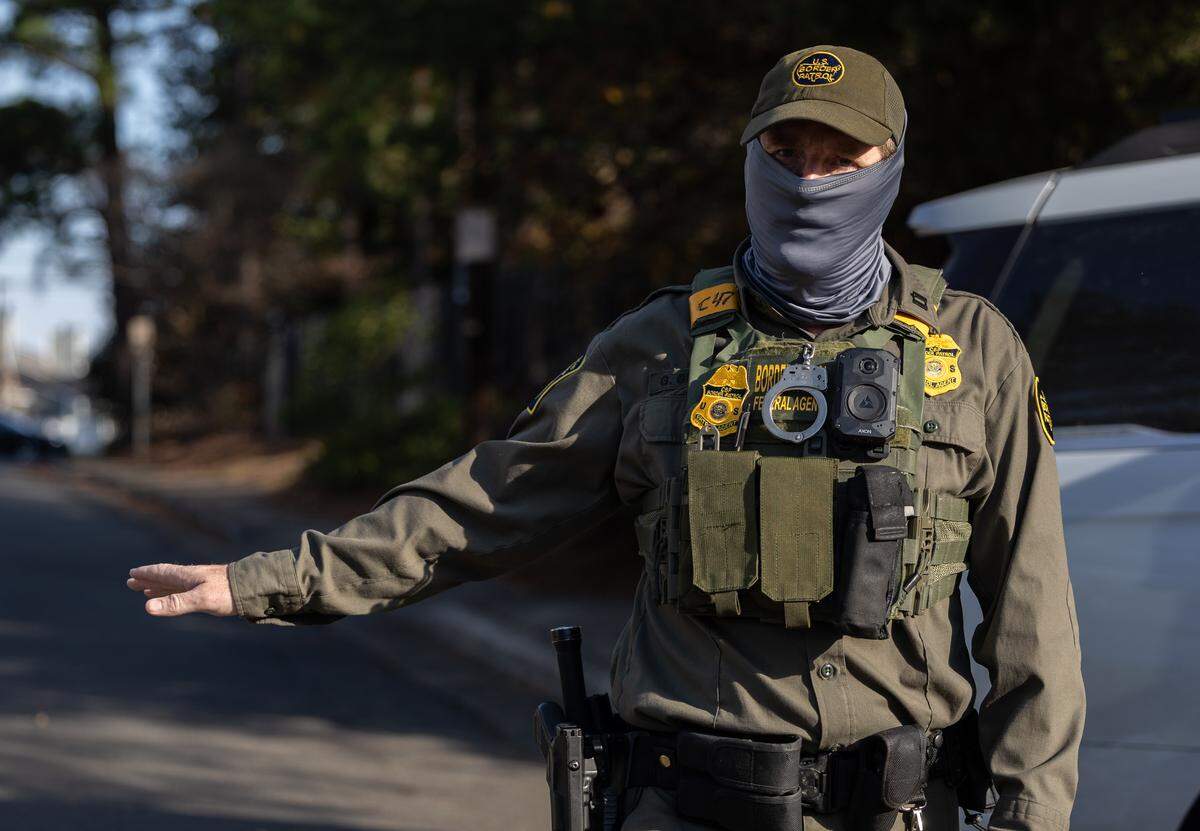
Those agents flooded Charlotte for five days starting Nov. 15. In unmarked SUVs and masks, they circled public areas including shopping center parking lots questioning and detaining people, often Hispanic people, they found there.
They smashed a man’s car window and stole his keys, stormed a church property, and dragged a young worker out of a grocery store. Thousands of students stayed home from school and businesses in East Charlotte, a heavily Hispanic area, closed.
It is unclear how many people the Border Patrol arrested in the Charlotte area because the government has published conflicting numbers with no explanation. The latest count, released Tuesday by Department of Homeland Security spokesperson Robert Brisley, is 425.
Federal officials are not releasing the names of those 425 people or where they were taken after their arrests.
CBS News on Nov. 24 reported that it obtained a document showing fewer than a third of 270 people arrested during “Operation Charlotte’s Web” were classified as “criminal aliens.” But it has not posted the document.
ICE arrests likely to ramp up
The Border Patrol and ICE both are arresting people to comply with President Donald Trump’s orders to remove people without legal status from the country.
While ICE has arrested a declining number of people with pending charges in recent months, a new state law requiring local law enforcement to cooperate more with immigration enforcement authorities is likely to reverse that and result in more arrests in general, Williams said.
He said that the law, known as House Bill 318, is making it easier to arrest people lacking legal immigration status directly from North Carolina jails.
ICE often asks jails to hold people without legal status longer than their otherwise release date from local court proceedings, so a federal agent can come pick them up. Before the law took effect in October, some sheriffs, including Mecklenburg County Sheriff Garry McFadden, argued that they were not legally able to do what ICE wanted.
Now any person in jail with an ICE detainer goes before a judicial official who determines whether they are the person ICE wants. If so, the official issues a state court order directing the local sheriff to hold the person in custody for up to 48 hours and to notify ICE, said Eddie Caldwell, executive vice president and general counsel for the North Carolina Sheriffs’ Association.
Prior to the new rule, about 90 out of 100 sheriffs honored those requests, he said. “As of October 1, to my knowledge, all 100 sheriffs are complying with the new state law,” Caldwell said.
ICE picked up inmates from the jail in Mecklenburg County for the first time this year in October, said Sarah Mastouri, spokesperson for the Mecklenburg County Sheriff’s Office. In Wake County, a policy to honor detainers for people charged with serious crimes that threatened the community’s safety has “evolved to stay current with changes in the law,” according to an emailed statement.
Since ICE no longer has to expend resources to track down people they wanted who got released from jail, the agency will have more bandwidth to arrest people outside of jails, Williams said.
He said if someone the agency wanted to arrest from jail gets released, it can take six to eight agents to do surveillance, find the person, box them in and make sure they don’t hurt themselves or others.
“Imagine we could have gotten this person six weeks ago while they were in jail, and it just takes our criminal alien program team to just drive over to jail, do their credentials, paperwork, grab this person plus whomever else and that didn’t take four or five days or two weeks of looking for this person,” Williams said. “Imagine what else we could have done.”
This story was originally published December 8, 2025 at 6:00 AM.