Cars come in hot — too hot — on this SouthPark road. Will fix make speeding worse?
AI-generated summary reviewed by our newsroom.
- City will spend $3.5M to soften Sharon Road curve and add Eastburn left turn lane.
- Construction starts later this year and continue through 2027.
- Plan aims to reduce crash frequency and severity but might not fix speeding.
When cars round the bend on Sharon Road across from the Sharon Academy preschool, they come in hot. Too hot.
So hot, in fact, that the city is spending $3.5 million on improvements to straighten the four-lane road and prevent cars from veering into yards or over the double yellow.
“It’s like a little s-curve race track there,” said Sarah Plott, whose SouthPark-area neighborhood feeds into Sharon Road.
The city isn’t completely eliminating the curve, but it is softening its sharpness. Crews will start work later this year to flatten the “superelevation” — tilting that makes one side of the street slightly raised over the other. They’ll also install a left turn lane at Eastburn Road and make pedestrian improvements such as a wider sidewalk and accessible curb ramps.
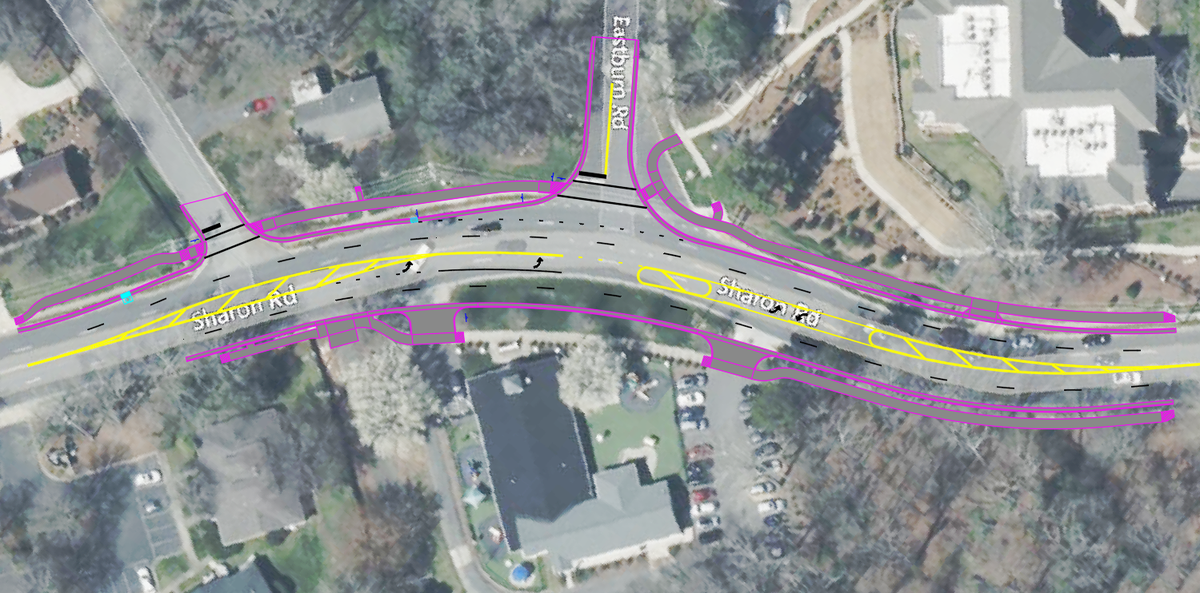
Sharon Road will remain open to two-way traffic with signage and flaggers. Construction is expected to wrap by the end of 2027.
For residents, improvements can’t come soon enough.
Driving habits have noticeably deteriorated since the pandemic, said Plott, who has lived in the same home for more than 30 years.
“It was always something like, ‘Ooh, there’s a big curve, slow down.’ That’s not happening as much anymore,” Plott said.
Cars regularly take the 35 mph road at 45 or 50, according to resident Tim Finch. He avoids that stretch “at all costs.”
“They just go through the curve as if it’s a straight,” Finch said. “Nobody stays in their lane. Everybody on the right creeps left, and everybody on the left creeps right. So if you’re in that center lane, you’re almost holding your steering wheel tight, hoping that the car coming opposed to you doesn’t come over too much.”
There have been 107 crashes along this stretch of Sharon Road in the past 10 years, according to the city. The project is designed to address the factors that led to 64 of those.

Crash frequency has gotten so severe that one Sharon Road resident reportedly keeps a crash kit at her house to aid injured drivers, Plott said.
Plott and Finch are board members for the SouthPark Association of Neighborhoods, a volunteer group advocating for the interests of 38 neighborhoods and condo associations in the area. They’ve worked closely with the Charlotte Department of Transportation on the issue.
A straighter road will hopefully reduce the frequency and severity of accidents, even if speeding and congestion remain, they said.
Could a straighter road make cars go faster? Maybe
CDOT engineering and operations manager Dave Smith presented at a town hall earlier this month held by City Councilwoman Kimberly Owens, whose District 6 includes the SouthPark area.
Some audience members said they worried a straighter road could make cars go even faster. Curves present a natural speed deterrent.
Smith didn’t deny that possibility. Drivers speed up on straightaways, he said. He’s not sure how to fix that.
Hilary Larsen, who chairs the SouthPark Association of Neighborhoods, considers speeding a separate issue from what this project seeks to accomplish.
“Since they announced they were doing it, the question was, what’s going to happen when it’s built? Will people speed? And the answer is, ‘maybe.’ But they’re already speeding in other places, and they’re actually speeding on the curve,” Larsen said. “That’s why people are having these accidents. So speeding is a definite issue, but it’s not one that means you don’t do the road construction.”
Her association polled neighborhoods early on to see where they stood on the project. They supported it, Larsen said, though some individual residents harbored speeding concerns.
“It isn’t going to get better by not doing the project. That’s the part that maybe got lost in that conversation. We have to solve two problems: Speeding and poorly designed roads,” Larsen said.
She’d like to see a bigger ticketing effort from police, more pedestrian crosswalk signals and a thorough traffic study to see just how many cars pass through the residential area, and what that might mean for additional city interventions.
Residents with concerns or ideas can contact project manager Ronakkumar Patel, whose contact information is listed on the project’s web page.
It’s likely too late to implement big-picture changes, Smith told the town hall audience. But CDOT can incorporate feedback to make smaller tweaks, like better driver signage or pavement markers, that lend to the project’s ultimate goal.
“People shouldn’t have cars ending up in their front yards,” Plott said.
This story was originally published March 30, 2026 at 5:00 AM.