
Ham the Astrochimp, first ape in space who retired to the NC Zoo, finally gets his due
AI-generated summary reviewed by our newsroom.
- Ham the Astrochimp flew a suborbital Mercury-Redstone flight in January 1961.
- Ham's flight lasted 16 minutes and reached about 157 miles altitude.
- Ham retired to the NC Zoo and will get state historic marker in Asheboro.
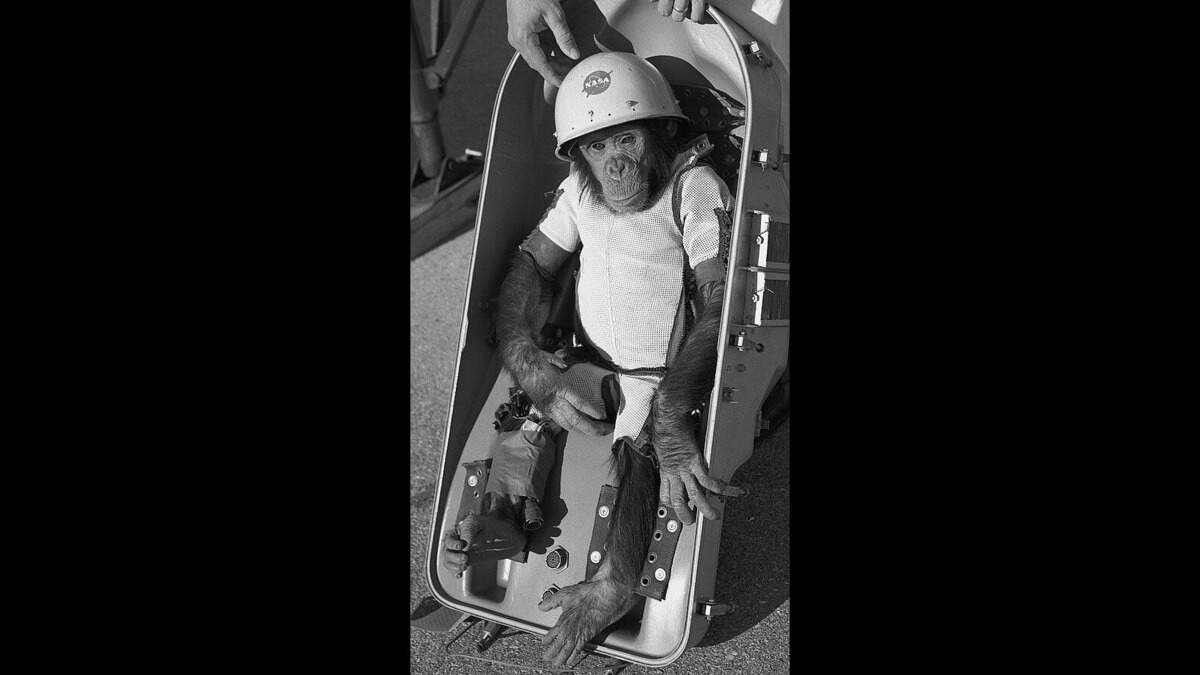
In 1961, scientists pinned their hopes for space travel on a 4-year-old chimpanzee named Ham, loading him aboard a Mercury-Redstone rocket, strapping on a NASA helmet and launching him 157 miles above the Earth.
For 16 minutes, Ham the Astrochimp zoomed through space at 5,800 mph, dropping safely into the Atlantic Ocean as the first hominid in space — only months before the first human.
Back on Earth, Ham would screech at photographers and bite the finger of his handler, but he demonstrated conclusively that people could endure the rigors of space flight, ushering in a new era of exploration.
And on Tuesday, the high-flying chimp will receive a state historic marker in Asheboro outside the NC Zoo where he enjoyed retirement — a monument to ape bravery.
“It was Ham’s curiosity and intelligence that brought him fame,” The N&O wrote in 1980. “He outscored all his schoolmates in learning to pull levers and execute commands.”
Better luck than Laika
Ham’s suborbital flight came in January of 1961, several years after the Soviet Union sent Laika the space dog into orbit aboard Sputnik 2. Unlike Laika, who died of overheating, Ham returned to tell the tale.
G-forces hit the chimp harder than expected, and his rocket veered off its trajectory, but he completed his tasks during the 16-minute flight, proving that cognitive and physiological functions could withstand the pressures.
“The picture was all in close-ups and the rubbery faced little ape made the most of it,” The Associated Press reported. “His wild-eyed glances over his shoulder as the Redstone rocket shot him along at 5,000 mph were more expressive than those of any terrified maiden fleeing from a Hollywood villain.”
NC marker officials noted that his flight notched not only a scientific triumph but also a geopolitical edge over the Soviets in the Cold War race to space. It was temporary, though, as cosmonaut Yuri Gagarin would beat US astronaut Alan Shepherd there.
“This outcome was instrumental in confirming the feasibility of human spaceflight, directly influencing the design and safety protocols for Alan Shepard’s mission four months later,” wrote the NC Department of Natural & Cultural Resources. “The physiological data collected during Ham’s flight, such as heart rate, respiration, and stress responses, provided NASA with critical insights into the biological effects of space travel.”
Retirement with Maggie
News reports recounted Ham’s “life of a loner” following his groundbreaking flight, continuing to perform experiments for the Air Force.
He retired first to the National Zoo in Washington, D.C., and then to the NC Zoo, where he died in 1983 at 26.
“He adapted well to the group,” zoo spokesman Sanders Lewallen told The N&O at the time, “and in fact, had begun showing very healthy signs of friendship with Maggie, a female in the group.”
This story was originally published July 8, 2026 at 2:34 PM with the headline "Ham the Astrochimp, first ape in space who retired to the NC Zoo, finally gets his due."