
Don Sturkey’s photos captured the emotions of the Carolinas
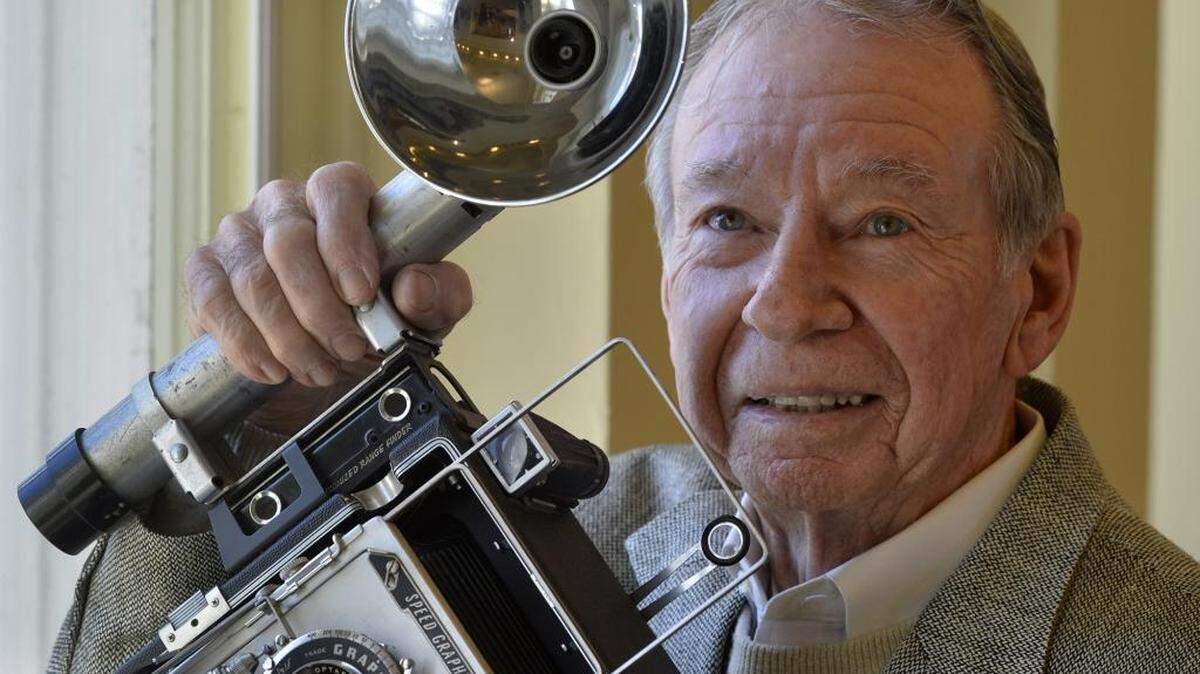
Don Sturkey showed up at the Shelby Daily Star in 1951 with an impressive résumé as a Navy photographer.
He’d worked on an aircraft carrier that bombarded North Korea for 10 months during the Korean War. Editor Holt McPherson jumped at the chance to hire someone with that kind of experience. The Star had no staff photographer and farmed out assignments to local commercial firms.
Sturkey, who would go on to become chief photographer at The Charlotte Observer and be the first Southerner to win the National Newspaper Photographer of the Year Award, was the Star’s first full-time photographer. He earned $32.50 a week and furnished his own photo equipment and car.
One of his first assignments was to cover two preachers competing in a cow-milking contest on the court square in downtown Shelby. As Sturkey captured the action, people came and went in the 1907 courthouse.
That same building has since been transformed into the Earl Scruggs Center: Music and Stories from the American South. And Saturday, the center will open a new exhibit called “Carolina Faces: The Photography of Don Sturkey.” The images are on loan from the North Carolina Collection at UNC-Chapel Hill, and the exhibit is sponsored by the city of Shelby and the Weathers Family Foundation.
It’s a wide-ranging, high-quality documentation of people and places in North Carolina in the second half of the 20th century. The images will be used for decades to come.
Robert Anthony Jr.
curator of the North Carolina Collection.During Sturkey’s 34 years at the Observer, he was ranked among the nation’s best photojournalists. His work appeared in Life, Look, The Saturday Evening Post, Ebony, Southern Living, Stern, Newsweek and Time. He authored two books – “A Slice of Time/Carolinas Album” and “This Old Wheel Will Roll Around Again.” He’s the co-author with Dot Jackson and Frye Gaillard of the 1983 book “The Catawba River.”
The exhibit will include images he took in Cleveland County over the years. Among them are shots of a 1971 Johnny and June Carter Cash concert at then-Gardner-Webb College.
“It’s fun to see something like the Cash show captured in action and know it was just down the road from you,” said Emily Epley, executive director of the Scruggs Center. “It’s really neat to see Don’s interconnection with the community.”
She called photos in the exhibit “phenomenal.”
“The thing that strikes me is how the images almost compel you to look at them,” Epley said. “The images capture all these wonderful, rich emotions. They are powerful.”
‘A really fabulous addition’
Sturkey retired from the Observer in 1990 and in 2005 donated 104,000 negatives to the North Carolina Collection. A small sampling of images from the collection made up an exhibit at the university in 2007. This is the same one that opens at the Scruggs Museum. The exhibit is available to other institutions in the state, and the entire collection is available to people doing scholarly research.
“It’s a really fabulous addition,” said Robert Anthony Jr., curator of the North Carolina Collection. “It’s a wide-ranging, high-quality documentation of people and places in North Carolina in the second half of the 20th century. The images will be used for decades to come.”
The images Sturkey captured reveal his great patience, not only for getting the best facial expressions, but the most favorable light.
How he managed to get into some of the places he did was also impressive, Anthony said, recalling a “stunning photo of a KKK rally. … He just got in the right place at the right time with a camera and a good eye.”
Finding his eye in the Navy
Sturkey was born in Lincolnton, Ga. At age 6, his parents separated, and he moved to Shelby with his mother, who worked in a textile mill.
He loved the schools and felt at home in the town, but he had to leave in the ninth grade when his mother’s new soldier husband returned from World War II. Sturkey moved to Ozart, Ala. He disliked the town and hated the schools.
In high school, he hitchhiked to Panama City, Fla., for his first look at the ocean. Using his stepfather’s small camera, he snapped his first photos – images of the beach.
Sturkey hated Alabama, and at age 17 dropped out of school and joined the Navy. (He would earn a high school GED while in service.)
He landed in the Naval Photography School in Pensacola, Fla. He knew little about taking pictures but during the seven-month course discovered he had a talent.
Making his mark in N.C.
After he left the Navy, Sturkey hunted a newspaper job – and found it in Shelby. At Shelby Daily Star, he took pictures with his own bulky Speed Graphic camera.
“There was very little breaking news,” Sturkey recalled. “If there was a wreck or fire, that was a big thing. I shot mostly fashion stuff, meetings, and events at City Park.”
While the work was stimulating, Sturkey couldn’t survive on his salary. After four months, he quit the paper and entered Gardner-Webb College on the GI Bill.
He stayed a year, until he was broke. By then, Holt McPherson had left the Shelby Daily Star to become editor of the High Point Enterprise. He offered Sturkey a job, and Sturkey accepted.
In November 1955, he joined the photo staff at the Observer, hired by the editor C.A. “Pete” McKnight, a Shelby native.
Sturkey began a distinguished career and was named chief photographer in 1963. Inducted into the N.C. Journalism Hall of Fame in 1991, the citation stated that Sturkey “made a major contribution toward understanding the world with which he came in contact. During the political and racial uprisings of the 1950s and 1960s, and through the anti-Vietnam War protests, Sturkey brought the images to his paper with great dexterity and sensitivity.”
He photographed presidents, rock stars, and just plain people.
Having an exhibit of his work in the town where he grew up and loved touches Sturkey deeply. Without the career opportunity he found in Shelby, “I could have ended up a nobody for sure,” he said. “Shelby was definitely a crossroads for me. That’s where I saw how newspapers work.”
Joe DePriest: jdepriest@carolina.rr.com
Want to Go?
What: “Carolina Faces: The Photography of Don Sturkey”
Where: The Earl Scruggs Center, 103 S. Lafayette Street, Shelby.
When: Jan. 23-May 15.
For information on admission and times, go to www.earlsruggscenter.org or call 704-487-6233.
This story was originally published January 20, 2016 at 5:21 PM with the headline "Don Sturkey’s photos captured the emotions of the Carolinas."