Trial delayed for man accused of shooting Charlotte protester. Suspect’s falling asleep.
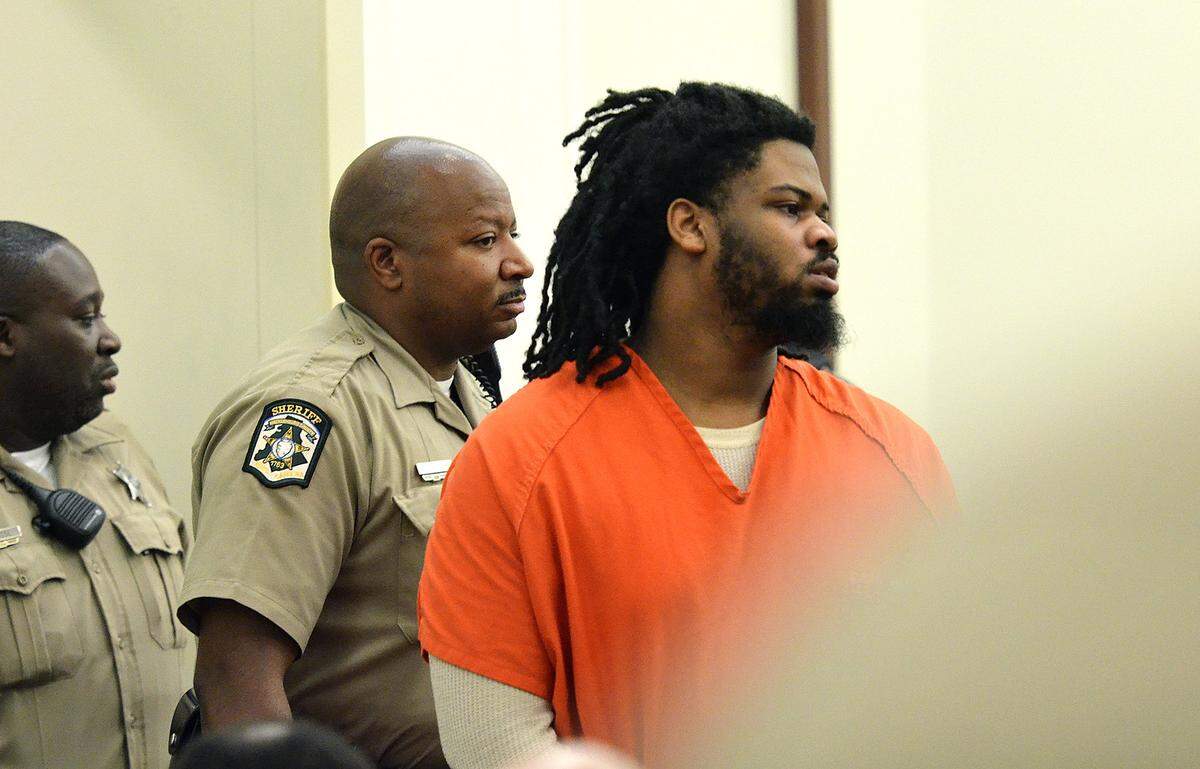
The first-degree murder trial of Rayquan Borum was unexpectedly delayed Thursday after his lawyers told the judge that their client was falling asleep in the courtroom.
Defense attorney Darlene Harris said Borum appeared to have been made groggy by anti-depression and anxiety medication he had taken at the Mecklenburg County Jail.
Harris said she and co-counsel Mark Simmons had both noticed that Borum had been “dozing off” at the defense table Thursday morning and had been “unable to participate in the trial” as he had earlier.
Prosecutors questioned the timing and veracity of Borum’s symptoms.
Assistant District Attorney Desmond McCallum told Superior Court Judge Greg Hayes on Thursday afternoon that in contrast to the depiction of Borum struggling to stay awake in court, recordings of phone calls the defendant made from the Mecklenburg Jail after the start of the trial reveal Borum “understanding in incredible detail legal concepts that would be complicated for a first-year law student.”
Hayes had hoped to finish picking 12 jurors and alternates this week so testimony could start Monday. Now his schedule has changed.
Without a single juror being yet selected, Hayes sent the entire 50-member jury pool home for the weekend. Friday morning will now be set aside for a hearing on Borum’s competency to go to trial, but that too could push into next week.
“This is like a ball of yarn,” Hayes said in quiet exasperation. “The more it gets pulled, the worse it gets.”
Borum is charged with the murder of Justin Carr, who died in the middle of an angry uptown protest following the Sept. 20, 2016 police killing of Keith Lamont Scott. If convicted, the 24-year-old convicted felon faces a mandatory sentence of life without parole.
A small group of activists, part of the group known as Charlotte Uprising, maintain that police shot Carr and framed Borum for the killing. Several of the members have appeared in the court daily.
Closed courtroom
Questions of Borum’s physical condition surfaced dramatically Thursday just as the prosecution had begun to question prospective jurors.
Superior Court Judge Greg Hayes sent the jurors out of the room. Simmons then asked that Hayes also clear the courtroom of reporters and bystanders, a highly unusual move for a public trial.
Hayes had done just that on Wednesday, and the court was closed to the public for about 45 minutes while the judge and attorneys discussed an undisclosed “legal issue.”
Despite questions from the Observer, Hayes gave no further explanation, and attorneys for both sides refused to comment. The Observer later sent word to the judge that it would object to future attempts to close the courtroom during Borum’s trial.
After noting the Observer’s objection Thursday morning, Hayes refused Simmons’ request to empty the courtroom. But he did ask about 10 members of the public observing the trial to leave while the legal matter was being discussed. Hayes allowed three reporters to stay.
Based on the discussion that followed, it became clear that Wednesday’s closed session had also been about Borum’s health.
Harris, the defense attorney, told Hayes that because Borum’s drowsiness was occurring in front of his possible jurors, she did not want his behavior to influence their opinion of him.
Assistant District Attorney Glenn Cole agreed to the delay so Borum’s medical and disciplinary records could be gathered from the jail and a formal assessment of his health be conducted.
But Cole described the timing of the defendant’s emerging health issues as “mighty suspicious.” He said Borum’s ability to stand trial had come into question only after his attorneys had lost a series of fights this week to restrict the evidence presented to the jury.
Thursday afternoon, a medical delegation from the jail told the judge that Borum is taking Remeron, commonly described as a medication for “a major depressive disorder.” Its side effects include drowsiness and dizziness.
The jail officials said Borum formerly had received a morning and evening dose, but had gone off his morning medication before the start of the trial. The officials said Borum would begin receiving his evening dose earlier in hopes that he would be alert for court.
Court naps
Sleeping habits in the courtroom have had significant impact on Charlotte-area criminal trials in the past.
In 2017, the N.C. Court of Appeals ordered a new trial in Gaston County for narcotics defendant Johnny Darnell Mobley, who slept through portions of the proceedings and appeared unable to follow what was happening.
“Now, Mr. Mobley, your lawyer brought to my attention that you appeared to be sleeping. She heard you snoring, I believe,” Superior Court Judge Carla Archie of Charlotte said before the start of the 2016 trial, according to the appeals court opinion.
“I’m tired right now,” Mobley replied. “I was going to ask, can I sit back down?”
The appeals court ruled that Archie should have brought in an expert to determine Mobley’s competence.
In 2016, the roles were reversed. The Fourth Circuit Court of Appeals threw out Nicholas Ragin’s conspiracy conviction and 30-year-prison sentence because his court-appointed attorney, Nick Mackey of Charlotte, had problems staying awake.
“Based on this record, we find it impossible not to conclude that Mackey slept, and was therefore not functioning as a lawyer during a substantial portion of the trial,” the judges wrote in their order vacating Ragin’s 2006 conviction and sentence.
On Friday, Hayes hopes to have a psychological assessment of Borum in hand to hold a hearing on the defendant’s ability to take part in his trial.
For now, the judge has two conflicting portrayals of the defendant to consider:
The Borum described Thursday by his attorneys as being barely lucid and who didn’t know what day it was vs. the Borum on the jail phone calls who prosecutors say critiqued their performances, correctly interpreted legal arguments and lamented how Hayes’ rulings on pieces of evidence — including Borum’s earlier jail phone calls — were hurting his case.
With the start of testimony still days away, Borum’s use of the phone at the jail, where inmate calls are routinely recorded and checked, already has emerged as a major issue in the trial.
Earlier this week, Hayes ruled that four jail calls Borum allegedly made after his arrest and interrogation by police could be heard by the jury. In one of the conversations, Borum admitted having told detectives that he shot Carr by accident.
Asked if he had advised Borum to stop making calls on the jail phone, Simmons paused briefly before answering.
“I tell all my clients not to make phone calls from the jail concerning their criminal cases,” he said.
This story was originally published February 14, 2019 at 10:51 AM.