CMPD changes chemical munitions policy following outcry over protest incident
A state review of a violent confrontation in uptown Charlotte this month did not conclude that police violated policies in dispersing hundreds of protesters. But that hasn’t stopped the Charlotte-Mecklenburg police from changing some of those policies.
As a result of the incident, officers will no longer fire chemical munitions at demonstrators from multiple directions, Deputy Police Chief Johnny Jennings told City Council members Tuesday at the council’s Safe Communities committee.
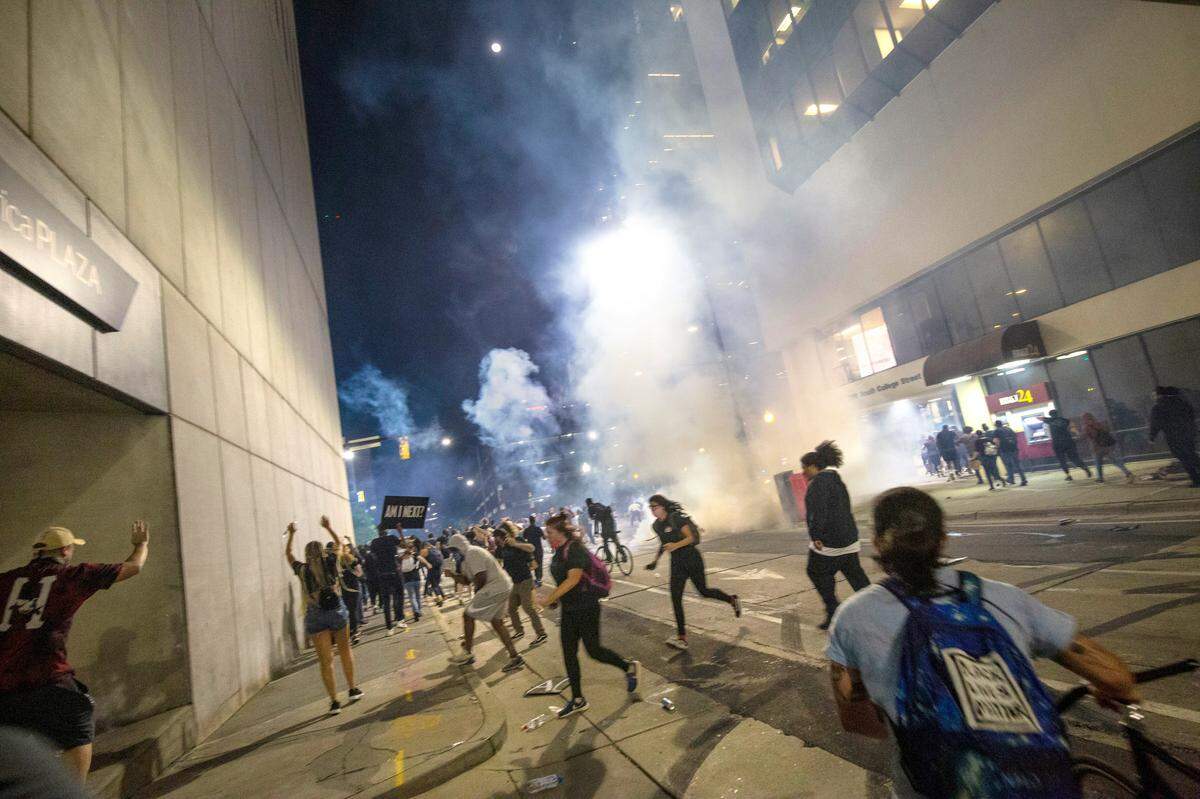
The incident occurred June 2 when hundreds of marchers protesting the Minnesota police killing of George Floyd were caught between two police lines on 4th Street and subjected to a barrage of chemical munitions.
Jennings’ announcement came during a discussion of what could be a wide-ranging council, CMPD and community review of police policies.
“We want to make sure the policies we have are the policies we want,” City Council member Larken Egleston said.
SBI review
The SBI review follows weeks of protests in Charlotte over Floyd’s death in Minneapolis, as well as local outrage over what happened on June 2.
Marchers interviewed by The Observer say they were targeted that night with tear gas, stun grenades and pepper balls fired by riot-control officers deployed at Tryon and College streets. Meanwhile, officers posted in a building fired down on them from above.
Protesters say they were trapped between police lines with no place to escape. Several marchers and groups have sued CMPD, describing the tactics as an illegal use of excessive force.
The incident also led to a rare court action Friday where a judge issued a temporary restraining order banning CMPD from using similar tactics against a Juneteenth protest march that night.
A review of the 4th Street incident by the State Bureau of Investigation did not conclude whether or not CMPD violated policies or laws. It did find that officers on the scene gave multiple dispersal orders, which included a warning about the possible use of “riot control agents.”
The SBI report, issued June 12 and released by CMPD a week later, also said that based on videos of the incident, marchers had two escape routes: east on 4th Street and south on College Street.
However, the report noted that the escape routes were shrouded in smoke.
Changes underway
Council member Matt Newton told Jennings Tuesday that it was “counter intuitive” to expect marchers to use an escape route when only moments before they had been fired upon by police to drive them away from the same intersection.
Jennings noted the tactical dissonance as he announced the change that officers will no longer fire chemical munitions from multiple directions. “Even though it was an appropriate method of dispersal, we understand that it forced (the protesters) to go into the (chemical) agents to disperse,” he said.
Last week, police also announced a change in their dispersal-order policies.
Under the old guidelines, if a group drew a dispersal order at one location in the city, it followed them if they moved elsewhere. Under the new procedure, the order expires if the crowd disperses. Police can issue a new dispersal order if criminal activity breaks out in the same group in a new part of town.
Disagreements on council
The 4th Street incident appears to have opened a division between police and some city leaders.
The day after the 4th Street confrontation, Mayor Vi Lyles joined in the widespread criticism of the police tactics. “I hope everyone is aware that that’s not the kind of department we want to have for policing. It’s not the kind of reputation that we want to have nationally or locally,” she said.
But Republican council member Tariq Bokhari said the SBI report exonerated police, and that Lyles and some of his council colleagues had done “irreparable harm” to police morale with their premature criticism.
Asked if the city owed CMPD an apology, Bokhari said, “100 percent.”
“And it should be as impactful and passionate as the critique that threw the entire department under the bus the day after the event,” he said.
Lyles did not respond Tuesday to requests for an interview.
Council member Malcolm Graham, however, told The Observer before the meeting that the SBI report gave an incomplete account.
“Obviously mistakes were made on the ground that impacted peaceful protesters who were out their exercising their constitutional rights,” he said.
Reviews continue
The incident remains under internal review by police and City Manager Marcus Jones. Meanwhile, CMPD awaits an analysis of its emergency procedures by the Center for Domestic Preparedness, a federal agency that trains emergency responders.
Outgoing Police Chief Kerr Putney called for the SBI review to determine whether police tactics on 4th Street had been legal.
But the report, which was based largely on interviews with police, did not make that judgment. If SBI investigators talked to protesters, they did not quote them.
The report also accepts CMPD’s assertion that the protests had become violent during the night, describing those targeted by the chemical agents on 4th Street as “rioters” in the second paragraph. In videos preceding the incident, the marchers appear peaceful leading up to their confrontation with police.
SBI spokeswoman Anjanette Grube told The Observer that the agency followed its policies in conducting the review.
“We investigate allegations of possible criminal activity and that is what we were investigating in this case,” she said. “We don’t make a determination as to whether a crime has been committed. We gathered evidence and facts at the request of the Chief, but we do not make charging decisions or any ultimate decision as to whether any crime has occurred.”
Other aspects of the report appeared to catch members of the council off guard. Mayor Pro Tem Julie Eiselt, among others, told Jennings that she was surprised to learn that CMPD’s riot squad members were not equipped with body cameras.
Jennings, who replaces the retiring Putney next month, said 300 special mounts needed to secure the cameras to the emergency equipment that squad members wear should be installed within the month.
Egleston, chair of the Safe Communities committee, asked the incoming chief why CMPD had the SBI report for a week before releasing it. Jennings said police had planned to make the report part of a comprehensive report that had been pre-empted Friday by the lawsuit and the temporary restraining order.
The discussions took place against what could be a three-month examination of police policies.
Jennings said CMPD will be a willing partner, if given the chance.
“We want to make sure that we are constantly getting better,” he said. “What I see is a collaboration with this committee, the community and the public.
“But it can’t be something done to us. It has to be something done with us.”
-
Editor’s note: This story was originally published on June 23, 2020. It was updated on July 8, 2020 to correct a mischaracterization of the SBI report’s findings. The report did not specifically exonerate police for their actions or conclude they had adhered to department policies.
This story was originally published June 23, 2020 at 7:02 PM.