In a Charlotte divided over its police department, new chief says his job is to listen
When Johnny Jennings is asked to look back over his 28 years in law enforcement, he hovers over one big regret.
“I can think of times I would have benefited from getting to know some of the people I encountered out there a little better,” the new chief of the Charlotte-Mecklenburg Police Department says.
Not that Jennings doesn’t try.
Five years ago, the future chief and his former CMPD boss, Eddie Levins, were in Memphis to teach a trauma-training class to a group of other cops when they took a post-dinner stroll down Beale Street. On the walk to their hotel, they passed a white homeless man who looked at Jennings and then unloaded the N-word.
“I was pissed. Johnny was hurt,” says Levins, a retired deputy chief. “I wanted to go back and kick his ass.”
Jennings?
“Johnny walked back and asked him why he called him that name,” Levins recalls. “He really wanted to know why.”
Two months after he stepped into one of Charlotte’s most visible government jobs, Jennings’s ability to listen and engage is already being tested by a city deeply divided over its police department.
On May 25, five days after City Manager Marcus Jones announced that Jennings would replace the retiring Kerr Putney as head of North Carolina’s largest police department, George Floyd died at the hands of officers in Minneapolis.
Within two weeks of Jennings’s selection, hundreds of marchers demonstrating against police violence in uptown Charlotte were ambushed by officers on Fourth Street, then pelted with chemical munitions.
Video of the incident subsequently revealed that the officers and their supervisors had laid a trap. When the protesters walked by chanting, “Hands up, don’t shoot,” the voice of an unidentified officer was captured on tape. “Hey, wave goodbye. They’re all about to get gassed,” he said mockingly.
Nationwide, the police killings of Floyd and other Black residents continue to ignite protests. Last month, a Gallup poll said public trust in police had fallen to an all-time low.
In Charlotte, where the police department traditionally has drawn strong support, activists are calling for a series of changes, including more transparency on how CMPD spends its money and greater oversight by the City Council and city manager over police operations and the use of force.
So before Jennings could take the oath of office in July, he and his department already were on the defensive.
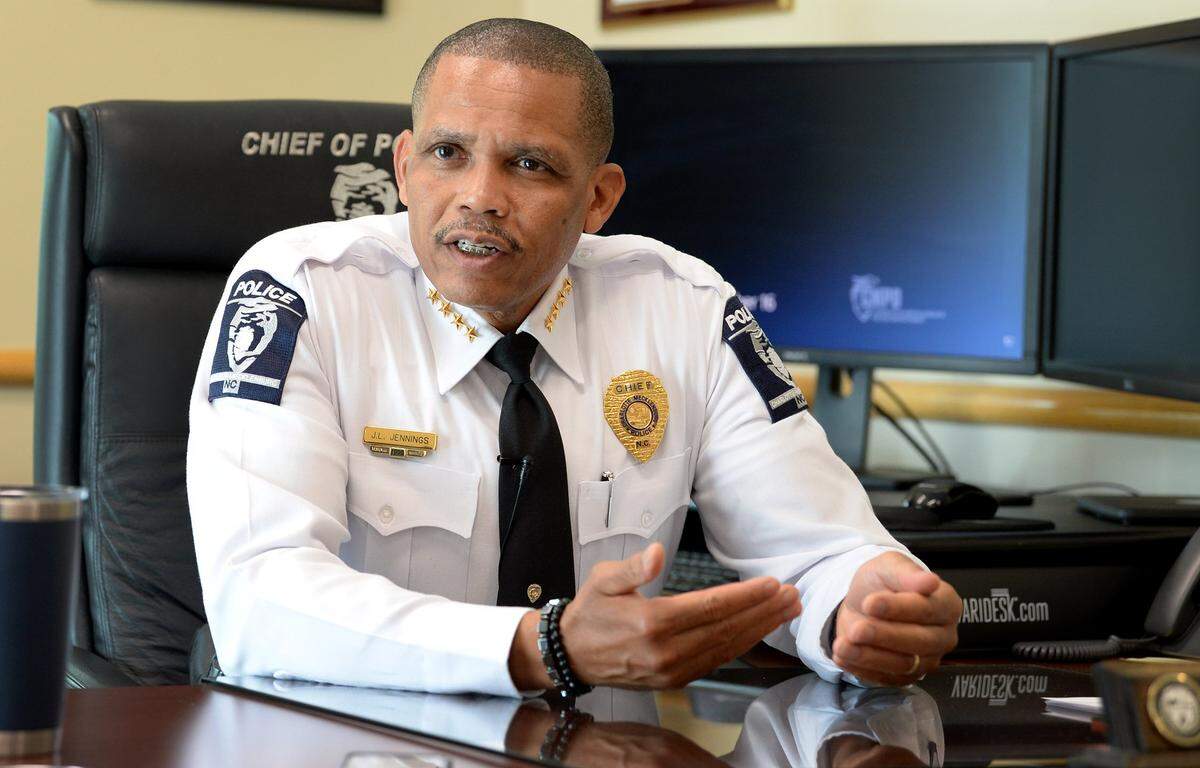
Not surprisingly, the new chief has made “community collaboration” one of his priorities.
“When I publicly come out and say we’re going to collaborate with the community, I’m putting myself out there,” Jennings says. “I have to make sure I follow through with that.”
Some activists say Jennings, despite almost three decades in a CMPD uniform, must still earn his credibility as chief.
“I think he walked into a situation that no Charlotte police chief has ever faced,” says Robert Dawkins, state organizer for the SAFE Coalition NC and a frequent CMPD critic.
“People are mad. In the old days, they would complain for a couple of weeks then it all would just go away. Now we’re at the point that we haven’t gotten the changes that were promised, and you best be doing something about it. That’s not just coming from the Black community. That’s coming from everybody.”
Police controversies in other cities continue to ignite demonstrations in Charlotte. On Wednesday, a decision in Kentucky not to charge the Louisville police officers who fatally shot Breonna Taylor brought marchers back onto uptown streets, resuming a summer of on-again/off-again protests against police.
Charlotte City Council member Braxton Winston, who was arrested in June during the city’s uproar over Floyd’s death, said the current police model in Charlotte and other cities is not working.
“Police chiefs have always been the ‘be all and end all’ in deciding what public safety looks like. Now we have to add democracy and the people’s voice to that,” says Winston, who arose to political prominence during the demonstrations that erupted in Charlotte after the 2016 police shooting of Keith Lamont Scott.
Jennings’s most immediate contribution to the conversation, according to Winston, is “his full acknowledgment — not just from a cop’s point of view but from a human being’s — that this has got to change. This is not about a police department or a ‘code of blue.’ As an American, as a Black man, as a human being, he has to recognize that we’re in a bad situation, and people are fed up.”
Harold Easter’s life
On Friday, Jennings sent a strong signal that he is listening.
In an aggressive move toward police accountability, the chief announced that he wants to fire four officers and a sergeant for failing to help Harold Easter. Jennings said the five had “intimate knowledge” that Easter had swallowed cocaine during a traffic stop but left him unattended in an interview room for 20 minutes. Easter later died. His family has sued.
“It’s difficult to watch and to know that had our officers followed our policy ... and had offered more concern for the sanctity of Mr. Easter’s life, we may not be looking at such a tragic outcome,” the chief said during a press conference.
Jones, the city manager, said the chief’s handling of the matter sent a message to the city “that we will be proactive and progressive in policing and will continue to make strides in how we serve our communities.”
During an interview with the Observer two days earlier, Jennings said he has already begun making changes. For example, he says, new policies for crowd control tactics should block a repeat of the June 2 events on Fourth Street.
While Jennings was quick to point out that what CMPD officers did that night was within the law, at least one police supervisor was punished for making “insensitive comments.” Given police actions captured on video, some CMPD critics found the department’s response lacking.
He decries an atmosphere in which the missteps of a single cop anywhere in the country bring broad condemnation of his department — overshadowing, he says, “the good things that we do.”
Yet, Jennings says he also realizes — and accepts — that he and his department are on the clock to prove that they stand behind what they say. So, he says, is the public.
“I need to show that I’m going to work with the community and that the community will also be able to have input on how we police,” Jennings told the Observer. “I can say all the right things. But if they do not see a difference, then anything I say is for nothing.”
Asked if he thinks the city has grown impatient waiting for police reforms, Jennings counters that its residents have become “more involved.”
“The community has now seen that they can be loud and vocal and make demands,” he says. “But what they can’t do is ... then go home and wait for it to happen.
“ ... Everything can’t be put on police.”
Asked to reflect on the incident on Beale Street, Jennings said he was thinking beyond the heat of the moment.
“Say we do go back and we end up fighting this person ... then what?,” the 52-year-old says. “I remember my thoughts being that you accomplish more by having that conversation .... If we can get through to this person, to get him to think about what he really said, maybe it’s going to keep someone else from being called that same thing later on.”
Not that the interaction was easy. Jennings describes it as “very tough.”
“But I’ve always kind of prided myself at looking at the big picture of things,” he says, “trying to realize, ‘What am I trying to accomplish with my actions?’”
Good guys and bad guys
Jennings is the city’s third consecutive Black police chief and, after Putney, the second in a row to have come up through CMPD’s ranks.
He entered the police academy in 1992 after a college career at Appalachian State that included a major in criminal justice and three years as a starting All-Southern Conference linebacker on the Mountaineer football team.
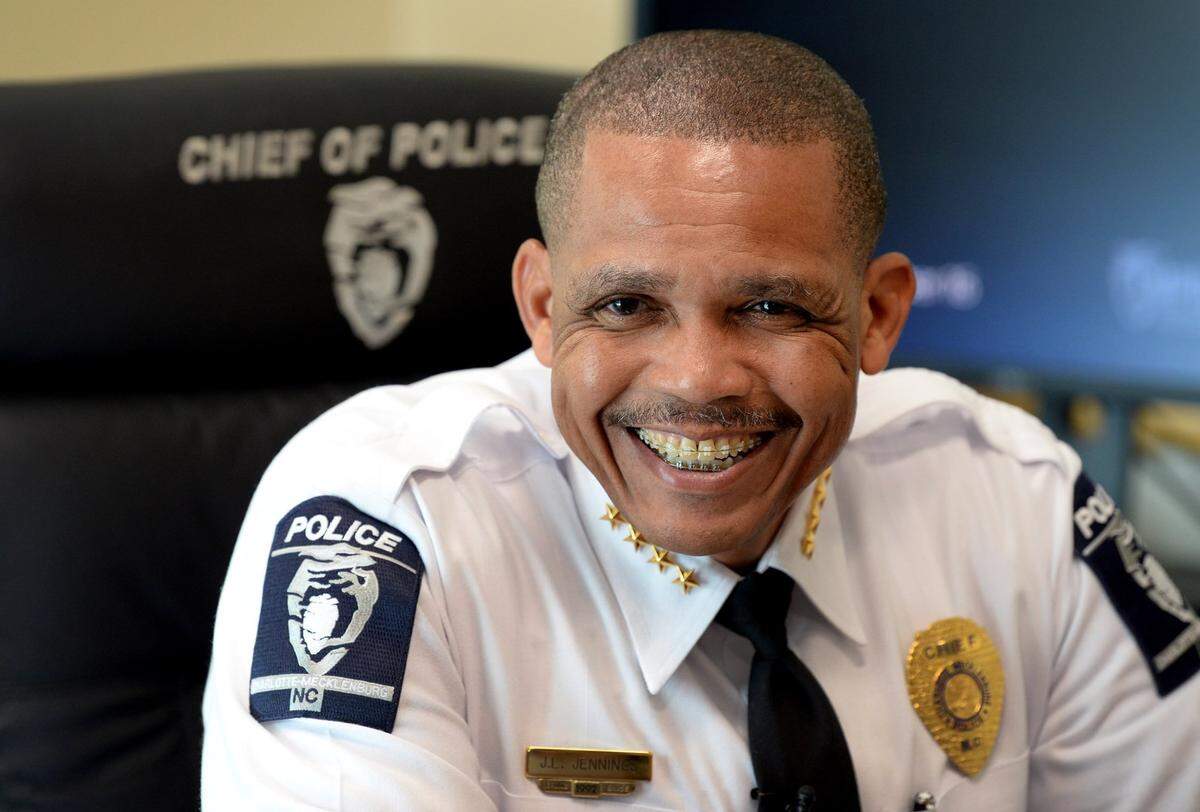
Jennings was set to launch a career as a postal inspector, but the post office wasn’t hiring. The police department was, but Jennings says he wasn’t interested. Not at first anyway.
“I had a perception of what being a police officer was, just like everybody else,” Jennings says. “I thought, ‘I don’t want to chase cars and run people down and arrest people all day. I don’t want to be a part of that.’”
Yet Jennings, who was working as a fitness instructor at a YMCA in east Charlotte, began talking to a couple of cops who came to his Y to work out. His opinion eventually changed and he applied.
Beth Boggess, a longtime friend who also was a member of the May 1992 police academy class, says she quickly bonded with Jennings, and their CMPD careers followed similar tracks.
Boggess, now an assistant special agent in charge with the Charlotte office of the FBI, says Jennings has always operated “with an internal drive to do the right thing for the right reasons.”
“The same things that made him a good officer and a good detective are inherent in him being a good person. At his core, he’s an ethical human being with a huge heart,” Boggess says. “His devotion is to the community in which he’s lived and served.”
Jennings likes to point out that he is part of the community. He and his wife, Lisa, are the parents of three sons, including 19-year-old twins, Jayden and Jarrett. His oldest, 23-year-old Jonathan Jennings, is a recent graduate of his father’s alma mater, Appalachian State.
Jennings says he has enjoyed having multiple roles at CMPD — from drug cop to homicide detective to lead planner for Billy Graham’s funeral and the 2019 NBA All-Star Game — that took him to all corners of CMPD. One of his most important lessons came during one of his earliest assignments, when Jennings had to be willing to question a cop’s traditional role.
During the crack epidemic of the early 1990s, when he was a young “no-tolerance” drug enforcement officer mostly assigned to the community of Belmont, Jennings found himself chasing and arresting the same teenagers day after day. Eventually, both sides began to talk to each other.
“We’d talk about, you know, why they did what they did and I’d talk about why I do what I do,” Jennings said. “We developed a mutual respect to where they knew I had a job to do, but they also knew I would respect them.
“That relationship helped me grow as an officer, instead of just saying, ‘I’m the law ... so you’re the bad guys.’ ”
That relationship also paid off in unusual ways. Years later, when Jennings was a homicide detective, some of his drug contacts were involved in a killing in west Charlotte. Instead of fleeing, Jennings says, they rode their bicycles down to the police headquarters.
“They wanted to come and confess, but they wanted to talk to me. They specifically asked for me,” he recalls.
“My point is, how many opportunities did I miss out on because I was in the old mindset, that they were the bad guys and I was the good guy. But in the mindset of ‘I got to know them and they got to know me,’ if they wanted to be treated fairly, they knew I was the guy.
“Why can’t every police officer have that same concept? I think we can.”
Jennings has admirers
Jennings’s decades-long philosophy of engagement has left him with a long list of admirers throughout the city.
Former U.S. Attorney Anne Tompkins, who joined the Mecklenburg County District Attorney’s Office the same year Jennings became a cop, says Jennings’s ability to relate and listen makes him “the right guy at the right time.”
She says she expects Jennings to take more chances than some of his predecessors because he’s confident in his own abilities and “more open to hearing other points of view.”
“Johnny just has better relationships with the public, the City Council and the department,” Tompkins said. “I think he can cover all those bases pretty well.”
Mayor Pro Tem Julie Eiselt says the City Council had little or no say in Jennings’s selection and that she still doesn’t know the new chief very well. Nonetheless, she says Jennings has made a strong early impression.
“I feel like he was a good choice based on what I’ve seen so far,” says Eiselt, who was elected to the council after working as a public safety activist. “He appears to be a confident and mature leader who seems to have the support of the community and his officers.”
Jennings’s decision to fire the five officers involved in the Harold Easter case indicates “for right or wrong that he can make a quick and decisive decision,” Eiselt says.
His pledge to engage with the community, she says, “is the only way we can all move forward.”
“As policy-makers we have to be willing, engage and take a few hits,” she says. “Leaders who understand that, as Chief Jennings seems to, are going to be in the position to make some positive changes.”
Charlotte attorney George Laughrun, who is representing Officer Brent Vinson in the Easter case, says he and Jennings have disagreed at times over disciplinary decisions. But Laughrun says he has always believed he had been heard.
“He’s not afraid to make a decision. He’s not always going to do what you want him to do,” Laughrun says. “But we’ve all been in meetings where we know how they are going to end. That’s not him.”
Dawkins, though, says Jennings’s encouraging words of allowing the public to have a major say in how it wants to be policed must be followed up by actions.
For starters, he wants a full audit of CMPD’s spending as well as a cost-benefit analysis of longtime practices such as targeted traffic stops, which police say help fight crime but which disproportionately affect Black drivers and passengers.
Like all police chiefs, Jennings must log roll between multiple constituencies, Dawkins says.
“Police didn’t think Kerr Putney had their backs. Jennings says he wants to make changes but he has to keep the confidence and morale up in his department. So the question to him becomes: Are you willing to go against your officers and police attorneys to police people the way they want to be policed?
“We’re giving you the opportunity now. If we don’t get results, he’s going to be in a very bad situation.”
‘8 can’t wait’
City Council member Winston, on the other hand, says that with Jennings at CMPD he thinks the city may be on the cusp of “big structural changes that otherwise would not be possible.”
“He recognizes the cultural moment. He’s a Black man who grew up in 20th century America,” Winston said. “He’s a cop. He’s a very good cop. He’s going to find a way to carry out his mission.”
At his swearing-in, Jennings said his administration would be built around what he now describes as his “core four” principles of professional accountability, community collaboration, crime management and employee wellness.
On the question of reforms, he says CMPD is one of the few big police departments in the country that already have met the “8 Can’t Wait” checklist of progressive police policies governing the use of force.
He says he is trying to achieve a balance between being a Black man and being a police chief for 1,700 officers that will give him some credibility and help him navigate the next police crisis in Charlotte or some other place.
“There has to be a balance, and I like to think I’m finding that balance because I have to look at serving our community and also serving the fine men and women who work within this agency. They are being unfairly broad-stroked as being racists,” he says.
“ ... I’m not (claiming) that that’s not an issue. But I wish there would be more of a look at the good things that we do. So when you have one individual officer, and at this point it’s anywhere in the country, and when one thing goes wrong, we’re just not totally on a broad scale placed in a category that’s unfair.”
After answering questions for 35 minutes in his office, Jennings stands up behind his desk. He’s already late for another meeting. But he is stopped by one last question: What public perception of police would he most like to change?
He falls back to a familiar theme. “That the public accepts that the police department is part of the community as well,” he says quickly. “I’ve been telling the public, ‘Don’t wait for an officer to come and say hello .... Extend the olive branch.
“I’ve been telling the officers, ‘Make sure we’re getting out to know people to make sure that the first time, the only time, they’re meeting an officer is not on their worst day.’ ”
Then Jennings is off. There’s another conversation to have.
This story was originally published September 22, 2020 at 11:23 AM.