CMPD made it hard for undocumented crime victims to get legal status. That may change.
It was snowing the night a short skinny man put a steel revolver to Krishna’s forehead in a Charlotte gas station and demanded all the money in the store.
Another man came behind the counter. He knocked Krishna, to the ground and emptied the cash register — pennies, quarters and all. When they left, only their footprints in the snow remained.
Krishna was an undocumented immigrant but didn’t hesitate to call 911. Charlotte-Mecklenburg Police Department officers and an ambulance came quickly. The next morning, a detective interviewed him, but there were few details to give: two men, one short and skinny and the other heavy-set, both wearing black masks and gloves.
The robbery occurred in 2010, but he still remembers the eyes of the young man who held the gun to his head — hazel and cold.
“I would be able to recognize them if they came back,” Krishna said in an interview. “Even though I only saw the eyes.”
Krishna, not his real name, asked that this pseudonym be used to protect his identity due to his immigration status.
A detective followed up a few times, Krishna said, but there was never an arrest. The robbery left him constantly panicky and once he ended up in the emergency room because of the anxiety. He saw a psychiatrist but it didn’t help.
Four years later, Krishna — whose birth country is India — heard about a federal program he thought could be a silver lining to the traumatic experience. He learned he might be eligible for a U visa — a visa given to undocumented immigrants who have been victims of certain crimes and have cooperated with law enforcement.
But more than 10 years after the robbery, Krishna believes CMPD unfairly denied him a shot at the program. In the past six years, the number of applications submitted to CMPD have plummeted while the number of denials has doubled.
Congress created the U Nonimmigrant visa program in 2000 to help law enforcement agencies investigate and prosecute certain crimes while also protecting undocumented victims who have suffered and are willing to cooperate with law enforcement.
The program acts as an incentive to encourage undocumented immigrants — who often fear deportation and do not trust law enforcement — to work with with police and prosecutors while also providing humanitarian assistance, University of North Carolina at Chapel Hill professor Deborah Weissman said.
The U visa gives temporary lawful status to the victims and their family members for four years. After three years, the victims and their families can apply for permanent residency. But there are only 10,000 U visas allotted each year nationwide and the backlog for the U.S. Citizenship and Immigration Services (USCIS) to review a new application takes years.
To apply, undocumented victims first need a local law enforcement agency to fill out a form that certifies they were a victim of a qualifying crime and that they were helpful, are currently being helpful or are likely to be helpful in the future.
However, CMPD has taken into account additional requirements — such as whether the crime is likely to be solved and the criminal background of the applicant — when signing a U visa certification. Those additional steps go beyond what federal guidelines require and were never envisioned when Congress passed the program, advocates say.
The U visa program is voluntary, meaning a police department is not required to implement it or do so in a certain way, but advocates argue those barriers are arbitrary and prevent undocumented immigrants from submitting an application to be decided by USCIS.
USCIS also says in its guidelines to law enforcement agencies that those additional requirements do not automatically make someone ineligible for a U visa and that law enforcement agencies are not responsible for determining whether someone is eligible for the program.
Attorneys and community leaders also say CMPD’s U visa rules worsen relationships with a community that already under-reports crimes to the police.
Data obtained from CMPD through a Freedom of Information Act request shows that U visa certifications have become harder to obtain in recent years.
A Charlotte Observer investigation found that since 2015, the number of U visa certification requests submitted to CMPD has plummeted by 70% — from nearly 1,100 applications a year to just over 300 in 2020. The percentage of requests denied every year has also nearly doubled. In 2015, around 30% of applications were denied. In 2020, nearly 60% of applications were denied.
The reasons for the decline in applications are complex and likely related to national politics and attitudes toward immigration. Applications dropped nationally for the first time in 2018 after a Trump executive order effectively put those denied a U visa by USCIS in deportation proceedings, said Cecelia Friedman Levin, policy director at Asista, an organization that provides legal assistance and advocacy for immigrant survivors of violence.
But in Charlotte, the decline in U visa applications requested and granted preceded the Trump administration.
CMPD Chief Johnny Jennings said the department has started changing its U visa policies this year and expects the program to be more accessible in the future. The drop in applications likely reflects that some people have been deterred from applying for a U visa, Jennings told the Observer.
“I want to make sure that people who are legitimately victimized have this opportunity to apply for U visas and be certified,” he said, adding the program is specifically geared toward communities that distrust the police and under-report crimes.
Only 18% of U visa applications have been denied this year, he said, which is far fewer than the near 60% denied in 2020.
One reason CMPD has certified more U visa applications recently is that the department no longer considers the likelihood an arrest or charge is made as a primary factor on whether to certify a U visa, Jennings said.
The policy change is an about-face for the department, and Jennings defended the previous practice in a May 2020 interview. He said then the program’s purpose was to ensure successful prosecution. But Jennings said the department changed its interpretation of the program after hearing concerns from the Latino community.
“Maybe our interpretation of ‘useful for the prosecution of the case’ was a little bit harsher than it needed to be,” he said.
CMPD’s policy change comes as a new president has ushered in a new era of immigration policy. President Joe Biden has proposed increasing the cap on U visas from 10,000 to 30,000 a year and expanding the eligibility to include those who suffer wage theft or other labor violations.
However, local advocates and attorneys said they are watching CMPD and the U visa program closely and that harm has been done in the meantime.
Victimizing the victims?
For Krishna, permanent residency would mean he could stay in the U.S. with his wife and two children, who are all legal U.S. residents. He originally came to the country on a student visa and until he received work authorization this year, he was too afraid of being deported to join his children at school or at playgrounds in public.
CMPD initially certified Krishna’s U visa application in 2014, which allowed his attorney to submit the application to USCIS.
USCIS reviewed the case in 2019 and ultimately denied his application, citing that the CMPD captain who signed his form was not on the list of approvers CMPD had submitted to the agency, according to documents reviewed by the Observer. When Krishna and his attorney repeatedly asked CMPD to confirm the existing certification or issue a new U visa certification, CMPD refused. On a final denial, CMPD wrote that his case was inactive due to insufficient evidence and that Krishna was not needed for prosecution.
Around that time, Charlotte immigration attorneys had been raising concerns that CMPD was certifying fewer U visa applications, denying applications for arbitrary reasons and damaging relationships with Charlotte’s undocumented communities.
Five local attorneys interviewed by the Observer said they noticed CMPD instituting barriers beyond what is outlined by federal guidelines in recent years, and that fewer people were wanting to apply for U visas, even if they thought they were eligible.
While some of CMPD’s denials align with federal guidelines, records show a growing proportion of denials had been for cases when CMPD said the “petitioner (was) not required for successful prosecution.”
In 2015, CMPD cited not needing a petitioner for prosecution for only 8% of all denied certification requests. In 2020, 86% of denied U visa certification requests were denied for that reason.
Federal guidelines state law enforcement agencies only need to consider whether someone was a victim of a qualifying crime and whether that person was helpful in the past, currently helpful or likely to be helpful in the future. They also state someone can be eligible for a U visa even when there isn’t a charge or an arrest. Jennings said CMPD no longer considers whether a case has a likely arrest or charge as a primary reason to certify or deny an application.
In these cases, victims of hard-to-solve crimes like armed robberies were being punished twice, Charlotte attorney Ted Maloney said.
“It’s ridiculous because that’s not what (the U visa) is based on. If the cops can’t get somebody, that’s not the victim’s fault,” he said.
CMPD also sometimes denies applications for people who have a criminal background, even if it’s for incident reports that never ended in a charge or minor crimes that have been dismissed, Charlotte immigration attorney Matthew Quinn said.
Jennings said he has heard those complaints and going forward, a criminal record itself — especially for minor misdemeanor charges — will not automatically disqualify someone from U visa certification. However, CMPD will continue to check the background of petitioners, he said.
“We have a great responsibility to uphold the integrity of the program because the last thing we want to do is to encourage abuse through the U visa program,” Jennings said.
USCIS also conducts full background checks and says in its guidelines a criminal record does not automatically make a victim ineligible for a U visa.
Advocates point out that when CMPD declined to certify a U visa application for a reason beyond federal guidelines, CMPD — not USCIS — effectively was making an immigration decision.
USCIS states in its guidelines police, prosecutors and other law enforcement officials are not responsible for determining whether someone is eligible for a U visa, and agencies that run background checks should include that information in the paperwork for certification.
Jennings said CMPD has recently acknowledged that perspective and said the department will take a harder look at restrictions it puts on U visa certifications.
“We’re just one small step, pretty much the initial step in the process,” he said. “We don’t make that final determination.”
The discretion CMPD exercises over the U visa program is not uncommon for law enforcement agencies across the country.
A 2019 Reveal investigation reviewed the U visa policies of 100 police departments and found that nearly one in four creates barriers that Congress never intended to be in place. Some police departments even refuse to certify any U visas, the investigation found. In 2015, the Gaston Police Department refused to review U visa requests citing an officer shortage, The Observer previously reported.
Since participation is voluntary, individual police departments have the discretion to design the rules and limitations of their programs, even if it undermines the program and results in fewer people applying for a U visa, said Levin, the Asista policy director.
“You can be the victim of one crime in a county and have a path to U visa certification and then be the victim of the same crime (in another county) and not have that opportunity,” she said.
A vulnerable community
Attorneys and community members said that, in general, undocumented immigrants are fearful of speaking to police, despite the fact that they are frequently targeted and victimized.
Most undocumented immigrants — especially new arrivals to the U.S. — don’t distinguish between CMPD and Immigration and Customs Enforcement, Maloney said.
Rusty Price, who has been a senior pastor at the Camino Community Center since 2012, said he has seen the frequent victimization of undocumented immigrants first-hand. The community center has a large Latino congregation and every week, Price has seen someone who has been victimized or injured — whether it’s a carjacking or armed robbery.
The common perception, he said, is that undocumented immigrants often carry large amounts of cash on them and are afraid to call the police.
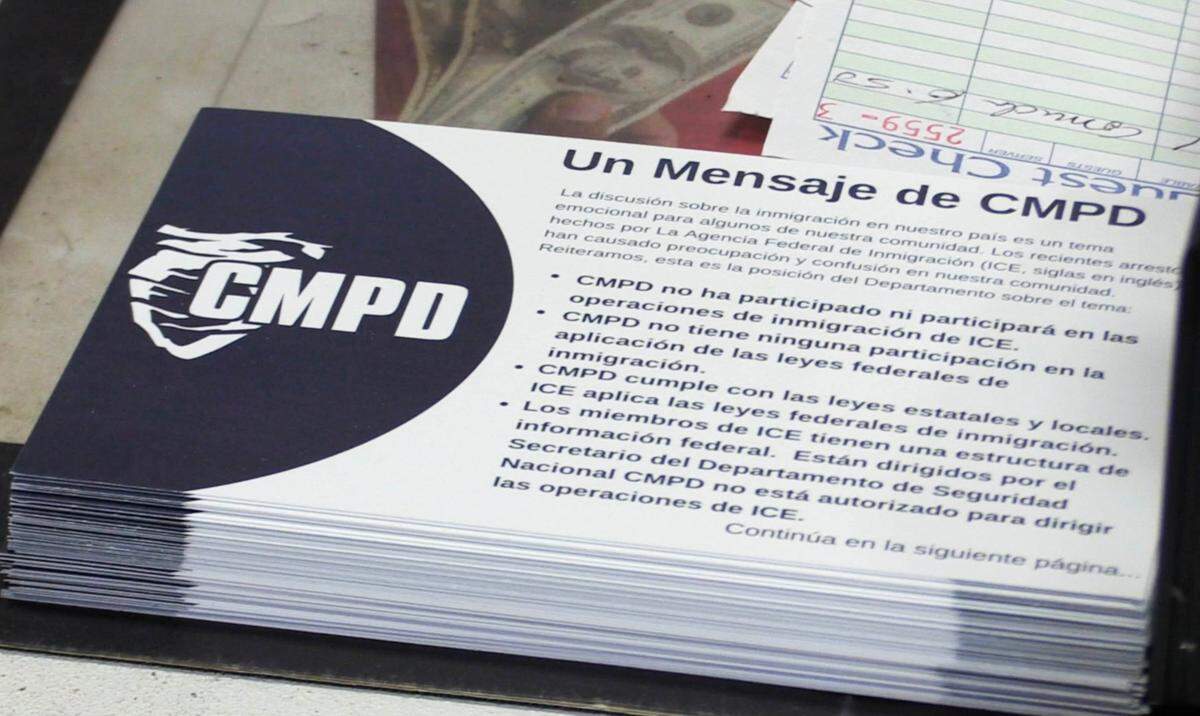
A 2020 study used survey data to estimate that undocumented immigrants are less likely to report crimes to police than native U.S. residents. The study estimates the reporting rate of undocumented immigrants is around 17% while that rate for U.S. residents is around 40%.
Price, who has met with CMPD to discuss the U visa program, said he hopes the department will revert back to a policy that makes U visa certifications more accessible without any extra requirements. He said the program has changed as different CMPD employees in charge have changed.
CMPD first met with leaders in the Latin community about the U visa program in late 2019. The meetings came after a heated discussion between a CMPD officer and immigration attorney Stefan LaTorre aired on La Voz Latina, a radio program on 102.3, concerning CMPD’s U visa program. Charlotte Spanish-language media outlets — including Hola News and Qué Pasa Mi Gente — also covered the debate and CMPD’s U visa program. Those meetings were stunted by the pandemic but resumed in 2021, CMPD spokesman Rob Tufano said.
“It is critical that we continue to earn the trust from Hispanic community members,” Tufano said. “Updating our U-Visa application process will allow us to cultivate an even stronger relationship with the community.”
Price called himself an evangelical conservative pastor — not an “open borders guy.” However, reforming the U visa program is a “no brainer” when it comes to building trust with the community, he said.
“If we do it right, it will help reduce crime in the city,” he said.
A long wait nationwide
Getting a local law enforcement agency to certify a U visa is only a first step, and legal experts say that a national processing backlog has also undermined the program.
According to USCIS, the current wait time for the agency to look at a new U visa application is estimated at around five years. If USCIS determines the petitioner is eligible, the person receives a deferred action status that includes work authorization and protections from deportation proceedings, Maloney said.
From there the petitioner has to wait additional years for a U visa to become available. The number of pending applications has exceeded the 10,000 annual number of visas allotted since 2010, according to USCIS.
“The program is supposed to provide a path to safety and stability. If you are in limbo for almost five years, then the strength of that path is diminished,” Levin said.
Krishna’s case advances
This year, Krishna received work authorization, which made him feel more comfortable spending time with his family in public. However that work authorization came as a direct result of a deportation proceeding.
In 2018, immigrants who had been denied a U visa were being placed in deportation proceedings due to a memo that followed a Trump executive order. Krishna said his attorney believes that was the reason he was served a removal hearing date around March 2020, after CMPD had denied his attempts for U visa.
That practice has now been rescinded by President Biden, Levin said.
Due to the ongoing pandemic, Krishna’s removal hearing was rescheduled to around March 2023, which bought him some time and temporary peace of mind. He said he received work authorization because the hearing is two years away.
Krishna said according to his attorney, his chances are about 50-50 that he will be deported. He said he worries about how many years it would take to come back to the U.S. to his family. His family could not move with him to India, he said. Krishna’s kids don’t know the language. All they’ve ever known is the U.S.
Krishna still feels he was unfairly denied a U visa certification by CMPD, however he said he would still never hesitate to call the police.
“Even though one person messed my life up entirely, I still believe in the system and still believe in the cops,” he said.
This story was originally published April 13, 2021 at 6:00 AM.