
As Mecklenburg weighs budget priorities, court leaders barely getting by ask for help
As Mecklenburg County commissioners weigh their budget priorities, leaders in the local criminal justice system have a familiar plea: Don’t forget about the courts.
“The demands on our offices are immense,” District Attorney Spencer Merriweather told commissioners at a meeting Feb. 11.
It’s an issue he and others have wrestled with for years. Though the state is responsible for funding the judicial system, Mecklenburg County has long had to pitch in.
While other counties support their justice systems with smaller checks for initiatives like jail diversion programs, Mecklenburg County pays for jobs — prosecutors, clerks and more. The county made an $8.5 million investment in the most recent fiscal year, according to its Criminal Justice Services department.
“I know the state is who ought to be paying for all of this,” Merriweather said to the commissioners. “And don’t you believe that I’m not saying that at every instance when I meet with our General Assembly. But I promise you that if you were to take away any of these resources, it’s not the district attorney who would suffer. It’s your constituents, your community, your public safety, your sense of justice that would suffer.”
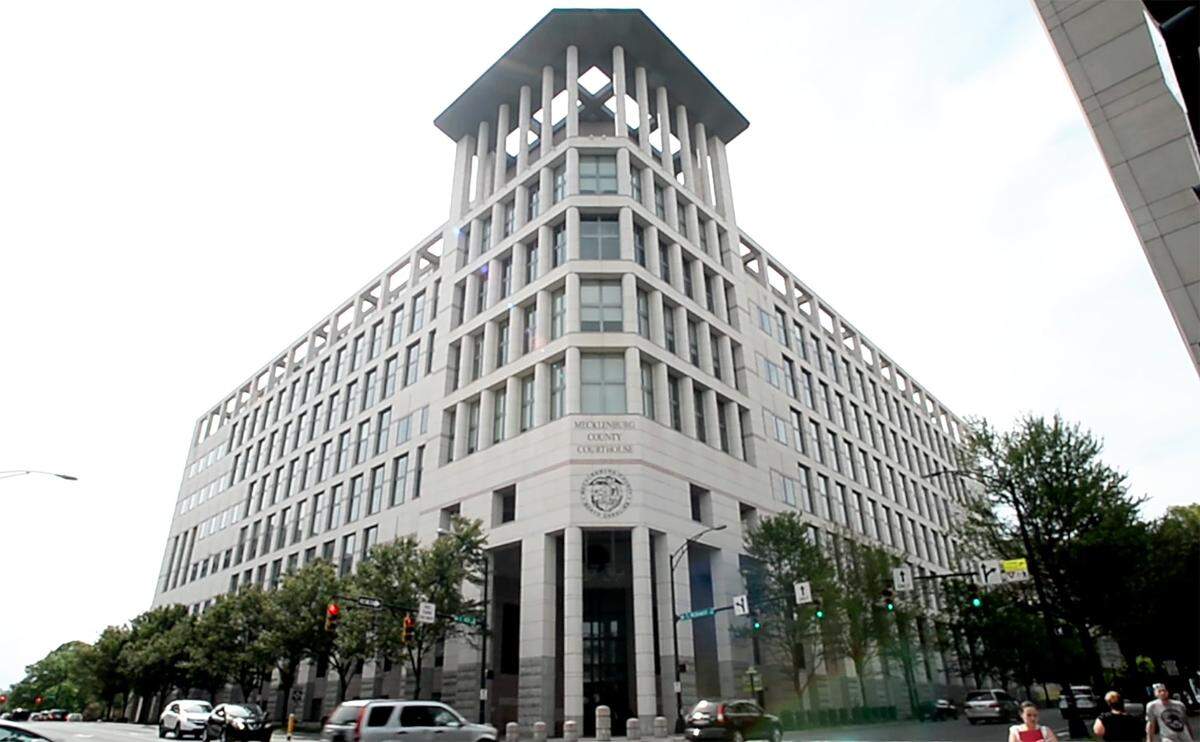
About 2.5 percent of the state’s budget goes to funding the judicial branch, Mecklenburg Trial Court Administrator Casey Calloway said last week.
“That’s less than one cent of every tax dollar,” she said.
Mecklenburg County pays for roughly 16 percent of local court operating costs, she said, and Charlotte’s own contribution covers 1 percent.
If history is a decent guide, the state will not step up, Chief Public Defender Kevin Tully said.
“You have invested because the state is not going to do it,” he told the commissioners. “I’ve been around since 1989. They’re not going to do it.”
Short resources in the ‘Great State of Mecklenburg’
Across North Carolina, there are complaints from court officials of underfunding and lack of resources from the legislature.
But in large, urban Mecklenburg County, which has the busiest courthouse in North Carolina, the burden from too little staff is greater, local officials say.
Most of the speakers at Tuesday’s meeting scorned research used by Raleigh’s Administrative Office of the Courts on workloads and staffing needs. By that count, Merriweather needs 84 prosecutors, his current staff level. The county pays for 20 of those, the district attorney said. Clerk of Superior Court Elisa Chinn-Gary should have 249 clerks, the study says.
The study is “fairly outdated,” Chinn-Gary said.
“The study that was done by the AOC was not accurate and, I would say, not honest,” Tully told the commissioners.
Merriweather was the most blunt. The number of prosecutors recommended for Charlotte was “bogus,” he said.
In fact, he needs about 120 to keep up with the system’s demands, he said. That would be just over 12 prosecutors for every 100,000 residents.
A 2019 investigation by The Charlotte Observer found that Mecklenburg had fewer prosecutors than almost any county its size in the United States.
“If you hear emotion in my voice, it’s not emotion for the people in my office that want to keep working,” the district attorney said last week. “It’s the emotion (from) thinking about the victims that we’re fighting for each and every day. We’re scraping and cutting and getting by and doing the best that we can.”
Other North Carolinians joke about the “Great State of Mecklenburg” and its unique needs, Chief District Court Judge Roy Wiggins noted. But the county truly does have unique needs, he said. Judges in smaller communities are “amazed” at what it takes to administer justice in Charlotte, he said.
“Myself and my judicial assistant prepare the schedule every week, and it’s a struggle every week to keep our courts fully staffed with judges,” he said. “However, our work cannot be done without the assistance of the clerk’s office, (Trial Court Administrator’s) office, the public defenders and the DAs. The support that you give us to help with their staffing, it gives us the ability to do our work.”
Clerk says new online system adds to workload
New demands have put an added strain on Clerk of Superior Court Elisa Chinn-Gary’s office, she said.
When North Carolina began its transition to a digital court records and case management system in 2023, a system called eCourts, the response from lawyers, clerks and other users was often negative.
ECourts, also called Odyssey and Enterprise Justice, promised to create a more transparent court system for North Carolina. But its February 2023 launch was plagued by glitches, confusion and accusations that its software led to people being arrested multiple times for the same charge. The project cost the state about $100 million.
Months after it came to Charlotte that October, the Observer found that search warrants were mostly not being posted online. They were more difficult to access and read than they were pre-eCourts.
Chinn-Gary attributed delays in posting records to understaffing.
The consequences are worse than stilted access to police records, though, she told commissioners last week.
If she is short on clerks, there will be more errors in the judicial system, she said. Those could mean someone is held in jail for too long or released from jail too soon. Special court sessions to deal with backlogs might not happen. Staff will face an impossible workload.
“If you work and overwork dedicated staff, it amounts to abuse,” she said. “It has amounted to abuse. We have seen the attrition rate increase as a result of that. We are losing institutional knowledge. We are losing dedicated public servants because of the work environment, of being overworked and not having enough resources to do the work that we very much care about.”
The county manager is slated to make budget recommendations in May.
Editor’s note: The information about staffing research used by the N.C. AOC was clarified in this story on Feb. 19.
Ryan Oehrli covers criminal justice in the Charlotte region for The Charlotte Observer. His work is produced with financial support from the nonprofit The Just Trust. The Observer maintains full editorial control of its journalism.
This story was originally published February 18, 2025 at 5:00 AM.