CMPD spokesperson sued cop who criticized her. His free speech argument won
The spokesperson for the city’s police department sued the Charlotte-Mecklenburg Fraternal Order of Police and its president for defamation after he publicly criticized her last fall, but a judge has now dismissed the case.
The lawsuit stemmed from what Sandra Vastola, director of CMPD public affairs, said were false and defamatory statements made by the FOP and local president Daniel Redford following publication of a WCNC story about some officers logging off their radios on the day of the deadly Galway Drive shooting on April 29, 2024.
In an email to WCNC for their July story, Vastola said CMPD would not “speculate as to why any individual logs off of his/her shift --- could be hundreds of different factors at play.” She also emailed WCNC to say its reporting was “irresponsible” and a “slam job.”
Redford and the FOP then criticized CMPD and Vastola in the news and on social media for what they said was a lack of transparency.
An FOP post called Vastola the “mouth piece” of the police chief and said she “resorts to petty nastiness whenever she doesn’t like the questions being asked.”
In another story by WCNC, which later reported CMPD punished two officers who logged off their radios the day of the shootout that left four officers dead, Redford said a response from Vastola was a “garbage response given by CMPD’s PIO office.”
First Amendment protections
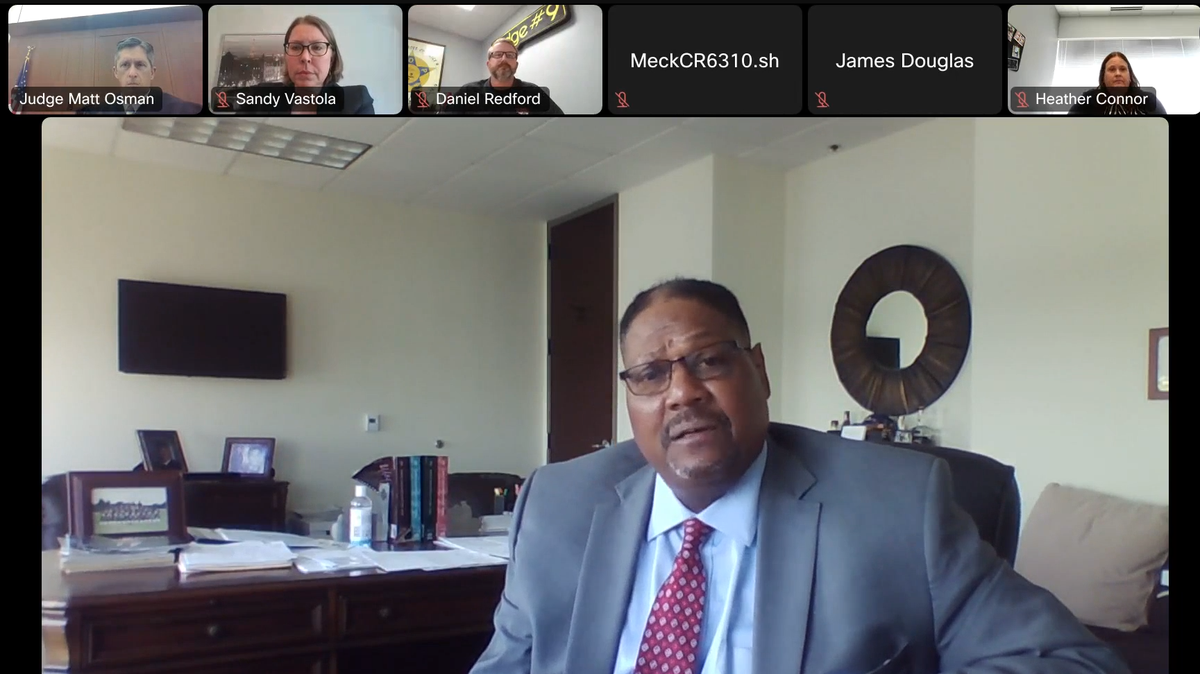
Heather Connor, the lawyer representing Redford and the FOP, cited New York Times v. Sullivan during an April 1 virtual court hearing in Mecklenburg Superior Court. The U.S. Supreme Court ruled in the landmark 1964 case that public officials must prove “actual malice” in libel suits.
She said that because Vastola is the spokesperson for the city’s police department, she is a public figure and subject to a higher standard to prove actual malice in a defamation suit.
The critical comments by Redford and the FOP were “mere opinions” protected by the First Amendment, Connor argued.
“We all have our opinions,” Connor said. “They might be wrong. They might sometimes come out, as the U.S. Supreme Court said, ‘in an ugly manner,’ but they are our right to express our opinions.”
Vastola’s attorney, James E. Hairston Jr., argued that even though she is the public face of the police department, she is also a private citizen, and was harmed by the “malicious” comments.
“All of the statements attributed to Mr. Redford and/or the FOP are false,” Hairston said during the hearing. “And they affect her reputation in her job, which is libel per se.”
Superior Court Judge Matt Osman sided with Redford in dismissing Vastola’s lawsuit in an April 4 order, saying during the hearing: “This isn’t England where we criminalize mean thoughts.”
Vastola did not respond to a request for comment. Redford said he was confident before the hearing.
“The First Amendment protects speech, whether we like it or not,” Redford told The Charlotte Observer. “I mean, there’s been countless cases where people have given the middle finger to police officers and there’s nothing that we can do about it other than just ignore it because it’s protected speech.”
Unpacking the case
Hairston also argued that Vastola was not able to divulge information about police officers reportedly logging off the radio on April 29 because of state personnel law and confidentiality around the investigation.
“They knew that and despite that, they targeted her as opposed to the office,” Hairston said during the hearing, referring to the FOP.
Vastola reports to higher ups and cannot provide statements or information of her own volition, Hairston argued. And because she was not elected or appointed to her role as director of public affairs, she is still a private citizen.
The Fraternal Order of Police, which has nearly 2,000 members in Mecklenburg County, is sometimes at odds with CMPD leadership. In one instance, the FOP last year disagreed with Chief Johnny Jennings over the type of bulletproof vests that should be assigned to police officers.
The department suspended Redford for 40 hours in March over comments he made while speaking as FOP president, he said.
Redford said the lawsuit took him by surprise.
“I read through it and I didn’t see anything other than maybe the FOP saying some things that maybe hurt some feelings a little bit,” Redford said. “But nothing that clearly rose to the level of libel and defamation.”
Redford said members of the FOP who work within CMPD thought the lawsuit was “a retaliatory attack” for the police organization being critical of Jennings on social media.
“They saw it for what it was … Sandy was the one that took the lead in trying to muzzle the FOP and try to shut us up through fear and intimidation by filing a lawsuit against us,” he said. “It didn’t work, because, again, we had the Constitution on our side.”