
MEDIC touts controversial $118M CPCC facility to train first responders in care
A $118 million project largely funded by Mecklenburg County is going to help MEDIC recruit and train, one of the agency’s leaders told The Charlotte Observer.
That planned first responder training facility at Central Piedmont Community College’s Levine campus has sparked controversy.
Groups like Stop Cop City CLT have criticized the college’s decision to cut more than 30 acres of trees in Matthews to build it. That group has also said an indoor, soundproof gun range would be dangerous and worried about a consistent police presence there.
New, large police training centers have been divisive with more scrutiny on police in recent years. But it’s not just law enforcement who will train there once the facility is finished in 2028.
“It’s a space (where) we can make mistakes,” MEDIC Deputy Director Sharon Taulbert said in a recent interview.
The project will include a driving course, movable walls to create simulations of common places responders go to and new academic courses, Central Piedmont has said.
Criticism focused on police, transparency
The Observer also reached out to the Charlotte-Mecklenburg Police Department and the Charlotte Fire Department about the facility. Neither responded to requests for an interview.
In statements through Central Piedmont, though, Chief Johnny Jennings has praised the project.
It “will provide our officers with advanced training in realistic, high-pressure situations, making them better prepared than any previous generation,” he has said.
Criticism of the facility has largely been centered on police. Opponents fear it will be a new “Cop City” like one that caused protests in Atlanta.
Officials touted that facility, too, for its potential to simulate real situations. But protesters worried about environmental damage and police militarization.
“Charlotte deserves investment in its people — not another militarized experiment in state violence,” Stop Cop City CLT said in a news release this month.
In a lawsuit that has now moved to federal court, some community members allege that planning for the Matthews project, Community Lifeline, broke state open meetings law. The suit is pending.
Exhibits in that lawsuit showed CMPD and Central Piedmont Public Safety Dean Luke Sell discussing keeping tabs on activists opposed to the project, the Observer previously reported.
What MEDIC has and what it needs
Taulbert said she and MEDIC’s operations manager met with architects designing the project in 2024.
“Don’t make the pavement nice,” she remembered telling those architects. “Have some cracks. Have some muddy areas. Have some sand and gravel where we’re moving stretchers across uneven surfaces.”
They asked for other inconveniences, like brick mailboxes that nine-foot-tall and nine-foot-wide ambulances might struggle to weave past.
“The reality of the world is it’s not all one smooth driveway or one smooth sidewalk or a very large street with no other vehicles in the way,” she said.
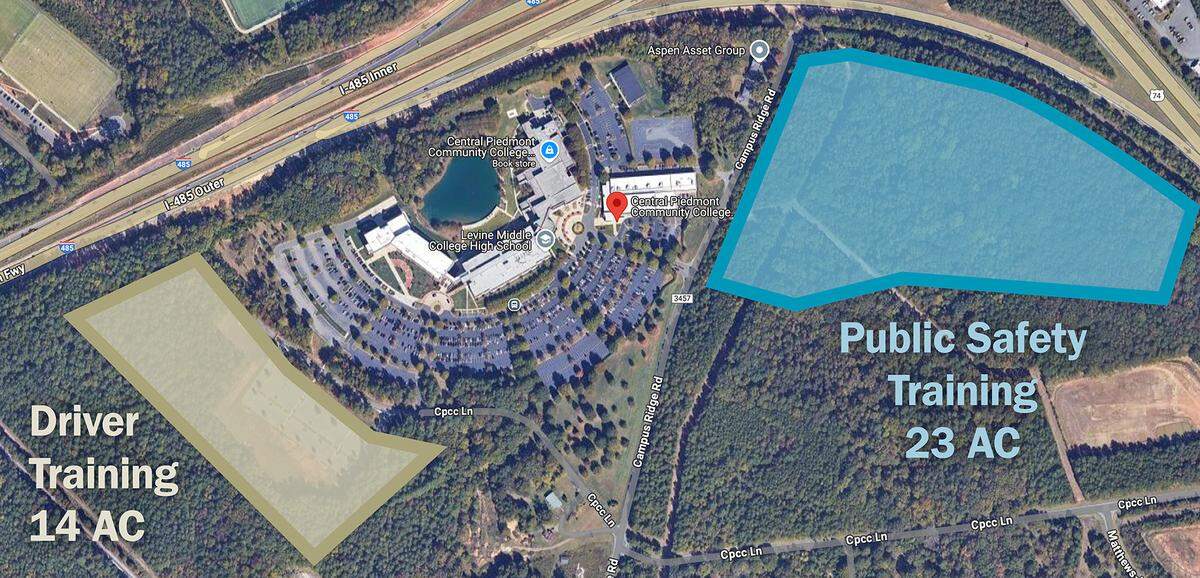
That’s what new medics will need to get used to, she said.
MEDIC is short on places to train, she said. The agency uses a city-owned driving course — the same one that garbage truck drivers and CATS bus drivers use, she said. It might take a year to reserve time there.
MEDIC has its own space where it can simulate a hospital room to some extent, she said. But that, too, is limited.
“With so many community partners, having a central location where we can all train together and have enough space is essential,” Taulbert said.
That includes Charlotte-Mecklenburg police, firefighters, a slew of county agencies and even some from South Carolina.
And with the way the county is growing and students at Central Piedmont already filter into MEDIC, the new facility will only help, she said.