
No name on CMPD officer leaves protestor wondering: ‘Who hit me?’
Everything was peaceful, Lindsey Key said — then a cop shoved a bike into her neck.
More than a month after uptown Charlotte’s “No Kings” march in opposition to President Donald Trump, Key, who is disabled, still doesn’t know the name of the Charlotte-Mecklenburg Police Department officer she says thrust a bike handle into her throat, leaving her sunburned neck purpled and bruised.
The officer wore only a number. Key reported the incident and sparked an internal investigation, The Charlotte Observer previously reported. No one at CMPD will tell Key his name.
The officer involved in Key’s complaint wasn’t the only nameless patroller. Where most police have traditional name tags, some bike officers at the June 14 protest had only three numbers where their name typically would be. And one officer, after the official march ended, sent stream of pepper spray into a crowd.
It happened as concerns rise nationally about Immigration and Customs Enforcement agents hiding their identities with masks while carrying out the Trump administration’s orders and arresting people they say entered the country illegally. People have also been arrested for impersonating ICE officers, at least two in North Carolina since January.
NC law says police names are public record
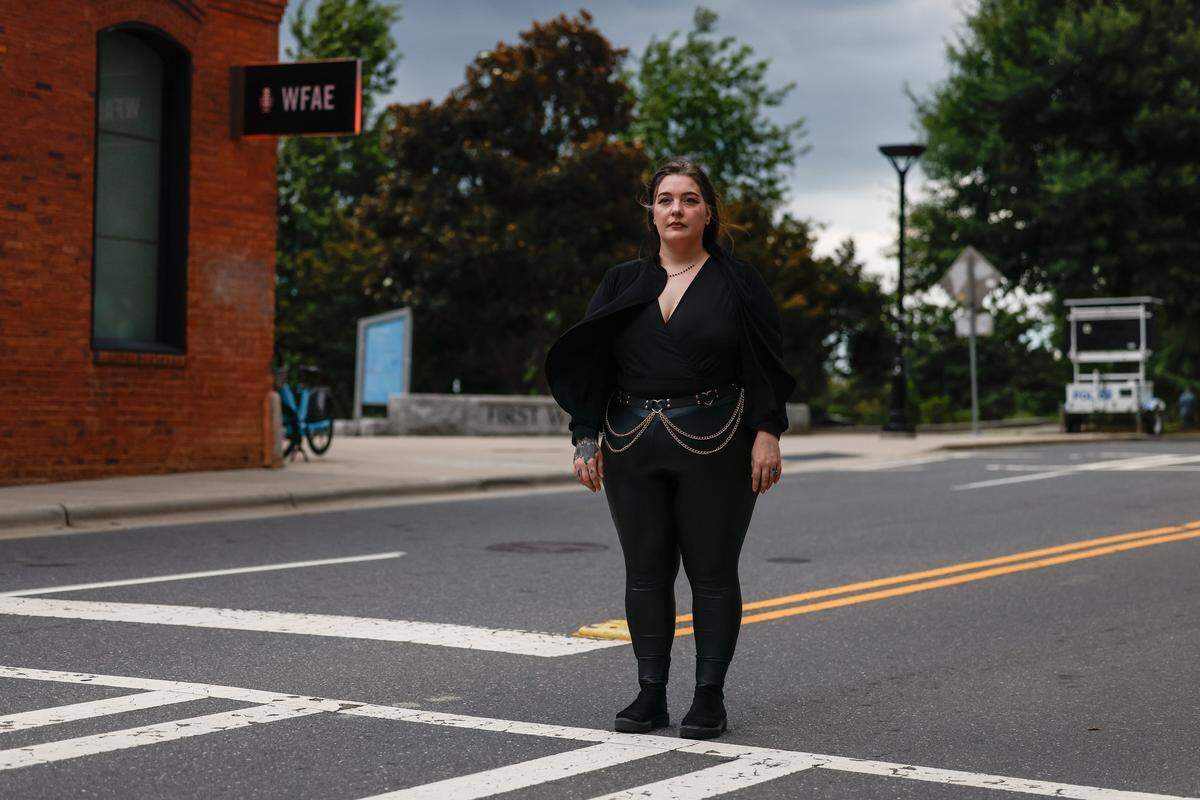
Key, who is 35 and has lived in Charlotte for four years, has provided CMPD with videos and photos of the incident and the officer. She’s asked other officers, the man’s supervisor and the internal affairs department at least three times for his name.
But her inquires have gone ignored and unanswered.
North Carolina law says the name of a public employee “is a matter of public record.”
Asked why internal affairs will not provide the officer’s name, CMPD spokespeople did not reply.
In a statement to the Observer, Chief Johnny Jennings’ public information officers said “some of our officers may wear numbered badges in place of traditional name tags... particularly those involved in crowd management.”
They said that the “use of numeric identifiers helps ensure officer safety while maintaining accountability,” and that CMPD remains “committed to transparency, professionalism, and building trust with the community we serve.”
Asked how the use of numbers helps ensure officer safety and when Jennings approved the use of numbers instead of names on officer uniforms, his spokespeople did not answer.
CMPD directives say sworn officers’ uniforms and outer carrier vests must include nameplates. An “appropriate alternative to the nameplate, such as screen printing or embroidering, may be used only on Class C uniforms (like the ones bike officers wear) not suitable for wearing a nameplate,” according to those rules.
Video of bike officer at ‘No Kings’ protest
Video taken by Key shows what happened when a crowd neared light rail tracks the day of the march.
Officers, in unison, told the crowd by the tracks to “move back!” and stepped toward the protestors, their bikes acting as a barrier between them and the crowd. An officer wearing number 180 acted differently from the rest, Key told the Observer.
Officer 180 picked up his bike higher than the others and shoved it more forcefully into the front line of people, Key said. That’s where she stood, and that’s where she got a handlebar to the neck.
“He just shoved me in the throat with his bike handle,” Key says in the video.
“Move back,” the officer said again, responding to her.
“I was moving back, you didn’t give me a ... chance,” Key said. “Not only am I disabled—.”
The officer interrupted: “Then go home.”
“Absolutely [expletive] not,” she replied. “You didn’t give me enough chance to move back. Again, I’m disabled.”
Key shared this video on her TikTok the day after the march. When the Observer reported on her 911 call — which, under North Carolina public record laws, had been provided to the paper with distorted audio and no name associated with it — she reached out.
Key told the Observer she had moved to the front of the crowd to get videos of officers and their faces “if anybody needs it in the future.” She says the officer did not give the crowd enough time to step back before using force.
She is diagnosed with rheumatoid arthritis and hypermobile Ehlers-Danlos syndrome, she said, which “makes me a bit slower.”
“Just to move back, I have to be a little bit more careful,” she said. “Because of my hypermobile Ehlers-Danlos syndrome, I could dislocate my hip… which happens.”
When the officer struck her neck, it flared up her fibromyalgia — a pain disorder — for a week, she said.
“Imagine you have a pain level of four,” she said. “For me, that’s a pain level of 10.”
Key said she wants officers “to be trained appropriately to handle large crowds.”
“I truly believe that the officer was not trained appropriately for the job that he was doing,” she said.
This story was originally published August 4, 2025 at 5:00 AM.