Charlotte leaders adopted a teen curfew more than 30 years ago. Here’s why
As Charlotte leaders consider changes to the city’s curfew amidst so-called “teen takeovers,” the questions being asked today echo those from 30 years ago when an ordinance was first put in place.
How do we keep teens safe while giving them freedom? How much would a curfew help? And could it lead to the overpolicing of teens of color?
These are the things the city council considered when putting an ordinance in place in 1995: teens under 13 and under cannot be in public between 10 p.m. and 6 a.m. without a parent or guardian. The curfew is between 11 p.m. and 6 a.m. for teens between 13 and 15.
The Youth Protection Ordinance, which was meant to run for two years and be reviewed every six months, is still in place more than 30 years later.
But a new proposal, suggested by the Charlotte-Mecklenburg Police Department on Tuesday, would set the curfew time for all ages at 9 p.m., and include 16- and 17-year-olds.
Those proposed changes have given rise to similar questions and concerns. Some officials and citizens are open to adopting the new rules, while others are hesitant, urging caution and consideration of alternatives to a stricter curfew.
A look back at the 1990s, when then-City Council member Pat McCrory began pushing the city to consider adopting an ordinance, shows the similarities between then and now.
Concerns of crime
Like the 1990s, elected officials and citizens have raised concerns about crime, homicide and youth violence in recent years.
However, unlike the 1990s, crime and homicide in Charlotte has been in decline. Regardless, the perception of rising crime and violence has brought about questions of how to improve safety in the Queen City.
Concerns have primarily been driven by high-profile incidents, such as the fatal stabbing of Iryna Zarutska on a Charlotte light rail train in 2025, or the killing of four law enforcement officers in an east Charlotte neighborhood in 2024.
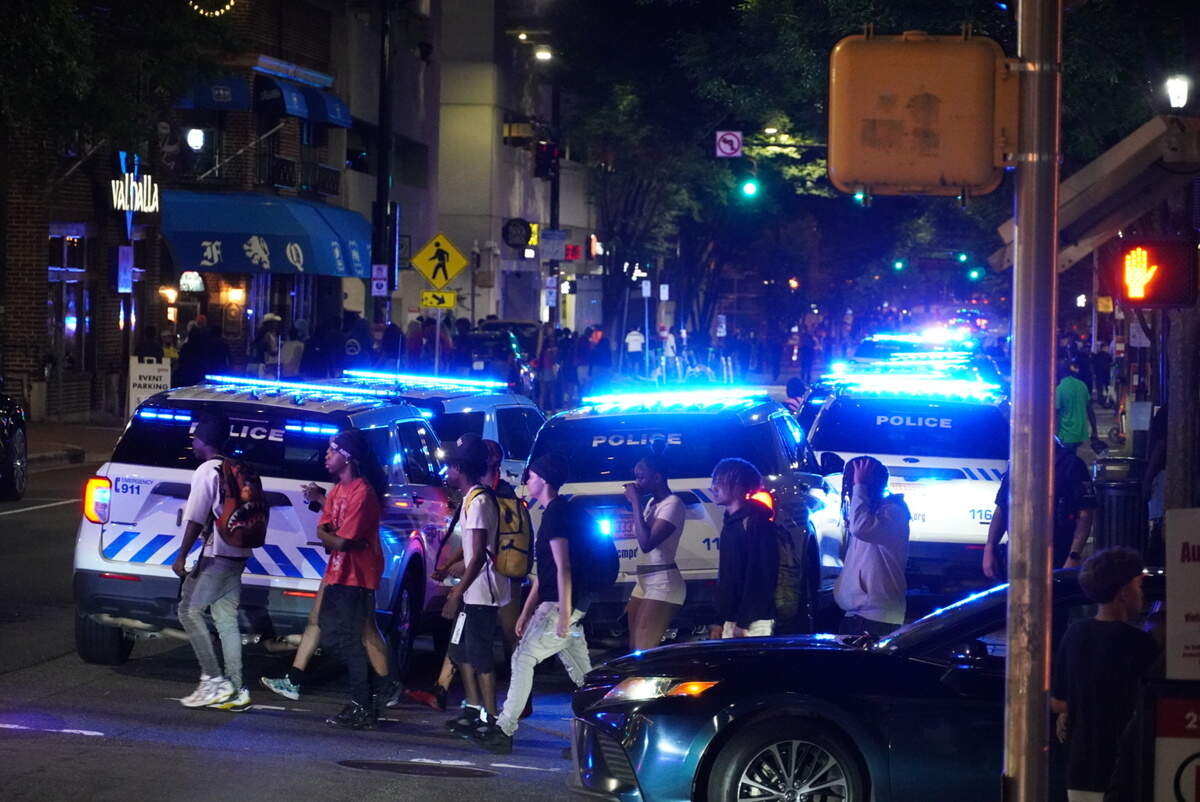
And, more recently, teen takeovers have dominated headlines, flagged by police as a community threat. Scenes of the takeovers, which have shown hundreds to thousands of teens swarming an area, have circulated online. Many, including CMPD Chief Estella Patterson, have raised concerns that these takeovers could culminate into deadly events.
“If we don’t get a handle on this, the consequences may become fatal,” Patterson said on Tuesday.
More than 30 years ago, McCrory had similar feelings about the matter.
“We need to get back control of our streets,” McCrory said, according to a Charlotte Observer story published in November 1990. “This may help us do that.”
Charlotte in the 1990s
Crime, homicides, and youth violence were on the forefront of peoples’ minds when the city council put the teen curfew in place.
It came a year after President Bill Clinton’s crime bill in 1994 that, among other things, increased the budget for hiring police and introduced a law that would give life sentences to people convicted of felonies three times.
It also came two years after Charlotte saw 121 homicides, a record-high number, in 1993.
Other cities considered putting curfews in place, but they were often challenged in court, including in Washington, D.C., according to a November 1990 Charlotte Observer story. There were concerns curfews would violate the constitutional rights of teens.
In 1990, Atlanta adopted a teen curfew. McCrory began floating the idea of one in Charlotte soon after.
People accused teens of taking over parking lots, shopping malls, and movie theaters, the Charlotte Observer reported in January 1995.
But some council members, as well as local police officials, were hesitant to support putting a curfew in place, let alone enforcing one. Lynn Wheeler, a city council member, said she didn’t think the curfew would fix the issue of juvenile crime.
Charlotte Assistant Police Chief Ronnie Stone said he didn’t think an ordinance would stand a “constitutional test.”
“We’re not of the opinion that a curfew is necessary or appropriate,” Stone said at the time.
In Pineville, where leaders began considering a curfew in response to Charlotte’s consideration, Police Chief Jack Thrower put the issue back on parents.
“Teenagers aren’t trying to take over shopping centers or the malls,” Thrower said in January 1995. “You’ve got to depend on the parents to do their baby-sitting or hire a lot more police.”
Concerns of racial profiling
However, by February 1995, the council voted 8 to 3 to put a curfew in place. And CMPD Chief Dennis Nowicki, unlike Stone, was more supportive of the curfew. The backlash was swift.
“They’re just going to be going in the Black neighborhoods like Southside homes, Earle Village and Dalton,” a first-year student at Myers Park High School said at the time. “They think Black people are bad. They think white people are perfect.”
Members of the NAACP Charlotte branch were also critical, saying it would be used to overpolice Black neighborhoods.
Nowicki tried to reassure the public the curfew wouldn’t be used in that way.
The goal was to help kids and prevent crime, not prosecute them, a CMPD captain said.
Does a curfew help?
When the curfew finally started, in May 1995, critics questioned if it would be enforceable and legal.
No youth were cited the first night of the curfew, The Charlotte Observer reported. A CMPD captain said enforcement started off slow because the curfew started on a Monday, a school night.
Another CMPD captain, Craig Huneycutt — also known as Capt. Curfew because he trained officers in enforcing it — said there were “legally acceptable” exceptions to the curfew.
Those exceptions, which include running an errand for a parent, traveling for work, or an emergency, remain today.
Officers also hoped to take a “three strikes” approach, similar to Clinton’s federal crime bill, The Observer reported. Youth would be given warnings and opportunities to avoid violating the curfew before being prosecuted, Huneycutt said at the time.
Some city council members felt the soft approach weakened the purpose for having a curfew.
Others felt the curfew made a noticeable difference. More teens were accompanied by parents, kids were getting picked up from skating rinks earlier, and movie theaters stopped selling tickets for times that would conflict with the curfew, The Observer reported.
Six months after it was implemented, youth crime dropped. The Observer reported fewer teens were out on the street after midnight, and the question on whether a candidate supported a curfew became a key question for council members heading into an election.
Mecklenburg County would adopt Charlotte’s curfew not long after.
Despite still having some critics, a year after it was adopted, in 1996, the curfew was considered a success.
“We have seen some very promising results,” Huneycutt said. “This is a start in protecting our children.”