
‘I am angry.’ CMS says air is safe but aging systems fall short of COVID-19 advice from CDC
As Charlotte-Mecklenburg Schools leaders weigh whether to allow some students to return for in-person learning after months of virtual-only class due to COVID-19, concerns linger about the air quality inside school buildings.
District officials and local health leaders have outlined reopening metrics — including the county’s positivity rate, the availability of personal protective equipment and whether school buildings are ready for students— but some teachers say they’re concerned aging heating and cooling equipment in school buildings increases the risk of spreading the virus.
Specifics on air filtration are not included in CMS’ current dashboard for reopening. Other facility preparations — like spacing seats out for social distancing and enhanced cleaning — are required.
CMS says it is working to improve indoor air quality in anticipation of bringing students back to in-person learning.
But some of the measures put in place fall short of recommendations by the Centers for Disease Control for reducing the spread of viruses.
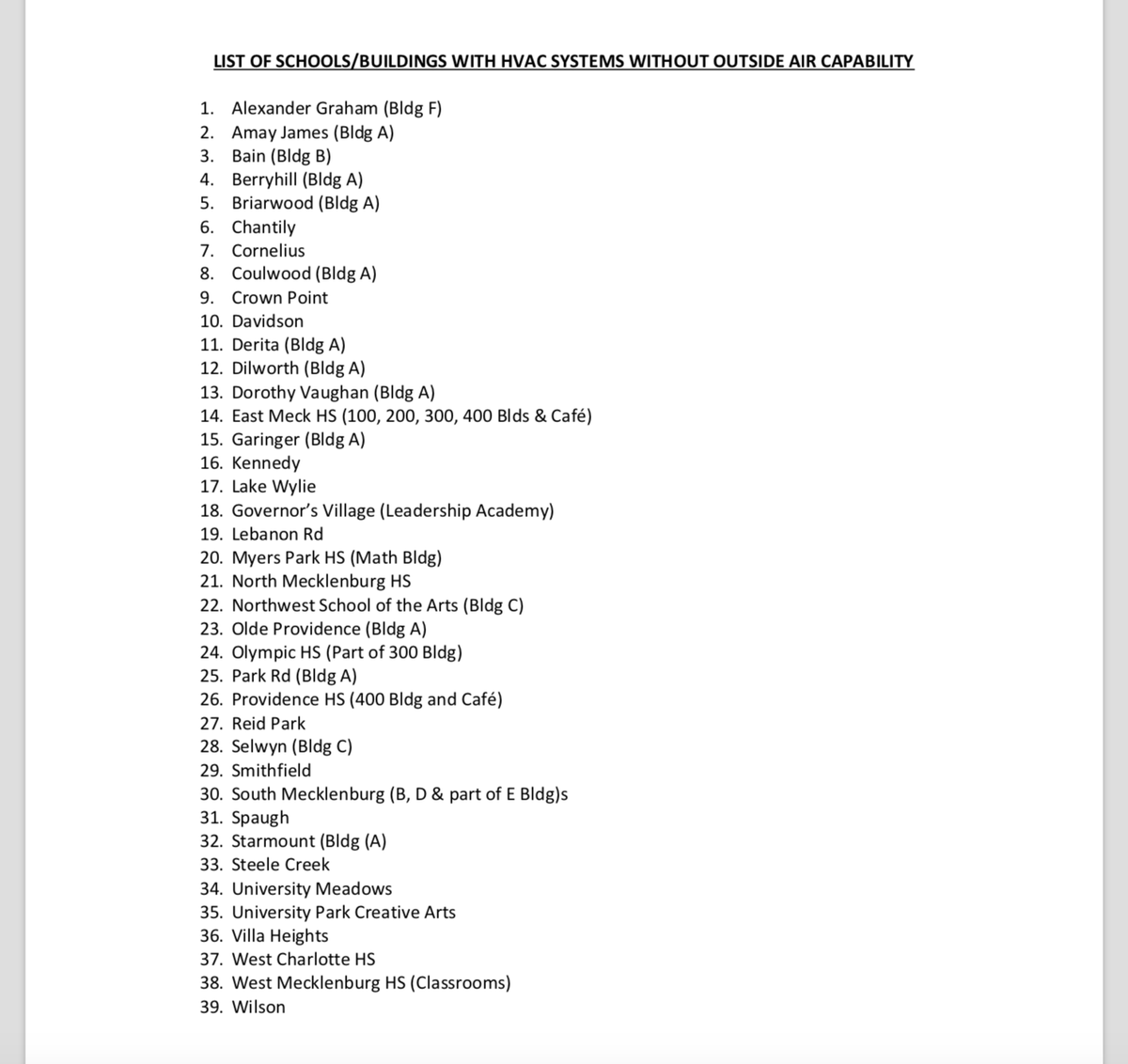
District officials, in response to questions this week from the Observer, said that school HVAC systems cannot accommodate the CDC’s prescribed filters. Another option — buying CDC-recommended portable filtration systems — would be too expensive, officials say. And last week, CMS released a list of 39 schools with HVAC systems incapable of bringing in outside air, a key reopening recommendation from the American Society of Heating, Refrigerating and Air-Conditioning Engineers.
Of those CMS sites, 26 on the list are schools that enroll predominantly Black and Hispanic students, according to an Observer analysis of district data.
Some teachers say the disparity is yet another example of how the pandemic has disproportionately harmed Black and Hispanic communities, who have seen higher rates of infection and worse medical outcomes from the coronavirus.
“I am angry about this. I’m watching where they are intending to bring people back, into those buildings on that list,” said Erlene Lyde, a teacher at West Charlotte High School. “They need to be transparent with communities of color. These buildings are not safe.”
Ventilation and HVAC upgrades have been in the works for years across the district but taken on more urgency during the pandemic.
In all schools, the district is increasing outdoor air flow where possible by 10 to 15%, examining exhaust fans, upgrading air filters and running HVAC systems for longer periods of time. Schools that do not have outside airflow are encouraged to open doors and windows, where possible.
The district said it has prioritized the 39 schools for upgraded filters and air optimization projects. That process involves dismantling and rebuilding HVAC systems in their entirety to achieve 100% of their original capacity, replacing parts that have worn out over time.
Still, public health and occupational safety experts said that the inability to bring in outside air significantly increases the risk of spreading the coronavirus indoors, unless sufficient filtration measures are put in place to clean the air of viral particles. That poses a significant challenge to schools across the country, as many districts struggle with outdated HVAC systems and sustained budget shortfalls for repairs.
School air quality
The issue of air filtration and how well school buildings’ systems will perform this fall came up just last week as district officials met with local health leaders to discuss how CMS could safely restart in-person learning.
Steve Oreskovic, the lone teacher in the group, asked whether the ventilation and airflow issues were resolved enough to safely return children to school.
“Yes,” said Kathy Elling, chief school performance officer. “The answer to that is yes. We’ve got a work-process flow to improve filters in schools, but it is not a no-go for us to open schools.”
But industrial health and safety experts said that school ventilation systems are not typically designed to filter out aerosols that can carry viruses, and simply restoring them to original capacity will do little to mitigate any potential spread or buildup of viruses.
“Until you actually implement systems that can control infections, you might as well not even be doing anything,” said David Krause, a toxicologist and industrial hygienist, and a member of the American Industrial Hygiene Association.
Increasing the outside air flow to an indoor space is one way to prevent viruses from building up and spreading within the room, Krause said. When that’s not possible, another option is to trap any particles in the air before recirculating it into the same space, using a portable filtration or air scrubbing system.
Combined, the systems should change and filter all the air in a room at least two times per hour, according to CDC guidelines issued for schools reopening during the pandemic. Phil Berman, executive director of CMS building services, told the Observer the district was working to meet that standard but that the rate could vary across schools.
In a recent public meeting, CMS maintenance and engineering Director Fakhar Shahbaz said that the district was able to increase outside airflow by 10 to 15% in some buildings. The 39 without outside airflow are prioritized for filter upgrades, he said, but the district’s HVAC systems cannot accommodate the recommended filters that would have an impact on catching viral particles.
Air filters are given a numeric rating based on their ability to capture particles, known as a Minimum Efficiency Reporting Values, or a MERV rating. Guidelines put forth by the CDC recommend using at least a MERV-13 filter or higher if systems can accommodate them. They also recommend in-room filtration systems, such as UV or portable air purifiers that meet HEPA standards.
CMS’s systems are designed for filters rated MERV-8. District engineers have found a way to adapt the system for the higher-rated MERV-10 filters, and have completed optimization projects in 25 buildings. Berman said the upgraded filters, while not up to CDC recommendations, could do a better job capturing viral particles that adhered to bigger droplets.
Some employees said they are concerned that change still will have little impact on filtering out viruses, leaving teachers and students at risk for exposure.
“We’re in a pandemic environment,” Oreskovic said. “Upgrading from one filter to another doesn’t mean you have what you need.”
Krause said that school ventilation systems were never designed to control infections, and that restoring them to full functionality would do little to mitigate the spread of a virus without investing in other control measures.
“We are kicking dust in the wind if we think we’re going to meaningfully reduce the risk of exposure to an airborne virus without controlling airborne aerosols,” he said. “The more we make the indoors like the outdoors, the better off we’ll be.”
Berman said that the district was engaging third-party consultants to look at additional measures in classrooms. However, he said, the cost of purchasing an in-room cleaning system would be significant.
“I’ve seem them $800. I’ve seen them $1,500 dollars,” he said during a recent meeting of the metrics committee. “When you multiply the numbers of putting an air scrubber in every classroom, and you say, ‘Where will this money come from, how will you do it equitably?’ That is a challenge.
“But it doesn’t mean we shouldn’t be trying to identify: This is where we’re at, how do we get to the next step of improvement? Then you have to advocate, where’s the funding?”
Some teachers have begun researching options to purchase or build their own systems using box fans and filters.
“None of our schools are really ready for indoor ventilation,” said Laurel Brooks, a teacher at Garinger High School.
“We’re out here scouring the internet, and it’s coming from our own personal budget.”
Vulnerable communities
As CMS moves closer to a plan for in-person learning, teachers say that questions of equity and the pandemic’s disproportionate toll on certain communities cannot be overlooked. Without adequate protective measures in poorly ventilated buildings, they said, students from the most vulnerable communities would be at greatest risk for getting sick or transmitting the virus to a family member.
On some campuses, only a select number of buildings are identified as lacking outside ventilation. While some buildings are newer, others have long dealt with poor circulation, stuffy classrooms and windows that can’t be fully opened to let in fresh air.
Oreskovic said that while he and his colleagues would all rather be back in their classrooms, they could not ignore the realities of a global pandemic and had to first try to “do no harm” to students.
Students have to be healthy and alive to benefit from in-person learning, Brooks said. The pandemic only exposed long-existing disparities in the community, she added, from differing health outcomes to the divergent quality of facilities within CMS.
“My students are scared of getting this,” she said. “They’re very well aware that they are part of a community that has a much higher risk of getting sick and poorer outcomes if they do.”
Erlene Lyde, a science teacher at West Charlotte, said that many of her students have had family members who have become ill or died from the virus. They often live in multigenerational homes, increasing the risk of exposing a family member if they get sick at school.
While the district will base its decision to return to in-person instruction on a countywide metric, Lyde said the higher rates of infection in Black and Hispanic communities had to be a consideration.
“I’m not surprised by that list, because I know those schools are in bad shape,” she said. “I’ve been out here advocating... Those black and brown children and teachers, if they come into a school building and get sick and take it home, how much guilt are we going to feel?”
This story was originally published September 15, 2020 at 3:49 PM.