Just 15 and 16, brothers earn college degrees quickly, cheaply — and in unusual fashion
On the surface, the simple fact that 15- and 16-year-old brothers Kamal and Shashi Yerra of Fort Mill, S.C., will soon have two bachelor’s degrees and three master’s degrees between them can appear to be unequivocally extraordinary.
And yes, those accolades bear repeating, with a little further explanation:
Shashi Yerra earned a bachelor’s degree in business administration at age 15 in June 2019, on the same day his younger sibling was awarded an identical degree, from the same school, at age 13. Since then, Shashi has been working toward his master’s degree, while Kamal has thrown himself into additional studies, earning a master’s in information systems security in August; on Monday, he will graduate yet again, this time with an MBA.
How rare is something like this?
“Kamal,” claimed their father, Ravi Yerra, in the email he sent suggesting the story to the Observer, “is the third-youngest kid in the entire U.S. ... to complete a master’s at the age of 14,” and once he has his MBA will be “the ONLY person in the U.S. to (hold) two master’s degrees at the age of 15.”
But while what the brothers have achieved academically is impressive by almost any measure, the backstory is even more unusual than you might think — and after learning how they got their college educations so quickly and inexpensively, you might view these achievements in an entirely different light.
An education on the educational system
Ravi Yerra explicitly makes clear that he doesn’t want this story to pay much attention to him or his wife, Durga.
That said, there’s no way around the fact that the couple paved the way for their sons to take this path with their education.
Ravi and Durga already had bachelor’s degrees from universities in India when they left with their boys in 2010 to relocate to the San Francisco Bay Area, where they worked in the software security industry. Their daughter, Nidhi, was born in California in 2012, and the family eventually moved east, first to Atlanta and then to the Charlotte area in 2016.
Around the time they settled in North Carolina, “I got a crazy idea,” Ravi says: to try to get an American college education.
“So I started exploring. Spent a good amount of time, almost 3-1/2 months, on research to identify ... how education works in the U.S.”
But in his research, he encountered a variety of obstacles to achieving the goal, from the high cost of tuition to the fact that his education in India often didn’t translate (many of the institutions he encountered, for instance, would require a GED or a High School Equivalency Diploma earned in the States).
Eventually, though, he discovered that certain types of colleges would allow him to enroll after earning a certain amount of college credits elsewhere — and that earning college credits elsewhere could be done quickly, cheaply, and without ever leaving home.
He homed in on two ways of amassing them.
The first was via Massive Open Online Courses (also known as MOOCs), which are free and accessible to anyone over the Internet. Many are just for enrichment purposes, but some — including those offered through websites like Saylor.org, StraighterLine.com and Study.com — will actually award college credit upon completion of a self-paced course and a proctored exam.
The second way was using Credit-By-Exam (CBE) programs that essentially allow people to bypass formal college courses, instead requiring them only to pass proctored exams proving proficiency in a certain subject in order to earn college credits.
Plenty of MOOCs and CBE programs can be challenging, and initially, he struggled with the tests. “My whole life I did a lot of excelling, but I failed in Saylor exams many times,” Ravi says.
Then, he says, “I started studying the pattern. How these things would work out. Then I tried. Got it. One, two, three, four, five. I started making credits. Hardly spent $3,500 to make 120 credits.”
It’s important to note that the types of credits earned in these ways (often through an organization like the American Council on Education or a program like the National College Credit Recommendation Service) come with a caveat: The credits are recommended but not guaranteed, meaning top universities can accept the credits but don’t always; approval depends on a number of factors.
Still, for determined students, it’s not impossible to utilize these methods to rack up more than 100 college credits in a matter of months — and that’s exactly what both Ravi and Durga Yerra did in 2017.
Then they transferred them to Albany, N.Y.-based Excelsior College, which has a generous transfer policy and a lower residency requirement than most schools for earning a bachelor’s degree.
Two online classes at Excelsior later, the Yerras had bachelor’s degrees in technology.
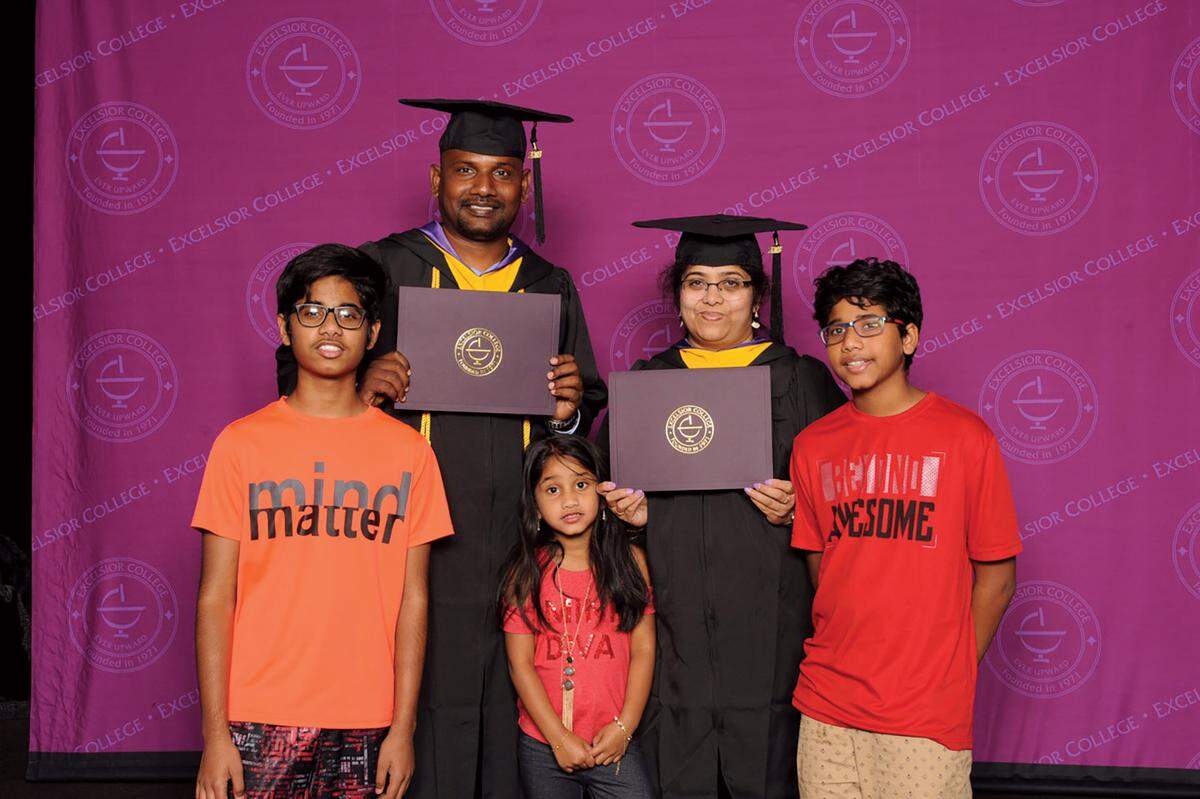
“It’s not unusual,” says Catherine Seaver, interim dean for the School of Undergraduate Studies at Excelsior, “for students like them who have taken courses at community colleges or other places to come to Excelsior and pull them all together.”
In fact, in the Yerra family, it was about to become fairly commonplace.
Like father, like sons
Shashi Yerra says he started feeling disillusioned with school when he was in sixth grade at Community House Middle School, which he attended when his family lived in Ballantyne.
“We like a challenge,” he says. “Normally in school, they tell you what to do and you just do it. With a challenge, you get to learn more. You get that excitement. And that excitement naturally just went away, I think, for me. ... I said, I can keep doing this ... or I could look for something more challenging. And I saw my parents, they were looking at this stuff, and that sparked my interest.”
Shashi asked his father, Can I start learning this way, too?
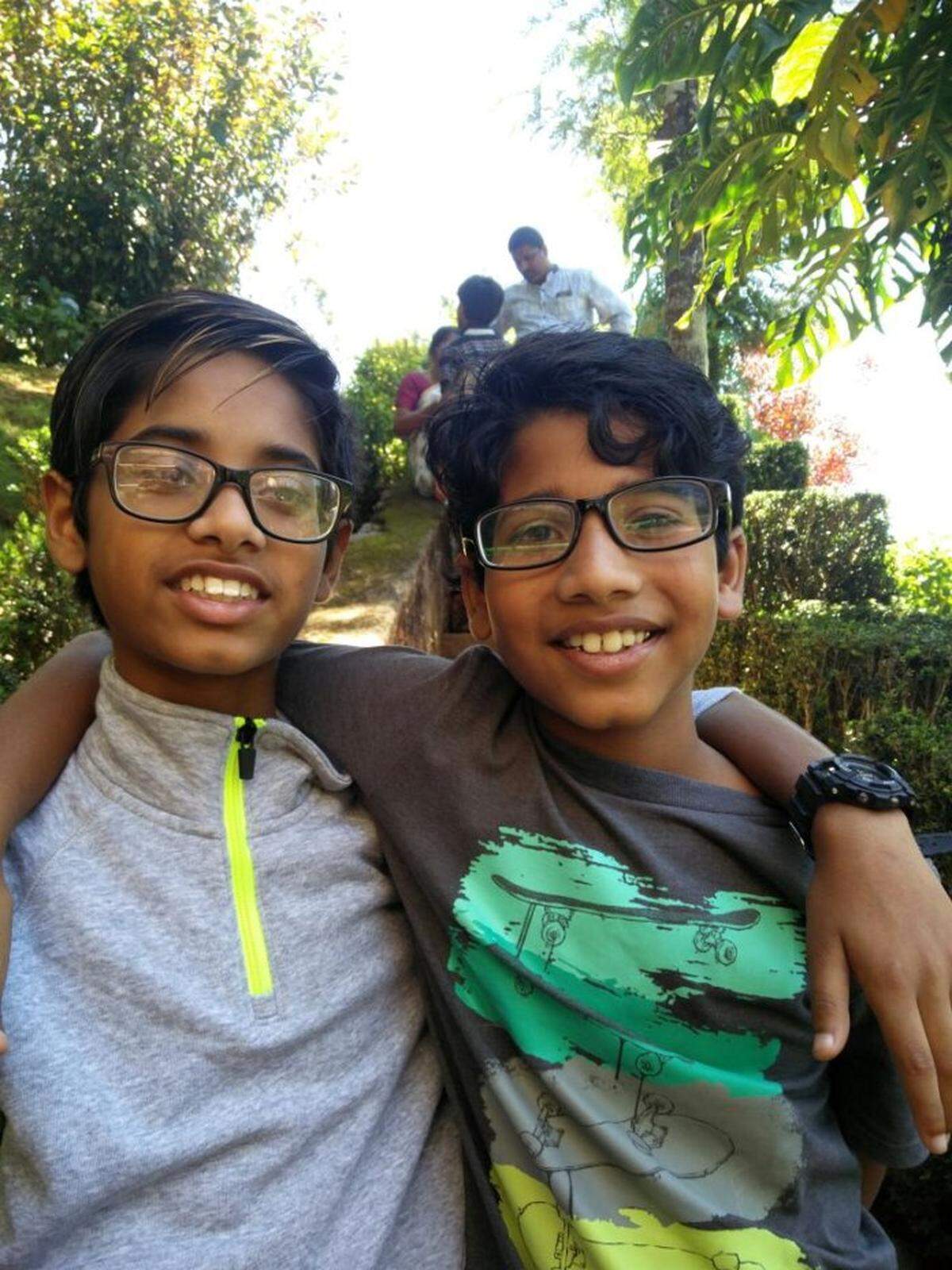
And although Ravi Yerra admits he was eager to permit it, he and his sons are adamant about this: The parents in no way pressured the children. “It was me putting pressure on them,” Shashi says.
So in seventh grade, Shashi began taking MOOCs and going through CBE programs for college credit — which anyone of any age can do (you just can’t actually enroll in a college without a high school-level education).
“He tried five, six examinations initially, failed,” Ravi says. “Then he understood the pattern.”
It’s the second time he mentions the word “pattern.” His English is good but not perfect, so we ask him to clarify.
“It doesn’t mean the questions and answers from the computer system,” Ravi says, “it is types and patterns you need to develop to improve your learning ability.”
In other words, he says, it just takes time to get used to this style of education. That’s all.
And once Shashi got acclimated, Ravi Yerra says, “He passed one test after another.”
The boys’ fast track to college
Within a short time, the family says, Kamal decided he wanted to copy his big brother, and also took to balancing middle-school classwork with more-advanced, unrelated online courses and exams.
After graduating from Community House in the spring of 2018, Shashi enrolled in James Madison High School, an online program that typically is completed at an accelerated pace. He had his diploma before the end of that year. Kamal transferred to Fort Mill Middle School after the Yerras moved across the state line in 2018, graduated in 2019, then enrolled in a different online program — Penn Foster High School’s — and also earned his diploma within a matter of months.
How? “They spent maximum available time regardless of weekday or weekend,” Ravi Yerra says. Typically, programs like James Madison’s and Penn Foster’s take one to two years.
Though both schools are regionally accredited, online high school diplomas are not accepted by all colleges.
But the Yerra brothers were focused on just one: their parents’ alma mater, Excelsior.
So, using the same blueprint as Mom and Dad, they both transferred the boatload of credits they had amassed through MOOCs and CBE programs to Excelsior. Then they took just two online courses each through Excelsior before earning their bachelor’s degrees (both in business) in June 2019 — Kamal collecting his in person in New York and Shashi participating in graduation remotely, from India, after having returned there temporarily to help care for his grandmother.
.JPG "IMG_7525 (1).JPG")
Kamal joined his brother in India shortly thereafter, with both continuing their studies by enrolling in an online master’s program (studying information systems security) at the University of the Cumberlands in Williamsburg, Ky. But while Shashi slowed his pace, Kamal doubled down by enrolling simultaneously in an MBA program, also online, at Assam Don Bosco University, a highly ranked university in Assam, India.
This time, both of them have focused on the books and materials provided by the universities. In other words, no MOOCs or CBE programs.
It’s unquestionably remarkable, the fact that Kamal — who would otherwise be sophomore in high school — pursued two master’s degrees in two different subjects in the same year on a traditional college timeline (i.e. not self-paced), albeit still online-only due to COVID-19.
And at least one of his instructors confirms that Kamal is a stand-out among her students, even though all of them are much older.
“Kamal is a high achiever,” says Machica McClain, director of the master of science in information systems security program at the University of the Cumberlands (a smaller private Baptist-affiliated school that is the alma mater of two former governors of Kentucky). “My ISOL-699 course didn’t start until June 29, and Kamal was trying to access the course back in May. That shows you how eager he was to start learning.”
Kamal graduated from the program on Aug. 27, four days shy of his 15th birthday. Ravi Yerra says Shashi will graduate sometime in 2021 with the same degree.
Both teens are now back living in the U.S., and Kamal will receive his MBA from Assam Don Bosco on Monday during a virtual commencement ceremony.
So how much did it all cost? In total, Ravi says, he paid about $1,200 each for their high school diplomas; about $11,000 each for their bachelor’s degrees; about $2,500 for Kamal’s MBA; and, in the end, he estimates he will have spent about $10,000 each for their master’s. On top of that, he says he has spent less than $5,000 on online tutoring.
Total: Just over $51,000 for five college degrees — far less than it would have cost to send just one of them to a typical private four-year college.
But some might wonder: Did they get what they paid for?
Outside perspectives on the Yerras
Kamal Yerra isn’t a genius or a prodigy. Not in the more-traditional sense, at least, where you might be talking about an off-the-charts IQ, perfect SAT and ACT scores in middle school, or Google or Microsoft recruiting them as teens.
Yet at the same time, it would be hard to argue that Kamal and Shashi aren’t uniquely focused and extraordinarily gritty.
“I am an extremely academic person and I still find online courses not particularly motivating,” says Fiona Hollands, senior researcher in the Department of Education Policy and Social Analysis at Columbia University’s Teachers College.
“So to me, that is the most impressive part, if they’ve really stuck through these courses, done all the work and the rest of it. OK, so that’s the positive. Let’s give them credit. These are smart kids, extremely self-motivated, and disciplined with their time. Because they were able to not just get through middle school but to get through all these courses as well.”
Adds David Henry Feldman, a professor of human development at Tufts University in Medford, Mass., whose areas of expertise include extreme giftedness and creativity among children: “I certainly have to nod in their direction for ambition and for putting together some kind of plan and an effort. ... I’m sure they are academically talented kids, or the strategy wouldn’t have succeeded to the point that it has.”
But that’s what we’re really talking about here, Feldman says. A strategy. Carefully calculated.
And to be fair, he says, “it’s not like they’re by any means the only ones involved in this way of trying to essentially shortcut the process toward a practical kind of a goal.”
If there’s a broader lesson here, though, he says it’s that the Yerras’ story “reveals some of the weaknesses of one major swath of current education, which is online, easy access.”
“There is also another angle to this, more from a policy-making perspective,” Hollands adds, “which is: Is this OK that kids are able to get all but two of the credits through these MOOCs, and then they run off to an Excelsior ... and they get a degree? How high-quality is that degree?
“You could say, ‘Well, if the rules allow it, then there’s nothing wrong with it.’ But then are those rules good rules?”
‘You think that it’s easy?’
Whereas his older brother Shashi can be loquacious when prompted, Kamal — while polite and well-mannered — only speaks a few sentences over the course of a nearly two-hour visit to the Yerras’ home, and seems uneasy when questions are directed at him.
Ravi Yerra, who warned that Kamal was “timid and shy,” says that’s something they’re working on. In fact, he says his plan to encourage Kamal to develop better social skills by making him join clubs for kids in their area has been foiled over the past several months due to the pandemic.
It’s something Kamal will certainly need to overcome if, as he has said, he hopes to be a successful CEO someday.
And that’s the plan: Both brothers have come up with ideas for companies that Ravi says are currently in development, Shashi’s being a title fraud detection services company and a criminal history monitoring company, and Kamal’s an ed-tech company called NthEye that proctors exactly the types of exams he took while doing CBE programs.
Their father says he is currently listed as the CEO and founder of all the companies, but that he’s prepared to eventually relinquish control to the boys.
He’s also prepared, at the end of the day, to argue that theirs is an approach to higher education that others could benefit from trying. That yes, he’s very proud of the fact that Kamal is “the only and first American to have two master’s degrees at the age of 15,” but that he’s not just courting the media simply to make his youngest son look good.
(By the way, though Ravi says his research shows that Kamal is “the only and first,” this seems to be based on anecdotal online evidence. A spokesperson for the Guinness World Records North America tells the Observer it does “not currently monitor record titles similar to youngest person to earn a bachelor’s degree, master’s degree, MBA or multiple ... degrees.”)
“We don’t want him to be shine and shown as a king,” Ravi says of Kamal. “One message that we wanted to give is if he could able to (do this so inexpensively), why the heck do we need to spend 40 grand and push people into debts?”
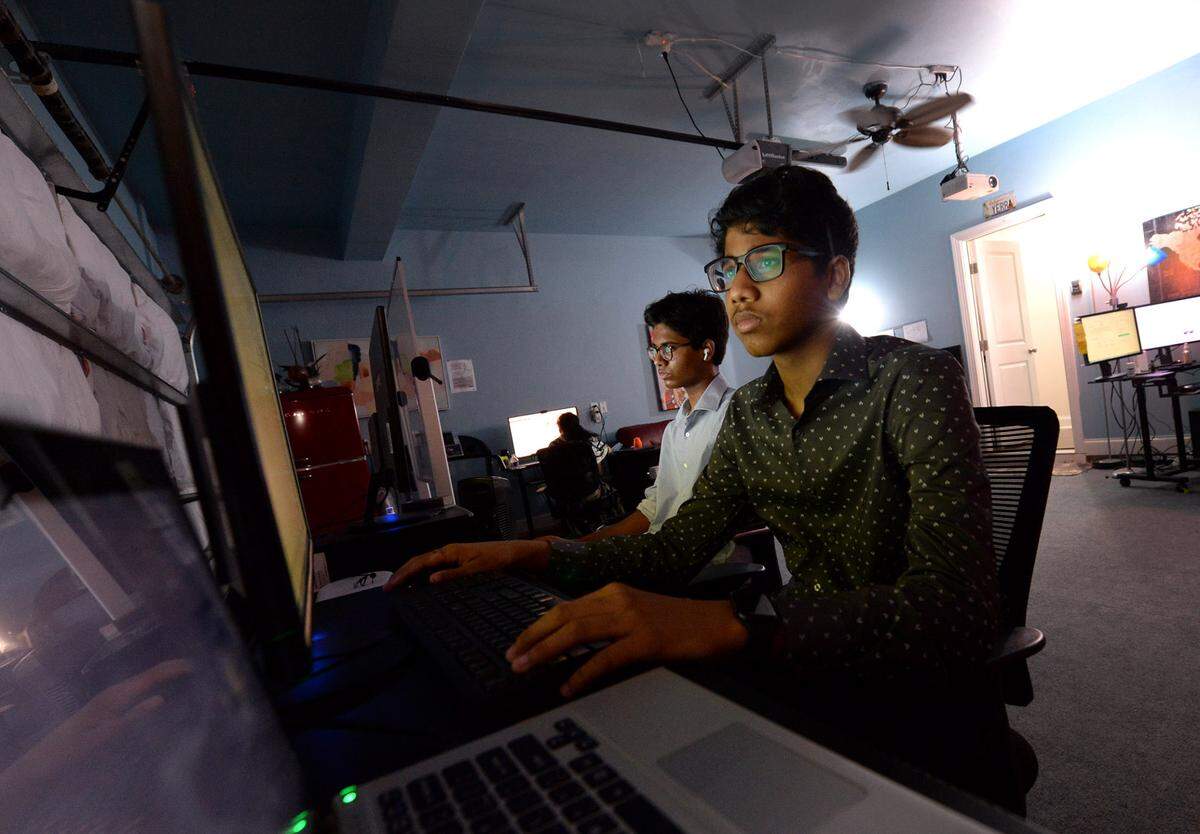
At this point, it seems like as good a time as any to ask, so we do: What would you say to someone who might think your approach to earning college degrees has been more quantitative and less qualitative?
The question is directed at Kamal and Shashi, but they defer to their father, who dives in without missing a beat.
“When any new thing comes in, and the first thing usually is about rejection, right?” Ravi says. “So to determine whether it is a quantitative or a qualitative, we suggest you to (try some) exams first. Anybody. Saylor.org is free. You don’t have to subscribe to anything. Pay $35. They have so many exams. Start knocking them down. Then we talk about whether it’s a qualitative or a quantitative.”
Ravi is smiling, and isn’t being overtly confrontational when he says these things — he’s a naturally warm, friendly, outgoing guy. But he’s clearly bothered by the notion that what his sons have achieved isn’t remarkable.
“You think that it’s easy? This is open challenge. Today. Right now. If you can actually doing it and you can schedule an exam, take exam now. Do not read any other thing.
“And you’ll see how easy or difficult it is.”
This story was originally published October 2, 2020 at 11:51 AM.