Uptown high school? Regional sports facility? CMS wants public input on future projects
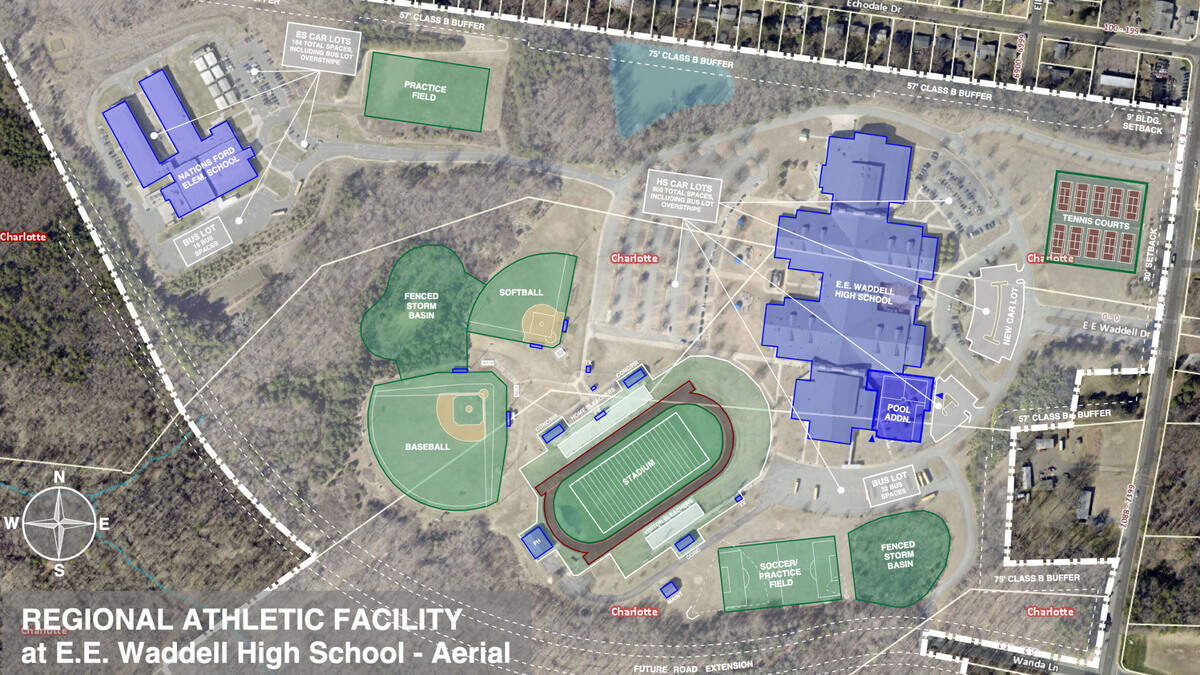
Charlotte-Mecklenburg Schools wants the community’s input on construction projects like which older buildings to replace, where to relieve overcrowding and where to create regional athletic complexes.
The Board of Education reviewed a first draft of the district’s 10-year capital needs at last week’s meeting. A final version will be brought to board members in 2023. Projects will be on the next bond referendum the same year. It will be the first since voters approved $992 million for projects in 2017.
Consultant Dennis LaCaria said the first draft is a starting point and is intended to “spur a conversation.”
“Even the rubric – the factors that we weigh in choosing one project over another – is a proposal, not a final version,” he said. “We hope the public will weigh in on every aspect.”
The headliners
LaCaria said 125 projects need to be tackled within the next decade at an estimated cost of $5.3 billion.
“The conditions of our school facilities impact education equity. Classrooms and school buildings affect how well students learn,” Board chair Elyse Dashew said. “It should go without saying that all students need a safe and healthy learning environment, and we want the community to weigh in on what this looks like. We have scheduled a full year to gather community input because we want to hear from everyone.”
Along with moving multiple magnet programs, a pair of projects highlight the list: the possibility of regional athletic facilities and a $175 million, multi-story high school in uptown Charlotte.
“Regional athletic facilities conversations are in conjunction with athletic projects at each of the district’s comprehensive high schools, in lieu of or both,” LaCaria said.
The athletic facilities could include swimming pools, stadiums and tracks, baseball and softball fields and gyms that could play host to state tournaments and sporting events. No existing facilities would be removed, but new schools will have shared athletic space.
“(These) regional athletic facilities would be very different for our community,” Dashew said. “It’s very innovative. I think that’s worth having a conversation about.”
The high school in uptown Charlotte would be a medical technology magnet school, and the district would partner with Atrium Health and Central Piedmont Community College. Dashew said there’s been a push to rebuild the old Second Ward High School torn down decades ago.
“A promise was made to rebuild it, and that promise was never kept,” she said. “Perhaps we finally hit upon the time ... to make good on that promise. “
Top 10 ranked projects
Here are the top projects in the list:
▪ South Mecklenburg High could get an $81 million replacement of the older parts of its campus. The price could be lower if CMS adopts a regional sports facility plan.
▪ Beverly Woods Elementary School could get a $49.5 million replacement building.
▪ East Mecklenburg High could get a $121 million replacement of the older parts of its campus. The price could be lower if CMS adopts a regional sports facility plan.
▪ Allenbrook Elementary could be demolished, with a $49.5 million replacement school built at Freedom Driving Range.
▪ Wilson STEM Academy could get a $61.5 million replacement school on the existing site.
▪ Sedgefield Middle School could be converted to a Pre-K through 6 Montessori magnet school, with a $49.5 million replacement school.
▪ Starmount Academy of Excellence could get a $49.5 million replacement and provide overcrowding relief for the Huntingtowne Farms zone.
▪ Harding High could get a $124.5 million renovation. The price could be lower if CMS adopts a regional sports facility plan.
▪ Dorothy Vaughan Academy of Technology could get a $61.5 million replacement building and become a K through 8 school. It would eventually expand to grades 9 through 12.
▪ A new middle school costing $61.5 million could be built to relieve overcrowding at Community House Middle School.
What’s next
The first draft of the district’s 10-year capital needs assessment is a starting point and will be shared in a series of meetings with the community. A final version will be brought to the board in spring 2023.
Community engagement will begin with the annual CMS magnet survey. Once the school year ends, a series of town halls will be held to gain feedback in person. The public will also be able to provide feedback online.
“This is an opportunity for the community to respond to our best thinking at this point,” LaCaria said.
This story was originally published May 31, 2022 at 5:00 AM.