Internal CMS emails reveal promise, problems with big bet on school body scanners
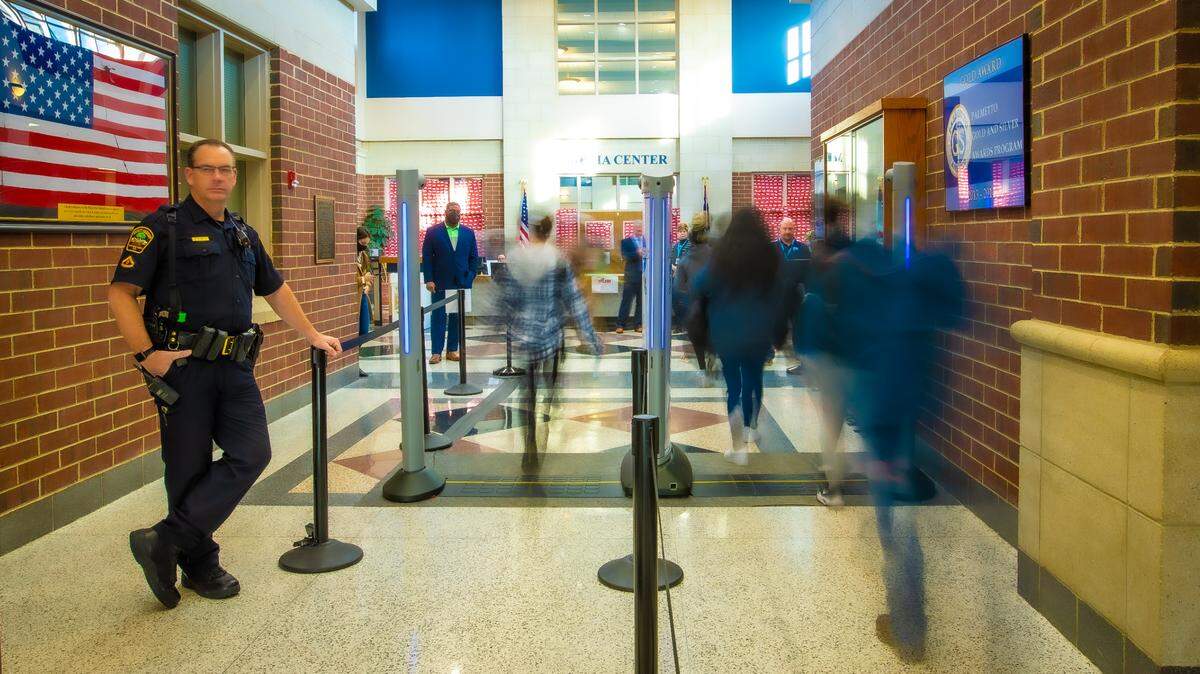
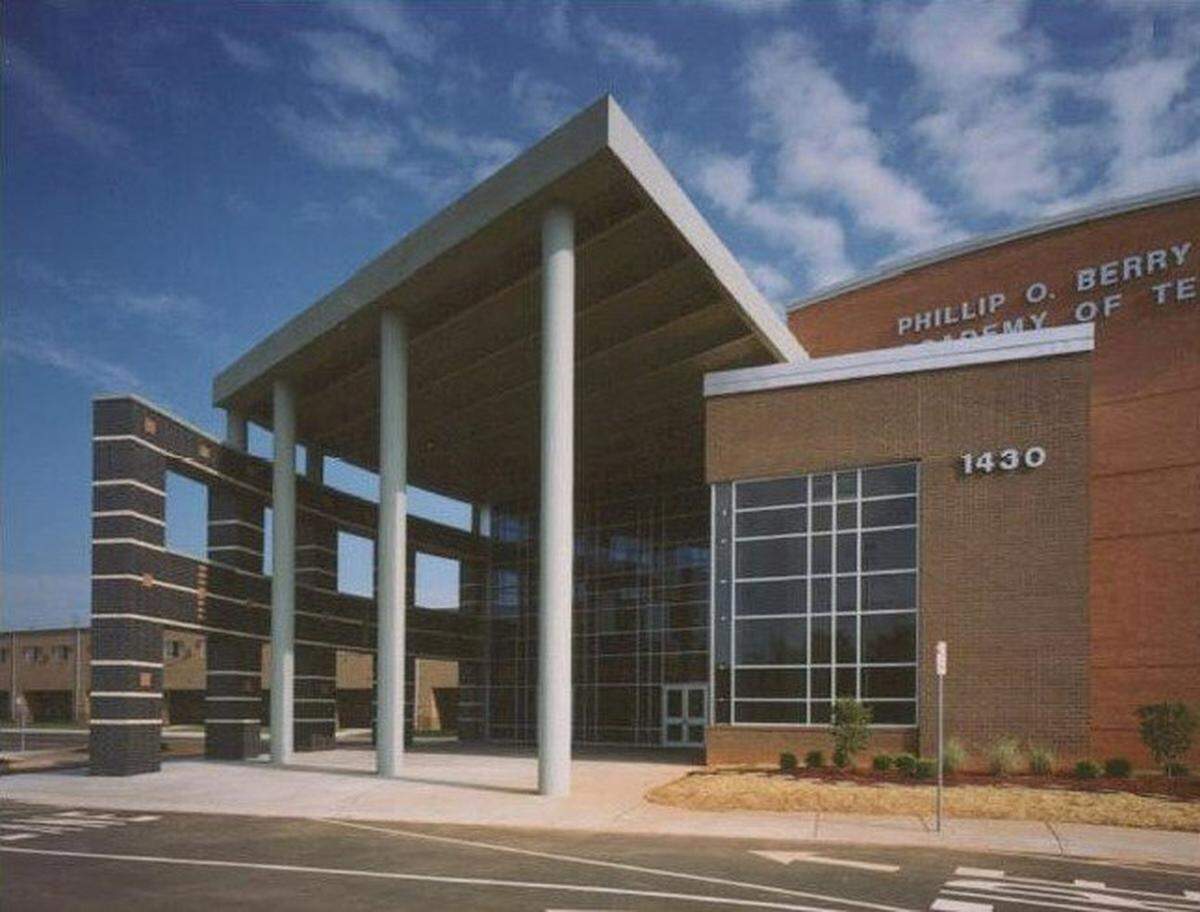
On May 2, just their second day in use, the body scanners at Phillip O. Berry Academy of Technology did what Charlotte-Mecklenburg Schools officials were desperately hoping they would do. They detected a loaded gun a student carried on campus.
That was the first weapon found by CMS’s then nearly $5 million fleet of body scanners, which were rolled out across all its high school campuses in the final months of last school year. An 18-year-old student was arrested and charged with possession of a weapon.
But 20 miles away, administrators at Ardrey Kell High School were struggling on their first day with the body scanners.
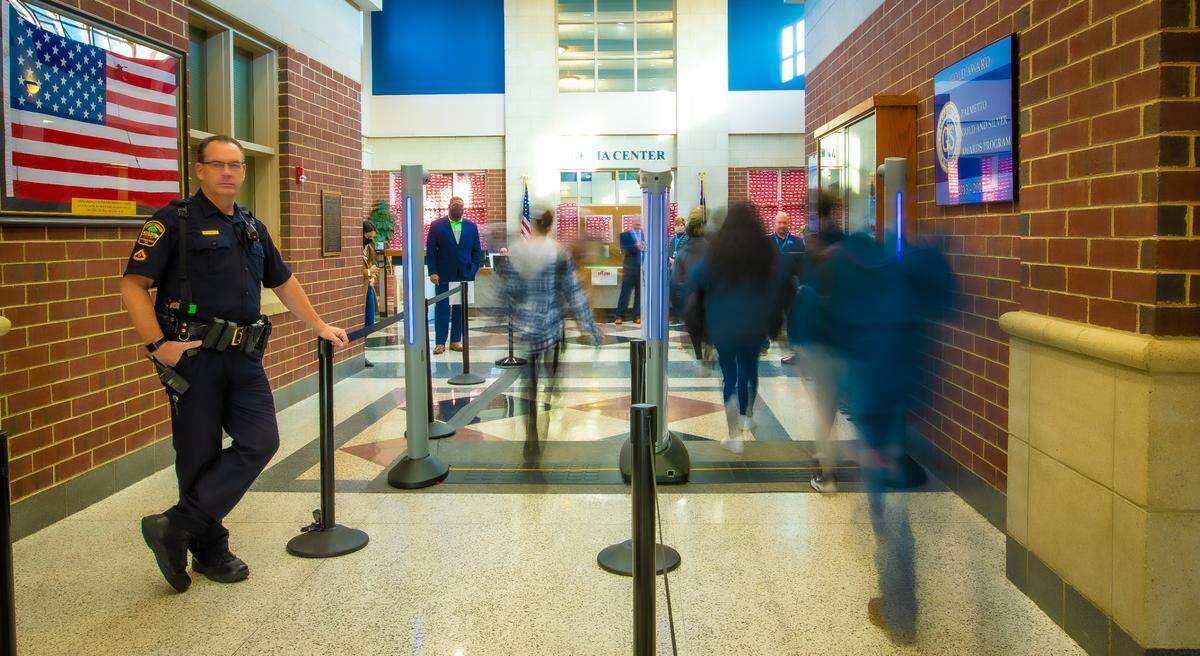
“The scanners were a cluster today,” Ardrey Kell Principal Jamie Brooks wrote in a May 2 email to CMS officials. “It took all 10 of my people to even come close to managing the chaos at the one entrance (they are supposed to eventually be at other entrances)… we do not have the manpower for this.”
The body scanners were sounding the alarm on three-ring binders – Brooks joked that they were “weapons of mass instruction” – and other personal items, creating delays and overwhelming school staff.
“Today was probably the least safe day at AK as all hands were at the front doors instead of monitoring kids throughout the building,” Brooks wrote.
The disparate experiences at the two schools on the same day illustrate both the promise and potential problems of CMS’s body scanners, machines that the district is spending close to $15 million on to help protect students in an era of distressingly frequent school shootings.
CMS officials have touted the body scanners as a major success because the gun detected at Berry was one of only two weapons found on campuses where scanners were up and running. The second was an unloaded gun found in a backpack at Harding University High School before the student went through the body scanners.
Nearly two dozen guns were found on district campuses before the machines were installed.
“The installation of the Evolv body scanners in our high schools have proven to be effective in deterring weapons in our schools in the second semester,” CMS officials wrote in a July statement to middle school parents. “We will continue the rollout of scanners to the remaining CMS high schools as well as a plan to reach our middle and K-8 schools.”
Based on that success, the district has committed another $10 million for dozens of additional scanners to be installed at all middle schools across CMS. Those machines are in the process of being installed in some middle schools now and will be phased in over the coming months.
But internal CMS conversations before and during the rollout of the scanners show that the machines have malfunctioned at several schools. They can struggle distinguishing between school supplies and weapons. In some cases they can fail to detect certain weapons at all.
Through a public records request, The Charlotte Observer obtained thousands of emails between CMS staff regarding body scanners to tell a fuller story about how they became the school district’s primary move to keep guns out of public schools. Internal conversations revealed a more complex picture than district leaders’ public comments have conveyed.
Unmentioned is the reality that some school safety researchers have doubts about whether body scanners and other devices, metal detectors included, actually make students fully safe. They point out that body scanners would not have prevented mass shootings inside schools in Uvalde, Texas and Newtown, Connecticut.
“Perhaps time will tell a different story, but as of right now, it appears to be security theater in response to everyone’s anxiety over Uvalde and other school shootings and the desire to do something to prevent the same thing from happening in their own schools,” said Jaclyn Schildkraut, a criminal justice professor at the State University of New York Oswego and a leading researcher on school safety.
The origin story
CMS officials were already deep in discussions about body scanners months before May 24, when a gunman killed 19 students and two teachers at Robb Elementary School in Uvalde. They were under pressure from gun-related school safety concerns here.
CMS has been fortunate to avoid a tragedy of the magnitude of the Uvalde massacre, but it hasn’t been free of gun threats. In 2018, a student was shot and killed by another student at David W. Butler High School. And the number of guns detected earlier in the previous school year was concerning.
Between August and mid-December 2021, 23 guns had been found on CMS campuses, including one that was fired on the grounds of West Charlotte High School after students got into a fight over a bookbag. Those weapons seizures broke the CMS record for guns found on campus in an entire school year before the year was even half gone.
As guns were starting to stack up in the district, John Diggs, the Carolina Panthers director of safety and compliance, directed CMS Police Department Chief Melissa Mangum to Evolv Technology on Nov. 30, an email shows. The Panthers use Evolv scanners for events at Bank of America Stadium.
An Evolv employee named Kyle Correll followed up with Mangum the same day to set a meeting, and also sent over a quote for the company’s machines, as well as photos of the scanners in use at other school districts, including in Spartanburg, S.C.
The Dec. 2 meeting must have gone well because, within a month, CMS officials had alerted high school principals via email that the district expected to roll out Evolv scanners to all high schools, even before they had selected a supplier or agreed a contract.
An expanding market, little research
Evolv claims its scanners are much faster than traditional metal detectors but retain the ability to find concealed weapons. They have been used at sporting venues, casinos, schools and hospitals since 2017.
The company “unfortunately” sees schools as a growth market for the product, with 15 to 20 school districts using them so far, co-founder Anil Chitkara told The Observer.
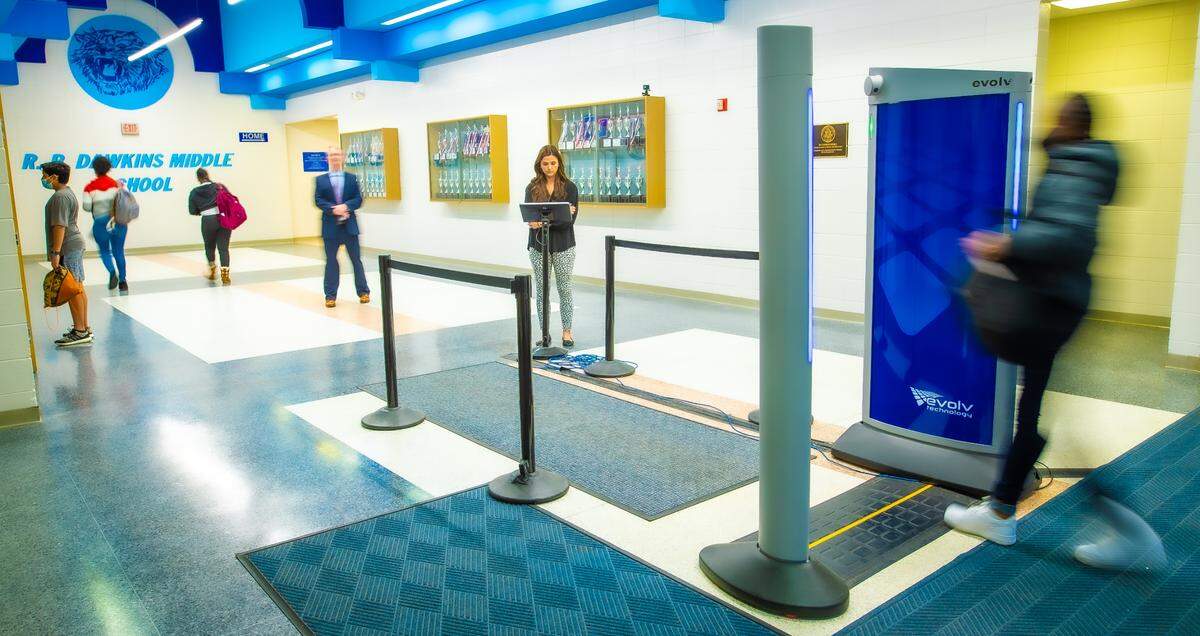
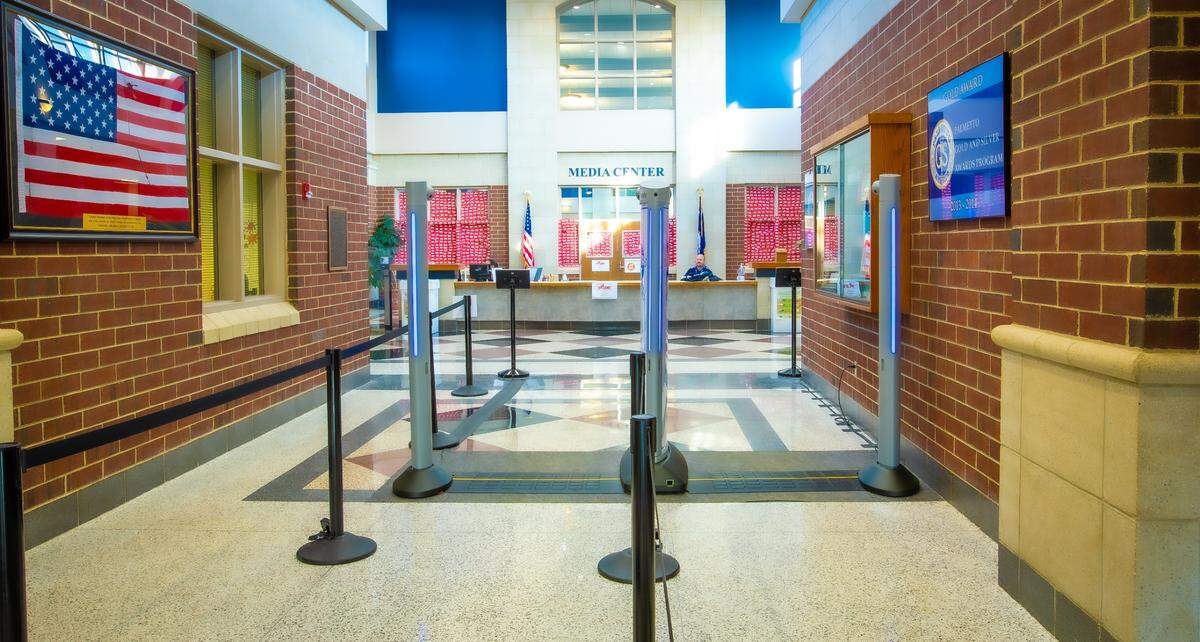
The Express scanner, which CMS has purchased for at least 70 schools, includes two towers and a floor mat, which create a “zone of detection.” When a person walks through that zone, sensors use ultra-low-frequency electromagnetic fields to scan for concealed items that the device has been trained to recognize as weapons.
And they’re supposed to get better with use, Chitkara said. Evolv uses artificial intelligence and machine learning to improve its algorithm to more accurately detect threats.
Body scanners share some qualities with metal detectors. Both use electromagnetic fields to examine what passes through them. But people walking through Evolv’s body scanners generally aren’t required to remove phones or keys from their pockets, as might be at a sporting event or courthouse that uses metal detectors to screen for weapons.
The company claims that sensors at each lane are capable of scanning 2,000 people per hour, or just about one person every two seconds, though that speed may be more likely at a sporting event when people are more likely to carry keys and a wallet instead of a backpack full of school supplies.
While the body scanners are the big-ticket solution CMS officials selected when responding to parent demand and safety concerns, school safety experts are not universally sold on technology solving the most serious gun threats at schools.
“Virtually none of the solutions out in the space have actually been researched,” said Schildkraut, the SUNY Oswego professor. “It would be difficult to say that (body scanners) would be more or less effective than metal detectors as neither technology is necessarily effective.”
She pointed to her own research, as well as a report from WNYC on New York City schools that shows for every 23,034 scans conducted by a metal detector, one weapon is found. That’s a big investment for a small return, Schildkraut said.
“While metal detectors may provide a visible response to concerns about school safety, there is little evidence to support their effectiveness at preventing school shootings or successfully detecting weapons at schools,” she wrote in a 2018 paper.
Paul Smokowski, research director at the North Carolina Youth Violence Prevention Center, sees an intangible toll on students attending schools with surveillance equipment like scanners or metal detectors.
“I often hear that school hardening like scanners sounds tough when announced by politicians, but is not effective,” Smokowsk wrote in an email. “Mass shootings, while horrible, are rare. But we are subjecting all of these non-violent students to police tactics just so we can feel like we are doing something.”
CMS did not make any staff members closely involved with deploying the body scanners available for interviews for this story. But in written responses to The Observer’s questions, the district’s chief operating officer said CMS is focused on students’ health as well as their safety.
“We are invested in preventing the types of incidents that could be psychologically damaging to students and staff,” Brian Schultz wrote in an email.
Emails from early in CMS’s rollout of the body scanners show that some school administrators were enthusiastic about getting them.
Within weeks of the first scanners hitting high school campuses, at least five administrators had asked CMS for additional scanners, according to an email exchange from April 22 between Mangum and Schultz.
There is also evidence that the equipment isn’t infallible.
Road trip to assess scanners
As CMS was preparing to bring body scanners to its high schools, district and school leaders drove down to Spartanburg, S.C. early one February morning. They met with Mark Smith, director of student services and safety in Spartanburg County’s District 6 and observed Evolv machines in action.
Smith told CMS officials that since his district installed the body scanners they hadn’t found any weapons, adding that he felt their presence alone was enough of a deterrent to keep students from bringing them on campus.
Smith noted, however, that the scanners are “not foolproof.” In an email attachment sent between CMS officials recounting a conversation with Smith, he acknowledged that in certain circumstances the machines can fail to recognize guns.
When Smith’s district held a test of the scanners’ ability to identify several weapons, they had to turn the system up to a more sensitive setting to recognize a Glock pistol as a weapon, since much of that gun is a “composite plastic material,” the email attachment shows.
Despite that, Smith said Spartanburg’s District 6 was running their scanners on the lower level that missed the weapon, the correspondence said. They’ll use a higher sensitivity setting if they have a security alert, Smith noted.
Smith did not respond to questions for this story.
In the interest of safety, The Observer is not reporting specific scanner settings in this article.
In emailed responses, Schultz declined to discuss the sensitivity level CMS uses on its scanners. However, in an email between Schultz and CMS Chief Technology Officer Candace Salmon-Hosey, Schultz said that CMS runs its body scanners on the higher sensitivity level that detected the pistol in Spartanburg.
Settings challenges
With higher sensitivity comes other problems, specifically more alerts on school supplies, like those three-ring binders that flummoxed Principal Brooks at Ardrey Kell.
The Google Chromebooks used by CMS students became such a common trigger that students were instructed to remove them from their backpacks and carry them out in front of them as they move through the scanners. Emails show that CMS staff has discussed buying laptops in the future that won’t trigger the scanners.
Even on the lower sensitivity level used in Spartanburg, 25% of students were triggering the scanners with school supplies or personal items as they passed through the scanners, according to the correspondence between CMS and Smith. Students whose belongings triggered an alert would have to be searched, Smith told CMS officials, according to the email attachment.
Similar hold-ups were commonplace in the early days of CMS’s rollout of the equipment, according to the emails.
On May 11, school board member Sean Strain forwarded a photo to interim Superintendent Hugh Hattabaugh that he said was taken that morning at Providence High School. It showed a line of several dozen students stretching deep into a parking lot as they waited to go through the scanners.
A post on the private Facebook group “Strengthen our Schools – Mecklenburg County” claimed it was taken five minutes before the school bell rang, meaning the students in line were likely late to class.
Strain asked the superintendent if the sensitivity levels of the scanners could be adjusted to ease the delays. Hattabaugh told Strain he’d look into it, but noted that Providence had been “one of the smoother operations.”

In their first few weeks of use, several schools besides Ardrey Kell High School had issues with their scanners, including days when the devices were not working at all. That included Hough, North Mecklenburg, Rocky River and West Mecklenburg high schools.
Schultz said multiple times in emails that some early growing pains were expected and that most issues were ironed out within two weeks of launching. But, some schools have had issues months after starting using the scanners. Emails show that on July 18, the scanners at West Mecklenburg High School were malfunctioning and an Evolv employee had to come out to fix them.
Other internal conversations suggest there were some concerns about the scanners and their efficiency in the weeks after they were rolled out.
On May 17, Schultz sent an email to Evolv asking about specific problems with the scanners at North Meck, asking to speak about “scanner issues in general.”
In a written response to Observer questions about this exchange, Schultz said he did not recall what scanner issues he was talking about, but said “it may have been about securing training and feedback sessions/dates for June or the best process for accessing customer service.”
Parental pleas
When CMS surveyed parents this spring about what the district could do to make schools safer, the most common response was adding security equipment and personnel. The results, which the district circulated internally but not publicly, were discovered among the emails obtained in The Observer’s records request.
More than 500 parents called for metal detectors or adding more security staff. Nearly 300 parents said CMS needed to do more to address bullying, and 50 parents called for more attention to mental health and counseling needs.
To help address those safety concerns, CMS announced in July that it would be adding body scanners – already running at its 21 high schools – to middle schools and K-8 schools, bringing another 92 scanners to the district, costing more than $10 million.
Delivery of the middle school scanners was scheduled to begin last week. Schultz in an emailed response to Observer questions said that he expects the machines will be up and running at all schools by October.
CMS opted to go with the Evolv body scanners to reduce the overall risk of guns on campus, not as a specific means to prevent mass shootings, Schultz wrote. But Schultz said the scanners are one of the tools they hope can reduce the likelihood of such an event.
“The Evolv system is designed to identify concealed weapons on individuals entering our schools,” he said. “However, the layers of security measures we have are in place to protect staff and students from many different types of threats.”
“Our goal is to ensure our students get home to their families safely every day,” he wrote.
Urgency after Uvalde
The Uvalde massacre on May 24 served as a devastating reminder of what’s at stake in school safety discussions.

The shooting led to a spike in messages from parents to Charlotte-Mecklenburg Schools and the school board that demanded action.
“Protect our children NOW, PLEASE!” wrote CMS parent Kimberly Raybon the day after the tragedy. “Sending our children to school should not be the equivalent of playing Russian Roulette with their lives. Please, equip schools with one entrance only for all, metal detectors, wanding and mandatory clear backpacks.
“Not one more tragedy!!! Enough is enough!!!!”
Schultz, the district’s COO, wrote Raybon back eight days later with a list of security measures CMS has implemented, including body scanners, an app CMS launched in January where students can anonymously report threats, security cameras and screening all visitors.
Unmentioned in that correspondence is that the Texas school massacre and others, including the murders at Sandy Hook Elementary School in 2012, would likely not have been prevented by CMS’s most high-profile safety investment: body scanners.
The gunman in Uvalde came in through a side door that should have been locked but wasn’t.
This story was originally published August 25, 2022 at 6:00 AM.