Student achievement gaps are wider post pandemic. Here’s how CMS plans to close them.
It wasn’t great before the pandemic, but since, the gap in academic achievement for Charlotte-Mecklenburg Schools’ Black and Hispanic students has widened, a national study released in October showed.
These achievement gaps — particularly in the fourth grade — between white and Black and Hispanic students have grown by double digits since 2003, according to the 2022 National Assessment of Educational Progress.
Known as the Nation’s Report Card, it’s the first report examining math and reading achievement since the pandemic began. NAEP is not a test of all students, and CMS and Guilford County Schools are part of a nationwide program of 26 urban districts.
“Do we have work to do? We certainly have work to do,” Frank Barnes, CMS’ chief accountability officer, said. “The gaps that we see between our subgroups did not start with the pandemic but they were exacerbated by the pandemic.”
On average, math and reader scores outperformed or matched most large school districts in every measure, but overall performance slid sharply.
“The whole village needs to hear the bell ringing, not just schools,” said Thomas Kane, faculty director at the Center for Education Policy Research at Harvard University.
The center researched district-level learning losses in North Carolina based on NAEP.
“Mayors should organize tutoring efforts at local libraries. Community organizations should plan school vacation academies and summer learning opportunities,” Kane said. “Governors should be funding and evaluating innovative pilots to provide models that everyone could use.”
Requests for comment about the widening gaps from the NAACP Charlotte, Black Political Caucus and community organizations CMS partners with, such as ourBridge for Kids, went unanswered.
A declining trend in fourth-grade math scores for Black and Hispanic student compared to white students showed:
- Average scores for Black students overall was 44 points lower; Hispanic students 50 points lower since 2003.
- Before the pandemic, in 2019, Black students averaged 36 points lower; Hispanic students 37 points lower.
- In 2017, Black students averaged 32 points lower; Hispanic students 36 points lower.
- In 2015, Black students averaged 29 points lower; Hispanic students 33 points lower.
“We’re situated, making our investments to help our students make as speedy and full and academic recovery as possible,” Barnes said. “We’re not trying to get back to normal, we’re trying to get back to better.”
“None of us are immune”
Justin Perry is a parent and community advocate for education. He was born and raised in Charlotte. His mom was a CMS teacher for more than 30 years.
When looking at the level of community growth and revenue growth, Perry believes the school district has had steady disinvestment from the state and county.
CMS receives 42% of Mecklenburg County’s revenue, and the county ranks 83 out of 100 counties in funding based on ability in North Carolina, Perry said. Instead of looking at the same metrics in isolation, Perry suggests looking at city and the county as shared units.
”They all are products of each other,” Perry said. “None of us are immune. We are in this together and need partnerships.”
Perry added the community can help by learning that CMS advocacy is not just at school board meetings.
“We need our business and philanthropic community to accept that there is no nonprofit or tutoring program that will be a replacement for teaching assistants, experienced educators, social workers, and actual staff,” Perry said.
Schools need more than volunteers. They, like any other business, need professionals, Perry said.
“Volunteers are excellent and crucial supplements once we have the basics met,” he said. “Lovingly, volunteers, tutors, and nonprofits are the side salads or deserts, not the entrees.”
CMS’ response to poor scores
District leaders, including Matt Hayes, CMS’ deputy superintendent of academic services, said CMS is working “intentionally and intensely” to accelerate academic recovery. Those efforts include monitoring student progress often, more strong group instruction and bolstering inventions in reading and math.
Hayes told the Charlotte Observer the district is developing a robust Pre-K program that focuses on students in Mecklenburg County with specific academic and/or financial needs.
“We believe that when students are introduced to early learning opportunities through Pre-K, they are better prepared to enter kindergarten ready to learn and excel,” Hayes said.
CMS also launched a new Multi-Tiered System of Support platform that enables a teacher or school to holistically view how an individual student is progressing.
The district also offers out-of-school time tutoring — an initiative addressing students’ skill sets and gaps, said Mark Bosco, senior administrator for expanded learning partnerships.
It serves 1,273 students with virtual tutoring, offering students up to 84, high-dosage sessions for this school year.
There are still 3,113 seats available at the 42 schools selected for the extra tutoring sessions.
“We understand that many students, families and school communities are interested in tutoring,” Bosco said.
Additional funding and community resources also may come via the Charlotte-Mecklenburg Public Library, Read Charlotte, the YMCA, Freedom Schools, HELPS, Augustine Literacy Project and Heart Math, he added.
CMS also needs more volunteer tutors, says Emily Elliott Gaffney, executive director of Heart Math Tutoring in Charlotte.
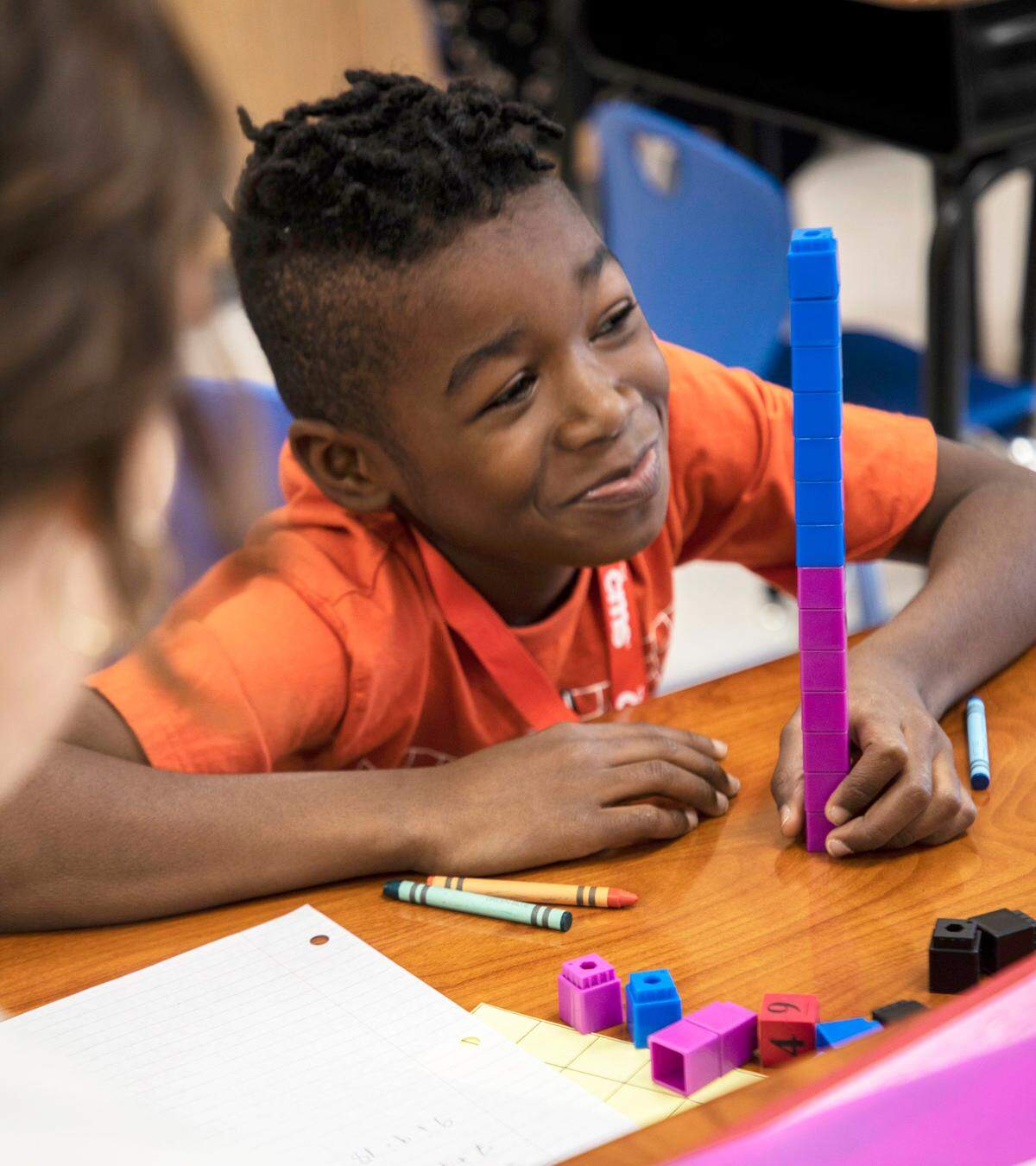
Heart Math Tutoring has 1,200 volunteers meeting weekly with elementary students across the district. Volunteers come from varied backgrounds. The majority have full-time jobs and fit in one hour per week at lunchtime or morning hours before work.
“To date, 98% of Heart students have shown growth on pre (and) post math assessments that meets goals set by math specialists at UNC Charlotte and CMS,” Gaffney said. “An additional 300 tutors are needed right away. Students are eager to learn, and one-on-one tutoring works.”
Additional information about the Out-of-School Time Tutoring initiative or other tutoring resources is available at the CMS website, or the schools’ website. Resources to serve as a tutor may be found at tutorcharlotte.org.
“Our declines coming out of the pandemic as a nation, state and district reflect a national crisis, which requires a community-wide response,” Barnes said, “(With) policymakers and community leaders at every level coming together as partners to rally around our educators, children, and families.”
CMS can’t shoulder all blame
Closing learning gaps cannot be the responsibility of one school or one district, Brenda Berg, president and CEO of BEST NC, told the Observer. The nonprofit is made up of business leaders committed to improving the state’s education system.
“Truly transformative change will require parents, educators, and stakeholders at the school, district, state, and even federal level (to) be willing to think differently about how the current system is perfectly designed to generate the result we are getting,” Berg said.
Charlotte has several promising programs such as the Science of Reading and Teacher-Leader Pathways, Berg said, adding parents also play a role.
“It is important for parents to examine their child’s academic needs,” she said. “The vast majority of parents believe their child is on grade level when, in fact, the majority of students are not proficient.”
In 50 years, the achievement gap between white students and black students had barely narrowed despite an increased national emphasis on closing academic discrepancies between groups of students, reported U.S. News & World Report in 2016.
In the Coleman Report, a review of education equity, James Coleman, then a sociologist at Johns Hopkins University, wrote: “If the achievement gaps continue to close at such an incremental rate, it will be roughly two and a half centuries before the Black-white math gap closes and over one and a half centuries until the reading gap closes.”
Harvard and Stanford earlier this month released the Education Recovery Scorecard, a look at COVID-related learning losses across the country.
Researchers stressed that steep drops in test scores were not solely caused by children’s experiences in school.
“A full recovery from the pandemic will require ... coordinated efforts by healthcare systems, and mental health systems, social service agencies, community organizations, and other state and local agencies,” this report stated.
This story was originally published November 18, 2022 at 5:50 AM.