In some of Charlotte’s most affluent neighborhoods, income emerges as school fault line
A washer and dryer sit in an undisclosed classroom in South Mecklenburg High School.
The set is a secret to most of the thousands of students who attend the school. It provides relief for some 60 homeless students who have nowhere else to wash their clothes.
“It’s not something we advertise,” said Heather Hogston, who is on the South Mecklenburg High Parent Teacher Student Association helping keep the laundry soap stocked. “Anybody who has a hardship can go in-between classes without anyone knowing. We want to be extremely private. We want to build these kids up.”
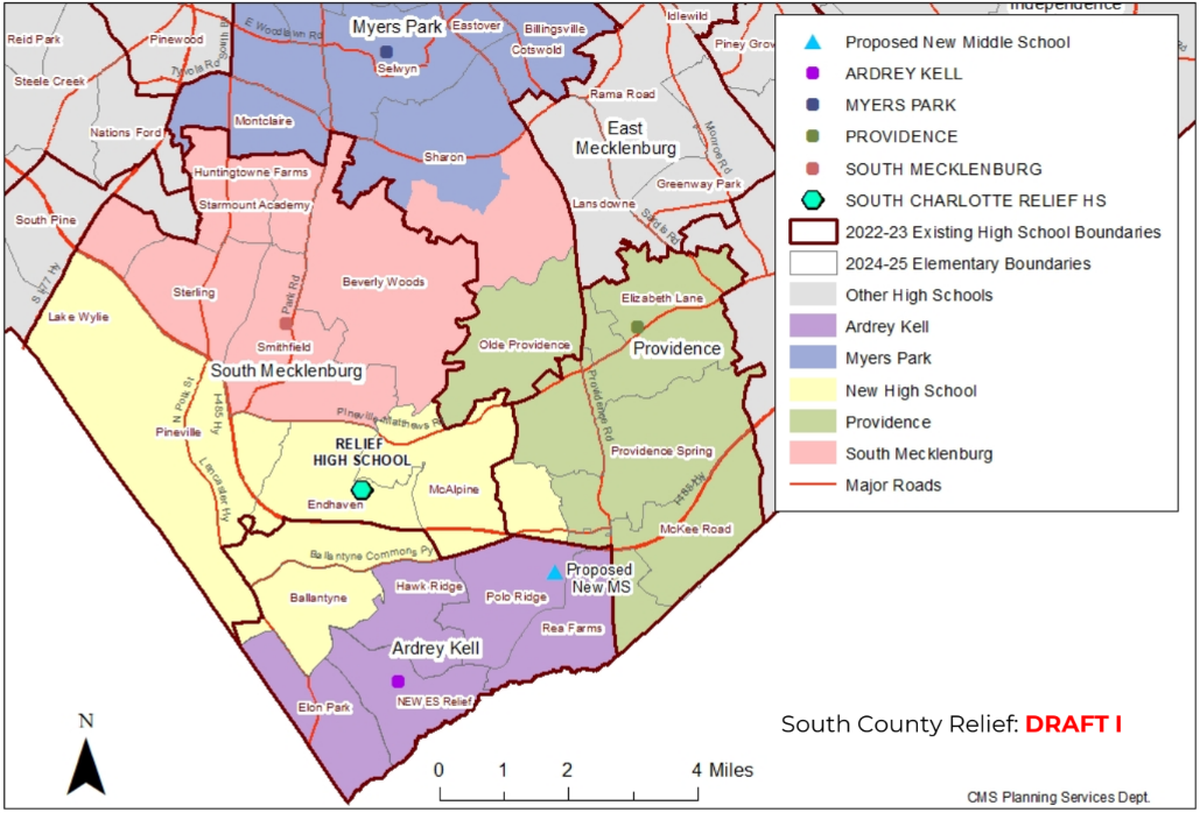
South Mecklenburg is one of four high schools that are part of Charlotte-Mecklenburg Schools’ plan to redraw boundaries in the southern part of the county, relieve overcrowding and populate a fifth high school at 12218 North Community House Road opening in the 2024-25 year.
South Charlotte contains the city’s most affluent neighborhoods, the “wedge” in the city’s crescent and wedge pattern. Ensuring CMS maintains socioeconomic diversity in those high schools is the latest flashpoint in parents’ fight for certain boundaries and feeder patterns — a process that will affect tens of thousands of families at all school levels.
But creating new boundaries is necessary. The new school building needs students.
“Anytime school boundaries change, people get understandably concerned,” said school board member Lisa Cline, whose District 5 encompasses most of south Charlotte. “I want to ensure the best outcome for every feeder pattern, for every student in every part of South Charlotte.”
The latest draft of school attendance lines comes after CMS tried unsuccessfully last year to get buy-in from parents. Another draft will be released this month after community meetings, with a school board vote on a final plan possible in May.
‘Make it fair and equitable’
Drawing parents’ ire in this draft: South Mecklenburg High, which already has a higher percentage of low-income students than Ardrey Kell, Myers Park and Providence high schools, would get more.
“It’s south Charlotte, but there is a large group of families that go to South Mecklenburg that are under the poverty level,” Hogston, who is a graduate of the high school, told The Charlotte Observer. “It’s not fair to those kids to put more on this school. It makes sense to spread it out so there are more resources available. It’s sad CMS can’t see this. People need to get moved because of the new high school. I get it. But let’s make it fair and equitable.”
Brian Schultz, CMS chief operations officer, told the Observer the district develops proposals based on school board policy. Decisions are based on home-to-school distance, keeping neighborhoods assigned to the same school and socioeconomic diversity.
One of the key components of the proposed draft, he says, is improved socioeconomic diversity at “some schools.”
CMS’ three largest high schools — Myers Park, Ardrey Kell and South Mecklenburg — have a combined enrollment of 10,466, according to district data. All are hundreds of students over capacity. Providence High has an enrollment of 2,048, and is below its estimated capacity.
Providence High also has the highest percentage of high socioeconomic status students in south Charlotte, with 79% of its student body considered affluent and less than 1% low income, according to CMS. Socioeconomic status, or SES, includes household income and parents’ education level, among other factors.
Ardrey Kell is second in south Charlotte, with 78% of students considered affluent and 1% low income. Myers Park’s student body is 56% affluent and 19% low income. South Mecklenburg is 30% affluent and 47% low income.
South Charlotte has the highest concentration of low poverty areas in the county, according to CMS data. The middle of the county has the highest concentration of high poverty, especially areas surrounding uptown.
“You have the opportunity to re-balance the area,” said Kristen Conway, who is a South Mecklenburg alumnae and parent of three. Her feeder pattern includes Smithfield Elementary, Quail Hollow Middle and South Mecklenburg High. “Instead of doing that, the scenarios that keep coming out are making it worse and worse. You can’t concentrate low-income students in one area.”
Parents worry about Title I designation
When the new high school opens in August 2024, the proposed boundaries would leave Ardrey Kell with the highest percentage of students with high socioeconomic status, with 83% of its student body considered affluent and less than 1% low-income students. Providence High would follow, with 78% of students considered affluent and less than 1% low-income students. But low-income student populations would grow by 3% at both Myers Park and South Mecklenburg.
The new relief high school would have a low-income student population of 18%. It’s high socioeconomic status students would be 43% of its population.
Conway and others worry the new scenario would put South Mecklenburg near a Title I designation. That means more federal financial help because of a high number of students in low-income families.
Schultz says the current draft wouldn’t result in a Title I designation at South Mecklenburg.
“We live here because we enjoy diversity. We want our children raised in a world that looks like our world,” Conway said. “But we’re headed in the wrong direction. Why would you purposely concentrate it? We know that 30-30-30 is the best for all. What they’re actually doing is creating segregation. We love this community and these schools, but we can’t handle the needs of 50% to 60% low-income students.”
Hogston and the South Mecklenburg PTSA help keep a food pantry stocked for Smithfield Elementary, Quail Hollow Middle and South Mecklenburg High students. A garden was started at Smithfield to also help feed families.
“More children here are in need — they need basic needs met,” Hogston said. “It’s much easier if you share resources. They’ll get more one-on-one with counselors, social workers at the schools. But CMS has to spread it out.”
Chester Finn Jr., president emeritus of the Thomas B. Fordham Institute, a conservative nonprofit education policy think tank, says there’s no optimal combination of students and such discussions distract from the truly important question: whether the school is effectively serving all its students, regardless of background, present achievement level, and particular needs or interests.
Parents sometimes worry about who is attending their school when they should be focused primarily on how good the school is at educating students, Finn said.
Resources for low-income students
Other experts say districts that balance socioeconomic status create an environment for all students to flourish. The Learning Policy Institute, a nonprofit that conducts education policy research, released a research brief in 2021 on the barriers and opportunities in high-poverty schools in North Carolina.
The study found high-poverty schools provide inadequate and unequal resources and opportunities to their students. Students from low-income families do far better at low-poverty schools than high-poverty schools.
Beth Platovsky is a parent of an eighth-grade student at Carmel Middle school. She has another child who attends The Fletcher School on a grant for a specific reading disability. Her family is currently zoned for Myers Park High. The district’s proposal, if approved, would mean her children would go to Providence High. She wants to see a plan that improves overall diversity: race and ethnicity, gender, disability and family income.
“There is not anything my children can learn in a classroom that is greater than the awareness of those that live differently than them, have different experiences than them, and think differently than them,” Platovsky said.
A new relief middle school also is on the schedule for CMS.
The largest pockets of low-income middle school students in south Charlotte attend Carmel and Quail Hollow middle schools with 44% and 57%, respectively. The draft proposal keeps those pockets after the new middle school is built, increasing the number of low-income middle school students attending Carmel by 9 percentage points and those attending Quail Hollow by 2 percentage points. The rest of the half-dozen middle schools in the south Charlotte area would have single-digit percentages of low income students, with three schools having less than 1%.
Avoiding problems before they start
Amy Frost is a parent of a seventh-grade student at Carmel Middle and students at Olde Providence Elementary. Her children are assigned to Myers Park High.
One group of Olde Providence community parents have been vocal in favor of rezoning all Olde Providence Elementary students to Providence High School. The draft proposal would do what parents asked.
But Frost is conflicted. She’s part of another group of Olde Providence parents who do not think Providence High is the best option — mainly because it throws all of the “schools in the area out of balance with socioeconomic status and creates more crowding at some schools while leaving others underutilized.”
Some south Charlotte parents started a petition on change.org begging CMS to come up with a second draft that better balances socioeconomic status.
Frost says she’s learned a lot over the past few weeks about the diversity and complexity of CMS. And there are challenges none of the proposed plans address, yet, she says. Quail Hollow Middle, for example, backs up to a wealthy neighborhood yet has a higher percentage of low-income students than all the surrounding middle schools.
“Those problems that have grown over time will take some effort and creativity to solve,” Frost said. “But the problems created by this latest draft are ones we can avoid before they start.”
What’s next
After CMS’ spring break, district officials will present a second draft map from April 19-21 through a series of in-person and virtual meetings. The two in-person meetings are at Ardrey Kell at 6:30 p.m. April 19, and Providence High at 6:30 p.m. April 20.
The school board will hear a final recommendation May 9, along with holding a public hearing. Board members are expected to vote May 23. A pair of school board meetings — one Tuesday and another in May — also will provide a public comment portion where parents can voice concerns.
Over the next several weeks, south Charlotte parents say they want CMS to hear what they’re saying, take their concerns to heart and work harder to come up with “viable solutions.”
“We don’t teach our kids to throw their hands up and quit when facing a challenge and CMS should not either,” Carmen Adams wrote on the supporting equitable schools petition that has 1,051 signatures as of Monday night. “(Challenge) the planning team to come up with more viable solutions and the board to support equity across the schools.”
This story was originally published April 4, 2023 at 6:45 AM.