What happens if St. Augustine’s loses accreditation? Three other HBCUs could offer clues
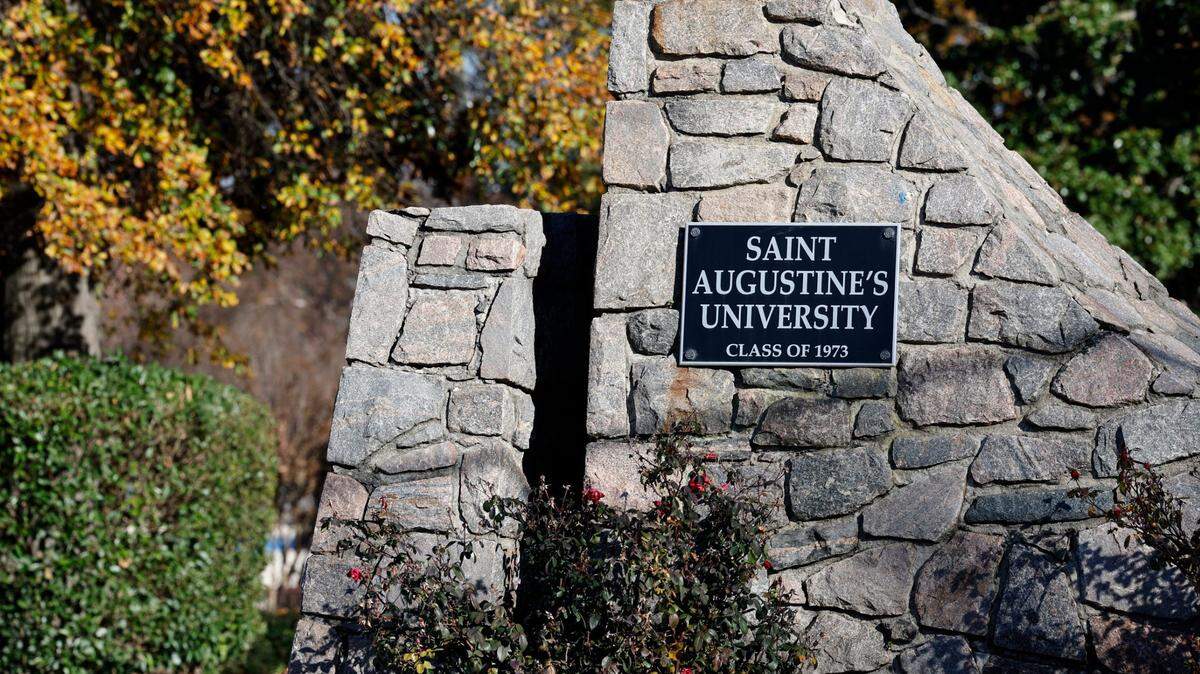
St. Augustine’s University will once again appeal a decision by the school’s accrediting agency to strip the historically Black university of its accreditation.
Financial problems and concerns about the school’s governance prompted the Southern Association of Colleges and Schools Commission on Colleges (SACSCOC)‘s December decision to remove St. Augustine’s from membership with the agency. University leaders expect another appeal hearing next month. That will mark the third appeal the university has pursued since SACSCOC first voted to strip the school’s accreditation last year.
Accreditation is crucial to several facets of university operations, including students’ eligibility to receive financial aid from the federal government. Throughout St. Augustine’s appeals, the university has retained accreditation, albeit on probation for cause.
Ahead of the February appeal, university leaders are projecting a sense of optimism about the possible outcome.
“I am very optimistic,” St. Augustine’s interim President Marcus Burgess told The News & Observer last month. “I feel great about our opportunities going forward, that we can turn this institution around.”
But leaders, including Burgess, also appear to be bracing for bad news. The university last month held its first-ever December commencement ceremony, with administrators specifically citing accreditation concerns as a key reason for the move.
“We wanted to make sure that these students graduated underneath an accredited institution,” Burgess told The N&O after the ceremony. “With our accreditation challenges, we just wanted to do the due diligence to make sure that the work that they put in was not sacrificed.”
If St. Augustine’s is not able to retain its accreditation with SACSCOC, there are other avenues the university could pursue in its fight to stay open. (Burgess has previously said that any decision to close the university is years away.)
Here are three examples of how other HBCUs, including two in North Carolina, have handled similar accreditation issues over the years.
Bennett College: Legal action & TRACS
When a SACSCOC committee initially denied St. Augustine’s first appeal last February, Burgess indicated the university would pursue legal action against the accrediting agency. Those plans never came to fruition, as the university first pursued a second appeals process with the agency — which was a temporary success.
Still, there is precedent for legal action against SACSCOC.
Bennett College, a private, historically Black college for women located in Greensboro, lost its SACSCOC accreditation in 2018 after being on probation for years over financial issues. In 2019, after raising $9.5 million but losing an appeal, Bennett sued the accreditor and received a temporary restraining order, allowing the college’s accreditation to remain intact while the court case proceeded.
But Bennett also took action outside of its legal battle, pursuing accreditation with another agency: the Transnational Association of Christian Colleges and Schools, or TRACS. That effort was successful, with TRACS fully accrediting the school in 2023.
TRACS, which is a recognized accreditor with the U.S. Department of Education, has been described as a “lifeline” for HBCUs that face a loss of accreditation with other agencies.
Burgess said early last year that St. Augustine’s would look into pursuing accreditation with TRACS as it continued to fight for its membership with SACSCOC. Asked by The N&O in December whether that option was still on the table, Burgess said: “SACS is our focus.”
Barber-Scotia: Remain open without accreditation
If St. Augustine’s officially loses its accreditation, Concord’s Barber-Scotia could offer another look at the university’s potential future.
Barber-Scotia, also a private HBCU, lost its accreditation in 2004, when SACSCOC removed the college from membership due to inaccurate reporting of information on the school’s finances and academics during a period of leadership turnover, The Charlotte Post reported.
But the college has remained open while it has been unaccredited. The college’s lack of accreditation leaves students unable to receive financial aid, and in 2023 the school enrolled just four students, The Charlotte Observer reported.
Now, after more than 20 years without accreditation, Barber-Scotia is pursuing membership with TRACS. In the college’s 2022-27 strategic plan, leaders outlined a plan to regain accreditation and strengthen its financial and academic standing, The Observer reported.
Morris Brown: Regain accreditation
While Barber-Scotia officials look to regain the college’s accreditation, there is a recent success story that shows it is possible.
Morris Brown College, an HBCU in Atlanta, in 2022 received accreditation from TRACS — roughly 20 years after SACSCOC revoked the school’s membership. According to the college, Morris Brown is the first HBCU to regain accreditation after nearly two decades without it.
Under college President Kevin James, Morris Brown underwent a “hard reset” as it worked to become accredited again. That included chipping away at more than $30 million in debt and entering into a partnership to build a Hilton hotel on campus through a long-term land leasing deal.
The Charlotte Observer reported that Morris Brown’s success inspired Barber-Scotia officials to pursue accreditation again. But TRACS President Timothy Eaton cautioned in 2022 that the road would still be difficult.
“People think that if Morris Brown did it it must be easy,” Eaton told The Observer at the time. “The people at Morris Brown went above and beyond when we talk about sacrifice.”
This story was originally published January 9, 2025 at 5:00 AM with the headline "What happens if St. Augustine’s loses accreditation? Three other HBCUs could offer clues."