He’s raised millions for his HBCU. Now he needs a gift that could save his life.
In less than three years as president of Livingstone College in Salisbury, Anthony Davis has proven enormously successful at getting people to give to the small but increasingly mighty HBCU he helms.
$42 million in just the past 12 months — an amount that would top the school’s best-ever year for contributions by more than double.
But when it came to using his platform as the leader of “Blue Bear Nation” to make a public plea for a much more personal, much more complicated type of donation, the 59-year-old Davis felt like he was out of his comfort zone.
“It’s different when it’s you,” he says. “How do I ask someone to share a body part with me? It’s not like you’re going to ask someone to give you a cup of sugar. ‘Let me borrow your car.’ ‘Let me borrow your motorcycle.’ What you’re saying is, ‘Go into surgery for me, let me have one of your kidneys, go through six weeks of rehab, so that I might live.’ You know how humbling that is that you’re asking someone to make that sacrifice for you?”
Davis, a diabetic and hypertension sufferer who was first diagnosed with kidney disease three years ago, had been suffering mostly in silence since going on dialysis last year — and not just any dialysis, but peritoneal dialysis, which involves him being hooked up to a machine that aids the filtration of his blood inside his stomach for 9-1/2 hours a night.
Dialysis fluid fills his abdomen, then is drained, over and over, while he sleeps. Six liters and four cycles, total. Every night.
It’s not painful, but it’s certainly a pain (especially when he’s traveling). It’s also not a long-term solution, because it can eventually stop working and require a switch to hemodialysis, which uses an artificial kidney machine to filter blood outside the body (and generally requires regular visits to a dialysis center).
No, the only permanent solution is a kidney transplant, and the wait time once you’re on the national list can be years.
There is, however, a well-known way to bypass the list: via a direct donation from a compatible donor. Once his kidney disease was classified as late-stage, Davis’s immediate family and a handful of others who knew of his condition were tested, but none were a match.
So a week ago Saturday, he expanded his search with an announcement at Livingstone’s spring commencement, moments before conferring degrees to 63 undergraduates and seven MBA students.
“I had friends and family that said, ‘This is a good time to let somebody know what you need. You’ve done so much for so many people. We believe that if you put it out there, someone will come forward,’” Davis says.
“And they were right.”
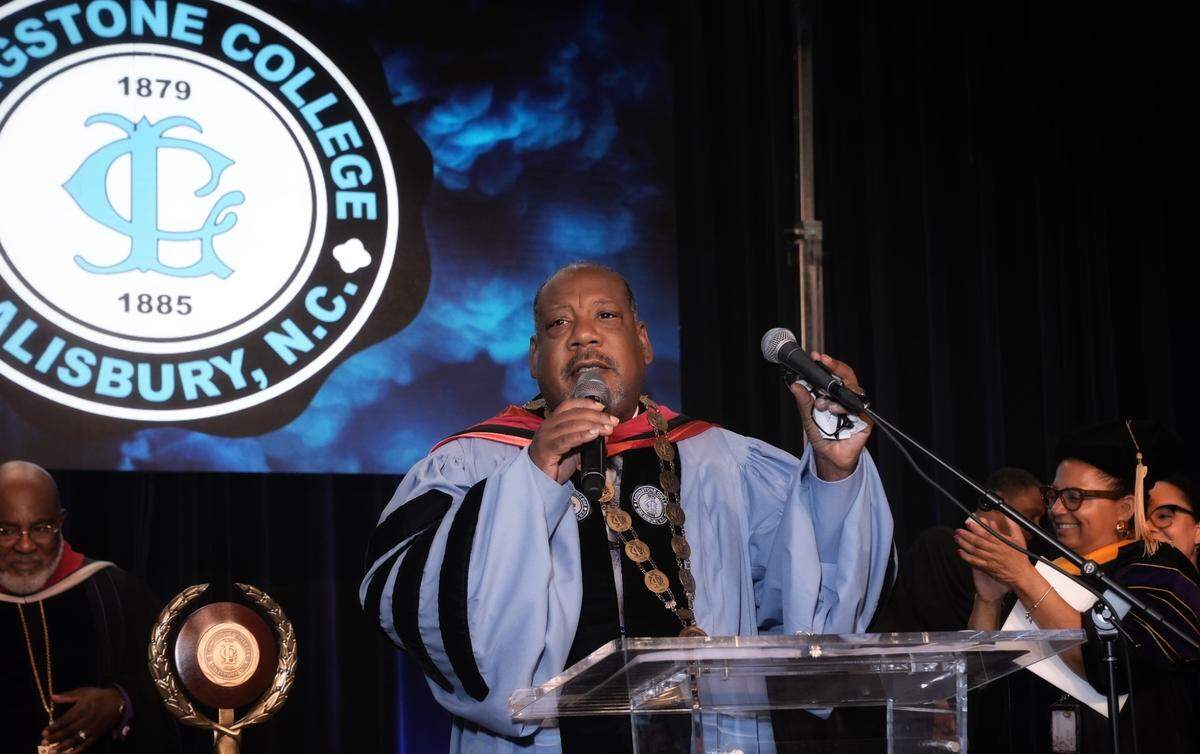
Davis is living his dream at Livingstone
On paper, Davis has transformed the 145-year-old Christian-based institution.
When he became president of Livingstone in October 2022, the school’s freshman class was 220. This year, it welcomed twice as many — 441, making it the fastest-growing HBCU in the state. The average GPA of that new crop of students, Davis says, was 3.26, the highest in school history.
Livingstone’s retention rate has increased to 78%, and it now boasts a persistence rate of 92%.
Meanwhile, Davis has been overseeing a campus revitalization project that has not required the college to take on any loans, thanks in large part to his acumen for fundraising.
But while he’s clearly focused on helping the college attain high-level, big-picture excellence and success, he also thrives on showing up for his students in meaningful ways, on meeting them where they live, work, and play. He is a visible and vocal fixture at football games, men’s and women’s basketball games, volleyball games, recitals for music students. He travels with his admissions team to meet with prospective students on recruiting trips, with dialysis machine in tow, the fluids often shipped separately since they’re hard to get on a plane.
This was, he says, literally his dream job.
When Davis graduated from Livingstone in 2001 (at 36, having been a non-traditional student in Livingstone’s evening and weekend program), he remembers taking pictures on the college’s vast lawn and telling his family, “Someday, I’m gonna come back and be the president of Livingstone.”
He initially returned to his alma mater in 2019, when he was tapped to be senior vice president for institutional advancement and chief operating officer; in that role, he was responsible for supervising the school’s entire fundraising enterprise. In two years, according to ProPublica data, contributions to Livingstone jumped from $6.6 million to $20.5 million.
Now, Davis says, “I’m the chief server.”
And he attributes his passion for service in no small part to his background as a product of a loving foster-care home, having been raised by an elderly couple in New Haven, Conn., from the time he was 2 months old until age 17.
“There is a passage of scripture that says, ‘To whom much is given, much is also expected,’” Davis says. “That’s a different translation. Some read it as, ‘To whom much is given, much is required.’ But for me it’s, ‘To whom much is given, much is expected.’ ... I’ve been given much. My desire is to give much, much more.
“That’s why I gotta get this kidney.”
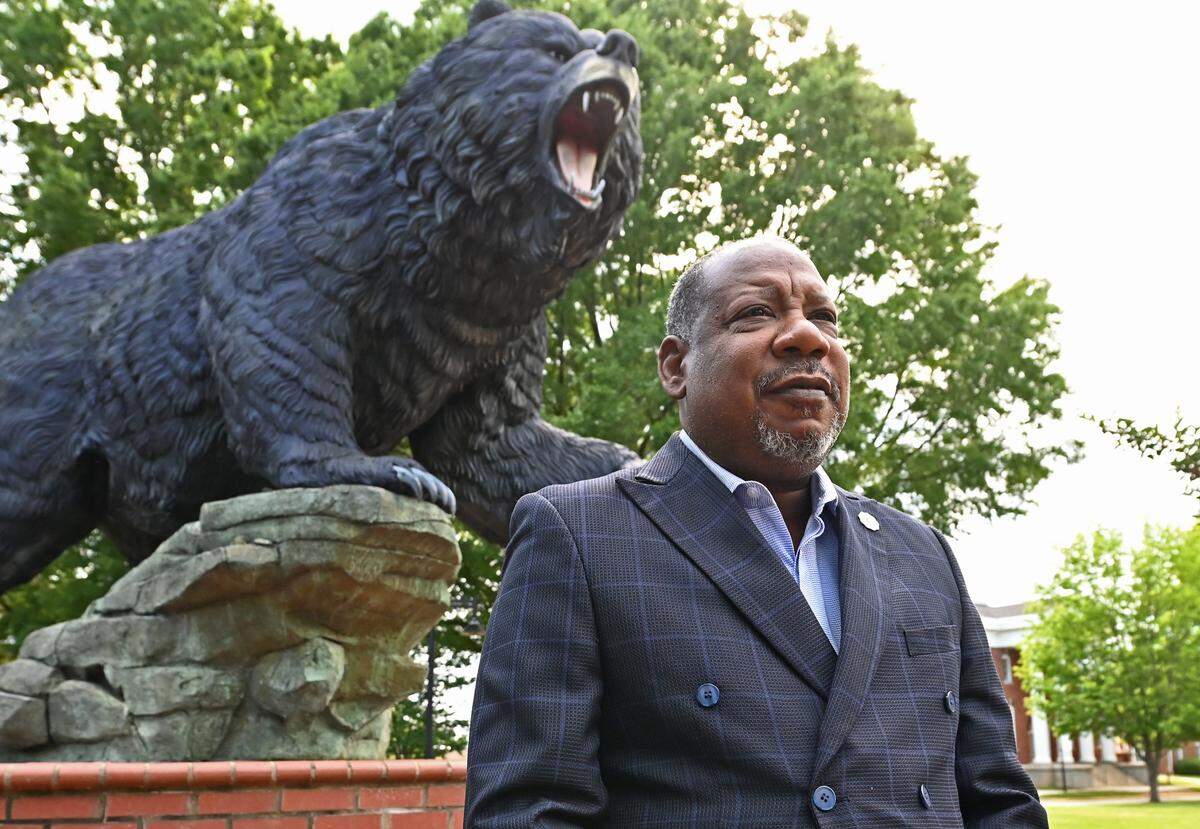
The reaction to college president’s plea
The reaction to Davis’s plea at graduation was swift and significant.
“Most of my students wanted to take pictures and say, ‘Hey, we’re gonna post your announcement on our social media pages. We’re gonna help you get your kidney,’” he said. “Livingstone College, we’re different. We’re one big, happy family. My students love their president, and their president loves them.
“If I thought for a millisecond, that it would mar their accomplishments, I would’ve never said it. But at the end of a very spiritual Commencement celebration ... (I thought) today is a good day to just let my students know. ...
“And I’m glad I did, because my students are running to my rescue like I would run to theirs.”
The school immediately created a form for people interested in getting tested to see if they might be a match. Within the first week, dozens of people — including current and former students — had registered with his transplant center to get tested, Davis says.
(Davis’s blood type, O positive, is not rare; but whereas people with A, B or AB blood types can all also receive kidney transplants from donors with O blood, people with O blood can receive transplants only from someone with an O blood type, meaning his pool of potential donors is smaller.)
He knows the process moves slowly and can be derailed at any time. About four months ago, he says, a staff member who wanted to help got tested, and “they went all the way up to the last phase,” but their GFR (Glomerular Filtration Rate), a test that gauges how well your kidneys are filtering waste and excess water from a person’s blood, was slightly too low.
But he and those in his circle are staying optimistic.
“We’re hopeful, and we’ll be even more excited when he’s on the other side of it, because we believe that this can position him to be a much bigger voice in the BIPOC community, to help other people know — especially people of color — to understand about early detection,” says Mai Li Muñoz, Livingstone’s chief communications officer, who noted in a news release about his announcement that Black people are four times more likely than white people to develop end-stage renal failure.
“We want (him) to survive this part. And then the next part of it is — part of your legacy is — making sure that other people are hyper-aware of how real this is in our community.”
Davis, by the way, turns 60 in October. A new kidney by then? “That would be a great birthday present.”
In the meantime, he says, “God is in control. For me, what I need to know is, ‘What lesson must I learn while I’m going through this process?’ I don’t know the answer yet. So, school’s in session.”
This story was originally published May 12, 2025 at 6:00 AM.