Federal health investigation into NC State’s Poe Hall to resume, chancellor says
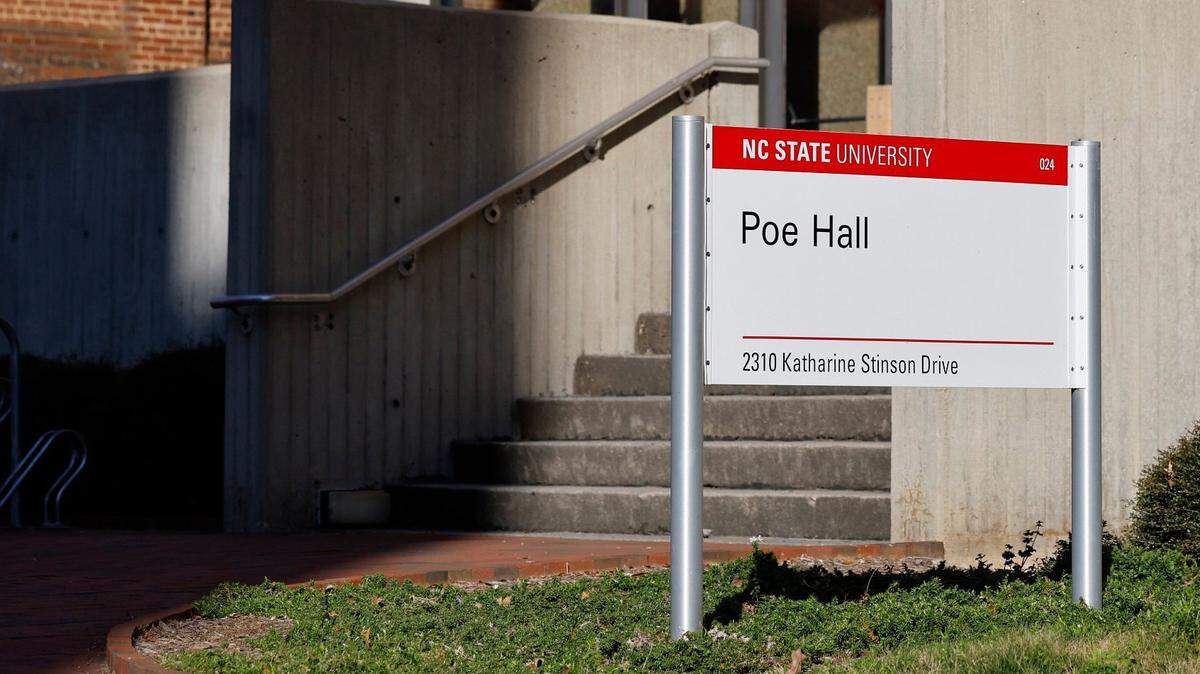
The federal health evaluation of NC State University’s Poe Hall will resume, Chancellor Kevin Howell announced Wednesday.
The university announced last month that the health hazard evaluation, performed by the National Institute for Occupational Safety and Health (NIOSH), had ended due to job cuts at the U.S. Department of Health and Human Services, which houses NIOSH.
DHHS has undergone massive cuts since President Donald Trump took office in January, with NIOSH alone set to lose at least 900 workers — or roughly 90% of its workforce, NPR reported. But the Trump administration reversed course on some of those terminations last week, reinstating more than 320 NIOSH employees, per NPR.
Poe Hall has been closed for 18 months after university officials shuttered it, citing preliminary test results that showed the presence of PCBs, or polychlorinated biphenyls, on various surfaces throughout the building.
PCBs are toxic, man-made chemicals that were banned from being produced in the United States in 1979. They are considered to be “probable human carcinogens,” according to the U.S. Environmental Protection Agency. They also are known to have a myriad of other negative health effects.
NIOSH’s investigation could provide clarity as to whether exposure to toxic chemicals in the building was responsible for employees’ illnesses, such as cancer.
“This is a welcome development for our community,” Howell wrote in a message to campus announcing the evaluation would continue. “I’m grateful that NIOSH will resume its evaluation to provide answers related to Poe Hall.”
The news also follows Rep. Deborah Ross, a Democrat who represents Raleigh and much of Wake County in Congress, urging DHHS Secretary Robert F. Kennedy Jr. to reverse the cuts at NIOSH for the sake of the Poe Hall investigation and other health concerns among North Carolinians. Ross sent a letter to Kennedy last week, calling the cuts and the subsequent halting of health evaluations “extremely alarming.”
In a statement to The News & Observer on Thursday, Ross said she was “relieved” that the Poe Hall evaluation would resume.
“Secretary Kennedy’s decision to discontinue the Poe Hall investigation as well as similar inquiries nationwide was wrong and could have cost lives,” Ross said. “I’m relieved that NIOSH heeded my call and will move forward with its probe of toxic chemical exposure at the facility. It’s time for leaders in the Trump administration to stop their reckless assault on federal agencies, which provide life-saving assistance to the people of North Carolina.”
Poe Hall tests, future plans
NIOSH and NC State reached a “mutual agreement” last February to do the evaluation at Poe Hall. That decision followed an initial health hazard evaluation being closed while the university used a private environmental consultant to conduct additional testing in the building.
University officials had hoped to pause the first evaluation while the consulting firm collected its samples, but NIOSH did not offer a “mechanism” for pausing its work, former NC State Chancellor Randy Woodson told The N&O at the time.
Last summer, additional test results from Poe Hall showed that the PCBs originated — as university leaders had said was likely the case — from the building’s HVAC system. But the results also showed that levels of the chemicals in the air, where they pose the greatest health risks, were found to be below exposure levels recommended by the EPA for school environments.
Still, federal regulations require any materials with concentrations of PCBs higher than 500 parts per million to be removed from buildings once they are discovered. The early-June test results last year showed PCB materials in the building had concentrations ranging from 0.91 to 53,000 parts per million.
Weeks after the university shared those results, Woodson said university officials had decided to remove the HVAC system and other building materials to remedy the presence of the toxic chemicals.
State lawmakers have shown interest in helping the university fix the issues in Poe Hall, earmarking millions of dollars last year for the rehabilitation and renovation of the building. Both the state House and Senate want to authorize the project receiving up to $185 million, as outlined in their budget proposals.
This story was originally published May 22, 2025 at 12:26 PM with the headline "Federal health investigation into NC State’s Poe Hall to resume, chancellor says."